If an electron is going in the direction of magnetic field $\overrightarrow B $ with the velocity of $\overrightarrow {v\,} $ then the force on electron is
Easy


Download our appand get started for free
Experience the future of education. Simply download our apps or reach out to us for more information. Let's shape the future of learning together!No signup needed.*
Similar Questions
- 1A galvanometer having a coil resistance of $60\,\Omega $ shows full scale deflection when a current of $1.0\, amp$ passes through it. It can be converted into an ammeter to read currents upto $5.0\, amp$ byView Solution
- 2An electron enters a region where electrostatic field is $20\,N/C$ and magnetic field is $5\,T$. If electron passes undeflected through the region, then velocity of electron will be.....$m{s^{ - 1}}$View Solution
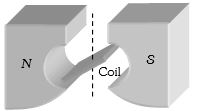
- 3The figure below shows the north and south poles of a permanent magnet in which $n$ turn coil of area of cross-section $A$ is resting, such that for a current $ i$ passed through the coil, the plane of the coil makes an angle $\theta $ with respect to the direction of magnetic field $B.$ If the plane of the magnetic field and the coil are horizontal and vertical respectively, the torque on the coil will beView Solution
- 4The ratio of the magnetic field at the centre of a current carrying circular coil to its magnetic moment is $'\alpha '.$ If the current and radius both are doubled then new ratio will becomeView Solution
- 5View SolutionWhich of the following statement is true
- 6An insulating thin rod of length $l$ has a linear charge density $\rho \left( x \right) = {\rho _0}\,\frac{x}{l}$ on it. The rod is rotated about an axis passing through the origin $(x = 0)$ and perpendicular to the rod. If the rod makes $n$ rotations per second, then the time averaged magnetic moment of the rod isView Solution
- 7A metallic rod of mass per unit length $0.5\; kg\; m^{-1}$ is lying horizontally on a smooth inclined plane which makes an angle of $30^o$ with the horizontal. The rod is not allowed to slide down by flowing a current through it when a magnetic field of induction $0.25\; T$ is acting on it in the vertical direction. The current flowing in the rod to keep it stationary is.....$A$View Solution
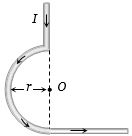
- 8In the figure, what is the magnetic field at the point $O$View Solution
- 9Assertion : A proton and an alpha particle having the same kinetic energy are moving in circular paths in a uniform magnetic field. The radii of their circular paths will be equal.View Solution
Reason : Any two charged particles having equal kinetic energies and entering a region of uniform magnetic field $\overrightarrow B $ in a direction perpendicular to $\overrightarrow B $, will describe circular trajectories of equal radii.
- 10A rectangular coil (Dimension $5\,cm\times 2\,cm$ ) with $100\,turns,$ carrying a current of $3\,A$ in the clock-wise direction, is kept centered at the origin and in the $X-Z$ plane. A magnetic field of $1\,T$ is applied along $X-$ axis. If the coil is tilted through $45^o$ about $Z-$ axis, then the torque on the coil is.....$Nm$View Solution