If an object of 10cm height is placed at a distance of 36cm from a concave mirror of focal length 12cm, find the position, nature and height of the image.
Download our app for free and get started
$h_1=10 cm, u =-36 cm, f =-12 cm$ We know that
$\frac{1}{\text{v}}+\frac{1}{\text{u}}=\frac{1}{\text{f}}$
$\Rightarrow\frac{1}{\text{v}}+\frac{1}{(-36)}=\frac{1}{(-12)}$
$\Rightarrow\frac{1}{\text{v}}=\frac{1}{36}-\frac{1}{12}=\frac{1-3}{36}=-\frac{2}{36}=-\frac{1}{18}$
$\text{v}=-18\text{cm}$
$\therefore$ The position of the image is 18cm in front of the mirror.
Magnification, $\text{m}=\frac{\text{h}_2}{\text{h}_1}=-\frac{\text{v}}{\text{u}}$
$\Rightarrow\frac{\text{h}_2}{10}=-\frac{(-18)}{(-36)}$
$\Rightarrow\text{h}_2=-5\text{cm}$
The image formed is real and inverted.
$\frac{1}{\text{v}}+\frac{1}{\text{u}}=\frac{1}{\text{f}}$
$\Rightarrow\frac{1}{\text{v}}+\frac{1}{(-36)}=\frac{1}{(-12)}$
$\Rightarrow\frac{1}{\text{v}}=\frac{1}{36}-\frac{1}{12}=\frac{1-3}{36}=-\frac{2}{36}=-\frac{1}{18}$
$\text{v}=-18\text{cm}$
$\therefore$ The position of the image is 18cm in front of the mirror.
Magnification, $\text{m}=\frac{\text{h}_2}{\text{h}_1}=-\frac{\text{v}}{\text{u}}$
$\Rightarrow\frac{\text{h}_2}{10}=-\frac{(-18)}{(-36)}$
$\Rightarrow\text{h}_2=-5\text{cm}$
The image formed is real and inverted.

Download our appand get started for free
Experience the future of education. Simply download our apps or reach out to us for more information. Let's shape the future of learning together!No signup needed.*
Similar Questions
- 1QUESTION For the same angle of incidence, the angle of refraction in three different media $A , B$ and C are $10^{\circ}, 25^{\circ}$ and $40^{\circ}$, respectively. In which medium the velocity of light will be maximum?View Solution
- 2View SolutionAt what distance should an object be placed from a convex lens of focal length 18 cm to obtain an image at 24 cm from it on the other side. What will be the magnification produced in this case?
- 3View SolutionIf the image formed by a lens for all positions of the object placed in front of it is always virtual, erect and diminished, state the type of the lens. Draw a ray diagram in support of your answer. If the numerical value of focal length of such a lens is 20cm, find its power in new cartesian sign conventions.
- 4View SolutionAn object of height 5 cm is placed perpendicular to the principal axis of a concave lens of focal length 10 cm. If the distance of the object from the optical centre of the lens is 20 cm, determine the position, nature and size of the image formed using the lens formula.
- 5View SolutionState where an object must be placed so that the image formed by a concave mirror is:
- Erect and virtual.
- At infinity.
- The same size as the object.
- 6View SolutionDraw a ray diagram to show the path of the refracted ray in each of the following cases:
A ray of light incident on a concave lens is:- Passing through its optical centre.
- Parallel to its principal axis.
- Directed towards its principal focus.
- 7a. What is the focal length of the lens used in sunglasses?View Solution
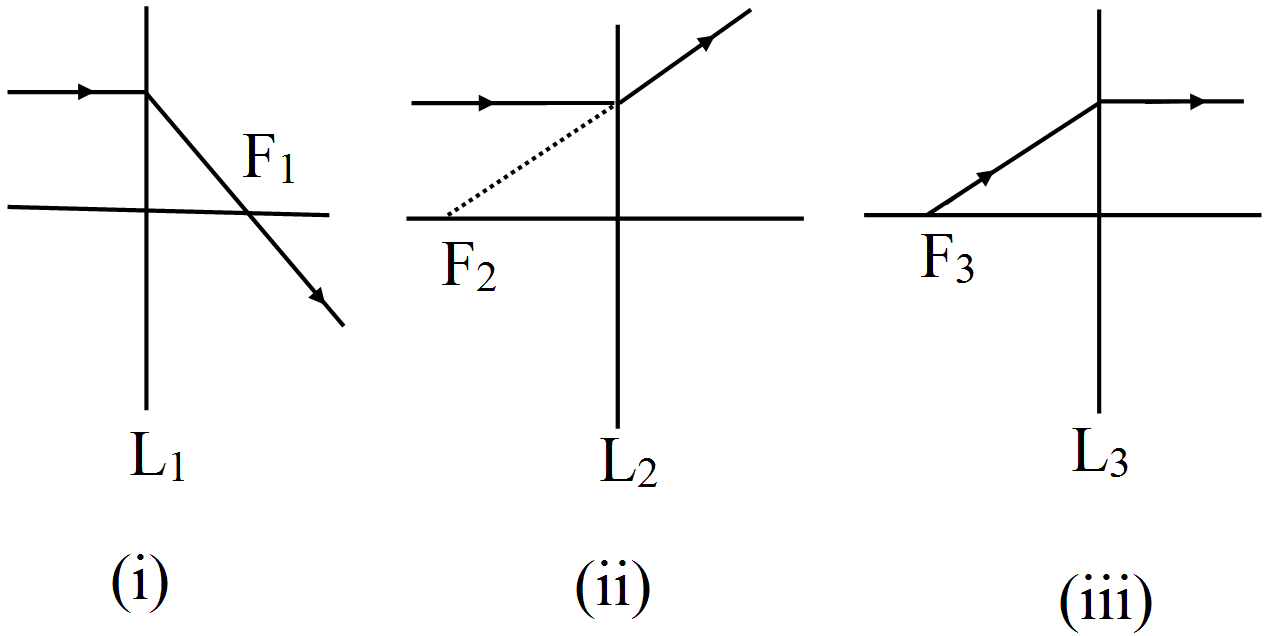
b. The following figures show the path of light rays through three lenses marked $L_1, L_2$, and $L_3$ and their focal points $F_1, F_2$, and $F_3$, respectively. Identify the nature of lenses.
- 8View SolutionA ray of light enters a diamond from air. If the refractive index of diamond is 2.42, what % (percentage) is speed of light in diamond with that of speed in air?
- 9An image $\frac{2}{3}\text{rd}$ the size of object is formed by a convex lens at a distance of 12cm from Find the focal length of the lens.View Solution
- 10View SolutionTwo lenses A and B have power of (i) + 2 D and (ii) -4D respectively. What is the nature and focal length of each lens?