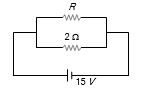
If in the circuit, power dissipation is $150\, W$, then $R$ is ............... $\Omega$
AIEEE 2002, Medium
Download our app for free and get started
(b) $P = \frac{{{V^2}}}{{{R_{eq}}}} \Rightarrow 150 = \frac{{{{(15)}^2}}}{{[2R/(R + 2)]}} = \frac{{225 \times (R + 2)}}{{2R}}$
$ \Rightarrow $ $R = \frac{{450}}{{75}} = 6\,\Omega $.
$ \Rightarrow $ $R = \frac{{450}}{{75}} = 6\,\Omega $.

Download our appand get started for free
Experience the future of education. Simply download our apps or reach out to us for more information. Let's shape the future of learning together!No signup needed.*
Similar Questions
- 1View SolutionA wire is broken in four equal parts. A packet is formed by keeping the four wires together. The resistance of the packet in comparison to the resistance of the wire will be
- 2A potentiometer consists of a wire of length $4\, m$ and resistance $10 \,\Omega$. It is connected to cell of $emf$ $2\, V$. The potential difference per unit length of the wire will be ............ $V/m$View Solution
- 3Two bulbs one of $200$ $\mathrm{volts},$ $60$ $\mathrm{watts}$ and the other of $200$ $\mathrm{volts},$ $100$ $\mathrm{watts}$ are connected in series to a $200$ $\mathrm{volt}$ supply. The power consumed will be ................ $\mathrm{watt}$View Solution
- 4Consider a wire having current $10\,A$ having area of crossection $1\,cm^2$. If number of electrons per unit volume is $9 \times 10^{28}\, m^{-3}$. Find the drift velocity of electronsView Solution
- 5The resistance of a rectangular block of copper of dimensions $2 \,mm \times 2 \,mm \times 5 \,m$ between two square faces is $0.02 \,\Omega$. What is the resistivity of copper?View Solution
- 6View SolutionSpecific resistance of a conductor increases with
- 7The electromotive force of a primary cell is $2\, volts$. When it is short-circuited it gives a current of $4$ amperes. Its internal resistance in $ohms$ isView Solution
- 8In $a$ wire of cross-section radius $r$, free electrons travel with drift velocity $v$ when a current $I$ flows through the wire. What is the current in another wire of half the radius and of the same material when the drift velocity is $2v$?View Solution
- 9When a resistor of $11 \,\Omega$ is connected in series with an electric cell, the current flowing in it is $0.5\, A$. Instead, when a resistor of $5 \,\Omega$ is connected to the same electric cell in series, the current increases by $0.4\, A$. The internal resistance of the cell is ................ $\Omega$View Solution
- 10The current in a conductor varies with time t as $I = 2t + 3{t^2}$ where $I$ is in ampere and $t$ in seconds. Electric charge flowing through a section of the conductor during $t = 2\,\sec$ to $t = 3\,\sec$ is ............. $C$View Solution