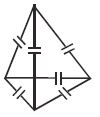
If the capacitance of each capacitor in the tetrahedron shown is $C$ , then effective capacitance of the network across any two junctions is ......$C$
Medium
Download our app for free and get started
One capacitor will be removed due to symmetry if we calculated then one of the capacitor will be removed and the remaining circuit will be
$\mathrm{Ceq}=\mathrm{C}+\frac{\mathrm{C}}{2}+\frac{\mathrm{C}}{2}=2 \mathrm{\,C}$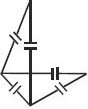

Download our appand get started for free
Experience the future of education. Simply download our apps or reach out to us for more information. Let's shape the future of learning together!No signup needed.*
Similar Questions
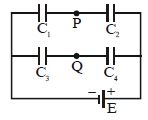
- 1The potential difference between the points $P$ and $Q$ in the adjoining circuit will be :-View Solution
- 2A capacitor of $20\,\mu F$ is charged to $500\;volts$ and connected in parallel with another capacitor of $10\,\mu F$ and charged to $200\;volts$. The common potential is.......$volts$View Solution
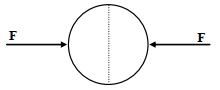
- 3A $30\,\mu F$ capacitor is charged by a constant current of $30\, mA$. If the capacitor is initially uncharged, how long does it take for the potential difference to reach $400\, V$.....$s$View Solution
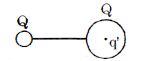
- 4Two conducting hollow sphere of radius $R$ and $3R$ are found to have $Q$ charge on outer surface when both are connected with a long wire and $q'$ charge is kept at the centre of bigger sphere. Then which one is trueView Solution
- 5Concentric metallic hollow spheres of radii $R$ and $4 R$ hold charges $Q _{1}$ and $Q _{2}$ respectively. Given that surface charge densities of the concentric spheres are equal, the potential difference $V ( R )- V (4 R )$ isView Solution
- 6A parallel plate capacitor is made by stacking $n$ equally spaced plates connected alternately. If the capacitance between any two plates is $C$ then the resultant capacitance isView Solution
- 7Voltage rating of a parallel plate capacitor is $500\,V$. Its dielectric can withstand a maximum electric field of ${10^6}\,\frac{V}{m}$. The plate area is $10^{-4}\, m^2$ . What is the dielectric constant if the capacitance is $15\, pF$ ? (given ${ \in _0} = 8.86 \times {10^{ - 12}}\,{C^2}\,/N{m^2}$)View Solution
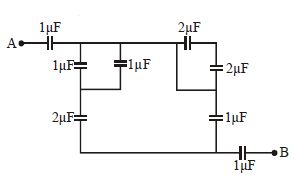
- 8Find the equivalent capacitance between $A$ and $B$View Solution
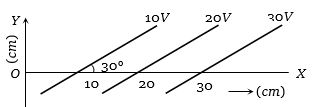
- 9View SolutionEquipotential surfaces are shown in figure. Then the electric field strength will be
- 10A uniformly charged thin spherical shell of radius $\mathrm{R}$ carries uniform surface charge density of $\sigma$ per unit area. It is made of two hemispherical shells, held together by pressing them with force $\mathrm{F}$ (see figure). $\mathrm{F}$ is proportional toView Solution