If the mass of the bob in a simple pendulum is increased to thrice its original mass and its length is made half its original length, then the new time period of oscillation is $\frac{x}{2}$ times its original time period. Then the value of $x$ is:
NEET 2024, Medium
Download our app for free and get started
$T^{\prime}=2 \pi \sqrt{\frac{\ell^{\prime}}{g}} \text { where } \ell^{\prime}=\frac{\ell}{2}$
$T=2 \pi \sqrt{\frac{\ell}{g}}$
$T^{\prime}=\frac{x}{2} T$
$2 \pi \sqrt{\frac{\ell}{2 g}}=\frac{x}{2} 2 \pi \sqrt{\frac{\ell}{g}}$
$\frac{1}{\sqrt{2}}=\frac{x}{2} \Rightarrow x=\sqrt{2}$

Download our appand get started for free
Experience the future of education. Simply download our apps or reach out to us for more information. Let's shape the future of learning together!No signup needed.*
Similar Questions
- 1Two masses $m_1$ and $m_2$ are supended together by a massless spring of constant $k$. When the masses are in equilibrium, $m_1$ is removed without disturbing the system; the amplitude of vibration isView Solution
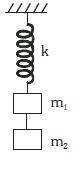
- 2View SolutionIn forced oscillations, a particle oscillates simple harmonically with frequency equal to
- 3View SolutionThe mass and diameter of a planet are twice those of earth. The period of oscillation of pendulum on this planet will be (If it is a second's pendulum on earth)
- 4A simple pendulum has time period $T$. The bob is given negative charge and surface below it is given positive charge. The new time period will beView Solution
- 5A body of mass $1\,kg$ is executing simple harmonic motion. Its displacement $y(cm)$ at $t$ seconds is given by $y = 6\sin (100t + \pi /4)$. Its maximum kinetic energy is ..... $J$View Solution
- 6View SolutionA particle of mass m is hanging vertically by an ideal spring of force constant K. If the mass is made to oscillate vertically, its total energy is
- 7A pendulum with time period of $1\, s$ is losing energy due to damping. At certain time its energy is $45\, J$. If after completing $15\,oscillations$ , its energy has become $15\, J$, its damping constant (in $s^{-1}$ ) isView Solution
- 8A particle moves along a circle with a constant angular speed $\omega$ Its displacement,with respect to this position of the particle at time $t = 0$ is plotted against time. The graph would look likeView Solution
- 9View SolutionThe graph between velocity and position for a damped oscillation will be
- 10A simple pendulum with iron bob has a time period $T$. The bob is now immersed in a non-viscous liquid and oscillated. If the density of liquid is $\frac{1}{12}$ th that of iron, then new time period will beView Solution