If the resistivity of a potentiometer wire be $\rho $ and area of cross-section be $A$, then what will be potential gradient along the wire
Easy


Download our appand get started for free
Experience the future of education. Simply download our apps or reach out to us for more information. Let's shape the future of learning together!No signup needed.*
Similar Questions
- 1A wire of length $100\, cm$ is connected to a cell of $emf$ $2\, V$ and negligible internal resistance. The resistance of the wire is $3\, \,\Omega$. The additional resistance required to produce a potential drop of $1$ milli volt per cm is ............... $\Omega $View Solution
- 2View SolutionA wire of non-uniform cross-section is carrying a steady current. Along the wire
- 3A current i passes through a wire of length $l$, radius of cross-section $r$ and resistivity $\rho$. The rate of heat generation isView Solution
- 4The current flowing through a conductor connected across a source is $2\,A$ and $1.2\,A$ at $0^{\circ}\,C$ and $100^{\circ}\,C$ respectively. The current flowing through the conductor at $50^{\circ}\,C$ will be $......\times 10^2\,mA$.View Solution
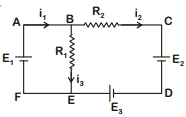
- 5For the circuit given below, the Kirchoff's loop rule for the loop $BCDEB$ is given by the equationView Solution
- 6A letter $A$ is constructed of a uniform wire with resistance $1.0\,\Omega \,per\,cm$. The sides of the letter are $20\, cm$ and the cross piece in the middle is $10\, cm$ long. The apex angle is $60^o$. The resistance between the ends is .............. $\Omega$View Solution
- 7A potentiometer wire of length $L$ and a resistance $r$ are connected in series with a battery of e.m.f. $E_0$ and a resistance $r_1$. An unknown e.m.f. $E$ is balanced at a length $l$ of the potentiometer wire. The e.m.f. $E$ will be given byView Solution
- 8A cell sends a current through a resistance $R$ for time $t$. Now the same cell sends current through another resistance $r$ for the same time. If same amount of heat is developed in both the resistance, then the internal resistance of cell isView Solution
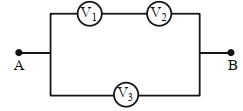
- 9Three voltmeters, all having different internal resistances are joined as shown in figure. When some potential difference is applied across $\mathrm{A}$ and $B$, their readings are $V_1, V_2$ and $V_3$. Choose the correct option.View Solution
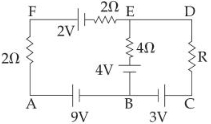
- 10In the electric network shown, when no current flows through the $4\, \Omega $ resistor in the arm $EB$, the potential difference between the points $A$ and $D$ will be ............... $V$View Solution