MCQ
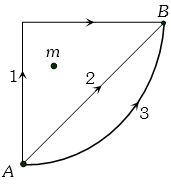
If ${W_1},\,{W_2}$ and ${W_3}$ represent the work done in moving a particle from $A$ to $B$ along three different paths $1, 2$ and $3$ respectively (as shown) in the gravitational field of a point mass m, find the correct relation between ${W_1},\,{W_2}$ and ${W_3}$
  • A
    ${W_1} > {W_2} > {W_3}$
  • ${W_1} = {W_2} = {W_3}$
  • C
    ${W_1} < {W_2} < {W_3}$
  • D
    ${W_2} > {W_1} > {W_3}$

Answer

Correct option: B.
${W_1} = {W_2} = {W_3}$
b
(b)Gravitational force is a conservative force and work done against it is a point function i.e. does not depend on the path.

Need a full question paper?

Generate a complete, print-ready paper with questions like this in minutes — across 16+ boards, with answer keys.

Start Generating Free

Similar questions

A bomb is released from a horizontal flying aeroplane. The trajectory of bomb is
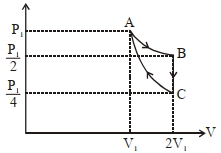
If one mole of an ideal gas at $\left( P _{1}, V _{1}\right)$ is allowed to expand reversibly and isothermally ($A$ to $B$ ) its pressure is reduced to one-half of the original pressure (see $figure$). This is followed by a constant volume cooling till its pressure is reduced to one-fourth of the initial value $( B \rightarrow C ) .$ Then it is restored to its initial state by a reversible adiabatic compression ($C$ to $A$). The net workdone by the gas is equal to  ...... .
Two waves having sinusoidal waveforms have different wavelengths and different amplitude. They will be having
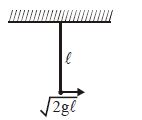
A simple pendulum having length $\ell $ is having speed  $\sqrt {2g\ell }$ at bottom most point of its trajectory. Its motion will be
A person sitting in an open car moving at constant velocity throws a ball vertically up into air. The ball falls
A container holds $10^{26} molecules/m^3$ each of mass $3 \times 10^{-27}\,\,kg$. Assume that $1/6$ of the molecules move with velocity $2000 \,\,m/s$ directly towards one wall of the container while the remaining $5/6$ of the molecules move either away from the wall or in perpendicular direction, and all collisions of the molecules with the wall are elastic
A bar is subjected to axial forces as shown. If $E$ is the modulus of elasticity of the bar and $A$ is its crosssection area. Its elongation will be
If the linear momentum is increased by $50\%,$ then $K.E.$ will be increased by:
A plane wave is described by the equation $y = 3\cos \left( {\frac{x}{4} - 10t - \frac{\pi }{2}} \right)$. The maximum velocity of the particles of the medium due to this wave is
A particle is acted upon by a force of constant magnitude which is always perpendicular to the velocity of the particle. The motion of the particle takes place in a plane. It follows that