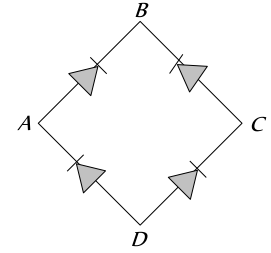
In a $P N$-junction diode
[MP PET 1993]


Download our appand get started for free
Experience the future of education. Simply download our apps or reach out to us for more information. Let's shape the future of learning together!No signup needed.*
Similar Questions
- 1View SolutionEnergy bands in solids are a consequence of
- 2For a thermionic emitter (metallic) if $J$ represents the current density and $T$ is its absolute temperature then the correct curve between $\log _e \frac{J}{T^2}$ and $\frac{1}{T}$ isView Solution
- 3A triode has a mutual conductance of $2 \times 10^{-3} mho$ and an amplification factor of $50.$ The anode is connected through a resistance of $25 \times 10^3$ ohms to a $250$ volts supply. The voltage gain of this amplifier isView Solution
- 4The $P N$ junction diode is used asView Solution
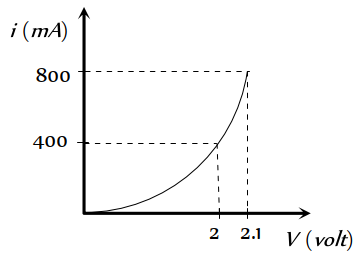
- 5The $i-V$ characteristic of a $P-N$ junction diode is shown below. The approximate dynamic resistance of the $P-N$ junction when a forward bias of $2$ volt is appliedView Solution
- 6View SolutionThe maximum efficiency of full wave rectifier is
- 7In an NPN transistor circuit, the collector current is $10 mA$. If $90 \%$ of the electrons emitted reach the collector, the emitter current ( $i$ ) and base current $(i)$ are given byView Solution
- 8View SolutionElectrical conductivity of a semiconductor
- 9The width of forbidden gap in silicon crystal is $1.1\ eV$. When the crystal is converted in to a $N$-type semiconductor the distance of Fermi level from conduction band isView Solution
- 10In the diagram, the input is across the terminals $A$ and $C$ and the output is across the terminals $B$ and $D$, then the output isView Solution