In a regular polygon of $n$ sides, each corner is at a distance $r$ from the centre. Identical charges are placed at $(n - 1)$ corners. At the centre, the intensity is $E$ and the potential is $V$. The ratio $V/E$ has magnitude.
Diffcult


Download our appand get started for free
Experience the future of education. Simply download our apps or reach out to us for more information. Let's shape the future of learning together!No signup needed.*
Similar Questions
- 1When a positive $q$ charge is taken from lower potential to a higher potential point, then its potential energy willView Solution
- 2Two parallel plate capacitors have their plate areas $100 \,cm ^2$ and $500 \,cm ^2$ respectively. If they have the same charge and potential and the distance between the plates of the first capacitor is $0.5 \,mm$, then the distance between the plates of the second capacitor is ........ $cm$View Solution
- 3$STATEMENT-1$ For practical purposes, the earth is used as a reference at zero potential in electrical circuits.andView Solution
$STATEMENT-2$ The electrical potential of a sphere of radius $R$ with charge $\mathrm{Q}$ uniformly distributed on the surface is given by $\frac{\mathrm{Q}}{4 \pi \varepsilon_0 R}$.
- 4Three capacitors each of capacitance $C$ and of breakdown voltage $V$ are joined in series. The capacitance and breakdown voltage of the combination will beView Solution
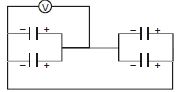
- 5The four capacitors, each of $25\,\mu \,F$ are connected as shown in fig. The $dc$ voltmeter reads $200\,V$. The charge on each plate of capacitor isView Solution
- 6View SolutionWhen a negative charge is taken at a height from earth's surface, then its potential energy
- 7Four point charges $-Q, -q, 2q$ and $2Q$ are placed, one at each comer of the square. The relation between $Q$ and $q$ for which the potential at the centre of the square is zero isView Solution
- 8Electric charges of $+10\,\mu\, C, +5\,\mu\, C, -3\,\mu\, C$ and $+8\,\mu\, C$ are placed at the corners of a square of side$\sqrt 2\,m$ . The potential at the centre of the square isView Solution
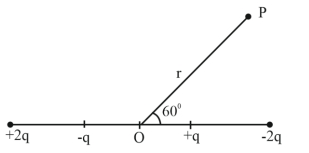
- 9The distance between charges $+\mathrm{q}$ and $-\mathrm{q}$ is $2 l$ and between $+2 \mathrm{q}$ and $-2 \mathrm{q}$ is $4 l$. The electrostatic potential at point $P$ at a distance $r$ from centre $O$ is $-\alpha\left[\frac{q l}{r^2}\right] \times 10^9 \mathrm{~V}$, where the value of $\alpha$ is____. (Use $\left.\frac{1}{4 \pi \varepsilon_0}=9 \times 10^9 \mathrm{Nm}^2 \mathrm{C}^{-2}\right)$View Solution
- 10Charge $Q$ is given a displacement $\vec r = a\hat i + b\hat j$ in an electric field $\vec E = E_1\hat i + E_2\hat j$ . The work done isView Solution