In case Hall effect for a strip having charge $Q$ and area of cross-section $A$, the Lorentz force is
Easy


Download our appand get started for free
Experience the future of education. Simply download our apps or reach out to us for more information. Let's shape the future of learning together!No signup needed.*
Similar Questions
- 1An electron is moving along $+x$ direction. To get it moving along an anticlockwise circular path in $x-y$ plane, magnetic field applied alongView Solution
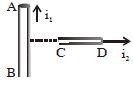
- 2An infinitely long straight conductor $AB$ is fixed and a current is passed through it. Another movable straight wire $CD$ of finite length and carrying current is held perpendicular to it and released. Neglect weight of the wireView Solution
- 3The magnetic field at the centre of a circular coil of radius $r$ carrying current $I$ is ${B_1}$. The field at the centre of another coil of radius $2 r$ carrying same current $I$ is ${B_2}$. The ratio $\frac{{{B_1}}}{{{B_2}}}$ isView Solution
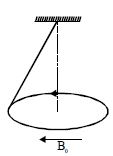
- 4A uniform current carrying ring of mass $m$ and radius $R$ is connected by a massless string as shown. A uniform magnetic field $B_0$ exist in the region to keep the ring in horizontal position, then the current in the ring is ($l =$ length of string)View Solution
- 5A straight wire of length $0.5\, metre$ and carrying a current of $1.2\, ampere$ placed in a uniform magnetic field of induction $2\, Tesla$. The magnetic field is perpendicular to the length of the wire. The force on the wire is.......$N$View Solution
- 6View SolutionAn electron moving towards the east enters a magnetic field directed towards the north. The force on the electron will be directed
- 7View SolutionTwo wires of same length are shaped into a square and a circle. If they carry same current, ratio of the magnetic moment is
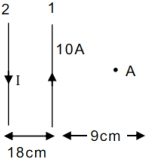
- 8In figure two parallel infinitely long current carrying wires are shown. If resultant magnetic field at point $A$ is zero. Then determine current $I.$ (in $A$)View Solution
- 9View SolutionA cell is connected between two points of a uniformly thick circular conductor. The magnetic field at the centre of the loop will be
- 10The magnetic moment of an electron $(e)$ revolving in an orbit around nucleus with an orbital angular momentum is given by :View Solution