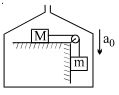
In figure, two blocks $M$ and $m$ are tied together with an inextensible and light string. The mass $M$ is placed on a rough horizontal surface with coefficient of friction $\mu$ and the mass $m$ is hanging vertically against a smooth vertical wall. The pulley is frictionless. Choose the correct statement $(s)$ related to the tension $T$ in the string

Diffcult


Download our appand get started for free
Experience the future of education. Simply download our apps or reach out to us for more information. Let's shape the future of learning together!No signup needed.*
Similar Questions
- 1In figure, two blocks $M$ and $m$ are tied together with an inextensible and light string. The mass $M$ is placed on a rough horizontal surface with coefficient of friction $\mu$ and the mass $m$ is hanging vertically against a smooth vertical wall. The pulley is frictionless. Imagine a situation in which the given arrangement is placed inside an elevator that can move only in the vertical direction and compare the situation with the case when it is placed on the ground. When the elevator accelerates downward with $a_0( < g)$, thenView Solution
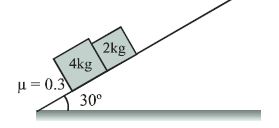
- 2Two blocks, $4\, kg$ and $2\, kg$ are sliding down an inclined plane as shown in figure. The acceleration of $2\, kg$ block is ........ $m/s^2$View Solution
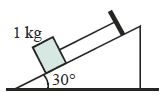
- 3The coefficient of friction between two surfaces is $\mu = 0.8$.The tension in the string shown in the figure is ........ $N$View Solution
- 4View SolutionA cube is resting on an inclined plane. What must be the value of coefficient of friction between cube and plane so that cube topples before sliding
- 5A plank with a box on it at one end is gradually raised about the other end. As the angle of inclination with the horizontal reaches $30^o$, the box starts to slip and slides $4.0\, m$ down the plank in $4.0\,s$. The coefficients of static and kinetic friction between the box and the plank will be, respectivelyView Solution
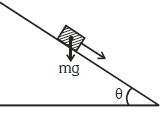
- 6A body of mass $'m '$ is tied to one end of a spring and whirled round in a horizontal plane with a constant angular velocity. The elongation in the spring is $1\, cm$. If the angular velocity is doubled, the elongation in the spring is $5\, cm$. The original length of the spring is ......... $cm$View Solution
- 7A body is sliding down an inclined plane (angle of inclination $45^o$). If the coefficient of friction is $0.5$ and $g = 9.8\, m/s^2$. then the acceleration of the body downwards in $m/s^2$ isView Solution
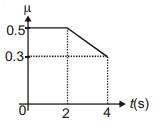
- 8A block is projected with speed $20 \,m / s$ on a rough horizontal surface. The coefficient of friction $(\mu)$ between the surfaces varies with time $(t)$ as shown in figure. The speed of body at the end of $4$ second will be ............ $m / s$ ( $g=$ $10 \,m / s ^2$ )View Solution
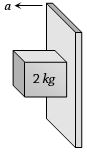
- 9A rough vertical board has an acceleration $‘a’$ so that a $2$ kg block pressing against it does not fall. The coefficient of friction between the block and the board should beView Solution
- 10A car is moving with a constant speed of $20\,m / s$ in a circular horizontal track of radius $40\,m$. A bob is suspended from the roof of the car by a massless string. The angle made by the string with the vertical will be : (Take $g =10$ $\left.m / s ^2\right)$View Solution