MCQ
In stationary waves
  • A
    Energy is uniformly distributed
  • Energy is minimum at nodes and maximum at antinodes
  • C
    Energy is maximum at nodes and minimum at antinodes
  • D
    Alternating maximum and minimum energy producing at nodes and antinodes

Answer

Correct option: B.
Energy is minimum at nodes and maximum at antinodes
b
In a stationary wave, node is the point where the amplitude always remains zero at all time and antinode is the point where amplitude will be either minimum or maximum at all time.

When amplitude is at its extremum values the energy of the wave will also be maximum. Hence, it will have maximum energy at antinodes, When amplitude is zero, the energy will also be zero and is the least possible value for energy. Hence, it will have minimum energy at nodes.

Need a full question paper?

Generate a complete, print-ready paper with questions like this in minutes — across 16+ boards, with answer keys.
Start Generating Free

Similar questions

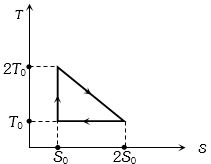
The temperature-entropy diagram of a reversible engine cycle is given in the figure. Its efficiency is
Two spheres A and B are heated till the sphere A appears orange and B red. Then the relation between their temperatures will be :
A square wire frame of size L is dipped in a liquid. On taking out, a membrane is formed. If the surface tension of liquid is T, force acting on the frame will be
The relation between time and displacement for two particles is given by

${y_1} = 0.06\sin 2\pi (1.04t + {\phi _1})$,

${y_2} = 0.03\sin 2\pi (1.04t + {\phi _2})$

The ratio of the intensity of the waves produced by the vibrations of the two particles will be

Three weights $W, 2W$ and $3W$ are connected to identical springs suspended from a rigid horizontal rod. The assembly of the rod and the weights fall freely. The positions of the weights from the rod are such that
By a surface of a liquid we mean.
 
A particle moves in a circular path with a uniform speed. Its motion is:
Two cars $A$ and $B$ are moving in same direction with velocities $30 \,m / s$ and $20 \,m / s$. When car $A$ is at a distance $d$ behind the car $B$, the driver of the car $A$ applies brakes producing uniform retardation of $2 \,m / s ^2$. There will be no collision when ......... $m$
A car is moving with high velocity when it has a turn. A force acts on it outwardly because of