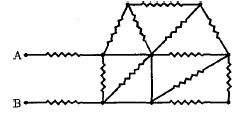
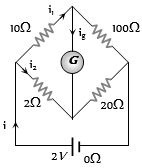
In the circuit shown below the resistance of the galvanometer is $20\, \Omega$ . In which case of the following alternatives are the currents arranged strictly in the decreasing order
Medium


Download our appand get started for free
Experience the future of education. Simply download our apps or reach out to us for more information. Let's shape the future of learning together!No signup needed.*
Similar Questions
- 1A steady current $i$ is flowing through a conductor of uniform cross-section. Any segment of the conductor hasView Solution
- 2In the part of a circuit shown in the figure, the potential difference $(V_G -V_H)$ between points $G$ and $H$ will be ............... $V$View Solution
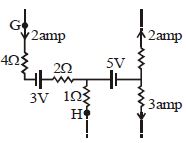
- 3The current in the given circuit is ................ $A$View Solution
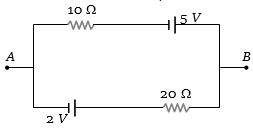
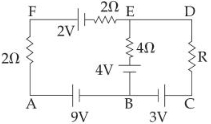
- 4In the electric network shown, when no current flows through the $4\, \Omega $ resistor in the arm $EB$, the potential difference between the points $A$ and $D$ will be ............... $V$View Solution
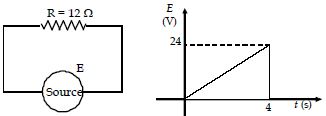
- 5A resistance $R = 12\, \Omega$ is connected across a source of emf as shown in the figure . Its $emf$ changes with time as shown in the graph . What is the heat developed in the resistance in the first four seconds ? ............. $J$View Solution
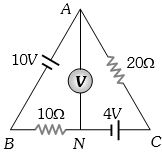
- 6The reading of the ideal voltmeter in the adjoining diagram will be ................. $V$View Solution
- 7The charge flowing in a conductor varies with time as $Q = at -bt^2$. Then for current, which statement is incorrect.View Solution
$(A)$ decreases linearly with time
$(B)$ reaches a maximum and then decreases
$(C)$ fall to zero after time $t = a/2b$
$(D)$ changes at a rate $-2b$
Options : - 8The series combination of two batteries, both of the same emf $10 \mathrm{\;V},$ but different internal resistance of $20\; \Omega$ and $5\; \Omega,$ is connected to the parallel combination of two resistors $30\; \Omega$ and $\mathrm{R}\; \Omega .$ The voltage difference across the battery of internal resistance $20\; \Omega$ is zero, the value of $\mathrm{R}(\text { in } \Omega)$ isView Solution
- 9What is the equivalent resistance between $A$ and $B$View Solution
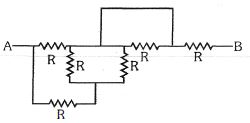
- 10In the given circuit all resistances are of value $R\,ohm$ each. The equivalent resistance between $A$ and $B$ isView Solution