The pole strength of a bar magnet is $48$ $ampere-metre$ and the distance between its poles is $ 25 \,cm$ . The moment of the couple by which it can be placed at an angle of $30°$ with the uniform magnetic intensity of flux density $0.15 $ $Newton /ampere-metre$ will be.......$Newton × metre$
Easy
Download our app for free and get started
(c)$\tau = MB\sin \theta = 48 \times 25 \times {10^{ - 2}} \times 0.15 \times \frac{1}{2}$$ = 0.9\;N \times m$

Download our appand get started for free
Experience the future of education. Simply download our apps or reach out to us for more information. Let's shape the future of learning together!No signup needed.*
Similar Questions
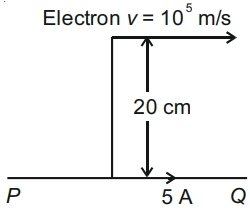
- 1An infinitely long straight conductor carries a current of $5 \,\mathrm{~A}$ as shown. An electron is moving with a speed of $10^{5} \, \mathrm{~m} / \mathrm{s}$ parallel to the conductor. The perpendicular distance between the electron and the conductor is $20 \, \mathrm{~cm}$ at an instant. Calculate the magnitude of the force experienced by the electron at that instant in $\times 10^{-20} \,N$View Solution
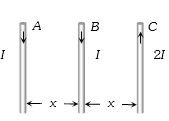
- 2$A, B$ and $C$ are parallel conductors of equal length carrying currents $I, I$ and $2I$ respectively. Distance between $A$ and $B$ is $x$. Distance between $B$ and $C$ is also $x$. ${F_1}$ is the force exerted by $B$ on $A$ and $F_2$ is the force exerted by $B$ on $A$ choose the correct answerView Solution
- 3View SolutionIf a long hollow copper pipe carries a current, then magnetic field is produced
- 4When a current of $5\ mA$ is passed through a galvanometer having a coil of resistance $15\ \Omega$, it shows full scale deflection. The value of the resistance to be put in series with the galvanometer to convert it into to voltmeter of range $0 - 10\ V$ isView Solution
- 5In an experiment, electrons are accelerated, from rest, by applying, a voltage of $500 \,V.$ Calculate the radius of the path if a magnetic field $100\,mT$ is then applied. [Charge of the electron $= 1.6 \times 10^{-19}\,C$ Mass of the electron $= 9.1 \times 10^{-31}\,kg$ ]View Solution
- 6A singly ionized magnesium atom $(A=24)$ ion is accelerated to kinetic energy $5\,keV$ and is projected perpendicularly into a magnetic field $B$ of the magnitude $0.5\,T$. The radius of path formed will be___________ $cm$View Solution
- 7A proton is moving along $Z$-axis in a magnetic field. The magnetic field is along $X$-axis. The proton will experience a force alongView Solution
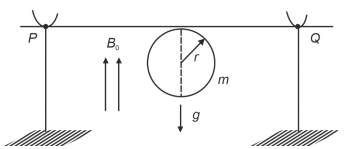
- 8A thin stiff insulated metal wire is bent into a circular loop with its two ends extending tangentially from the same point of the loop. The wire loop has mass $m$ and radius $r$ and it is in a uniform vertical magnetic field $B_0$, as shown in the figure. Initially, it hangs vertically downwards, because of acceleration due to gravity $g$, on two conducting supports at $P$ and $Q$. When a current $/$ is passed through the loop, the loop turns about the line $P Q$ by an angle $\theta$ given byView Solution
- 9A milli voltmeter of $25\,millivolt$ range is to be converted in to an ammeter of $25\,A$ range. The value (in $ohm$) of necessary shunt will beView Solution
- 10A square current carrying loop is suspended in a uniform magnetic field acting in the plane of the loop. If the force on one arm of the loop is $\overrightarrow F$ the net force on the remaining three arms of the loop isView Solution