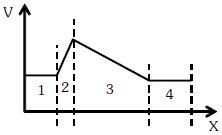
In which region magnitude of $x$ -component of electric field is maximum, if potential $(V)$ versus distance $(X)$, graph is as shown?
Medium
Download our app for free and get started
$\mathrm{E}=-\frac{\partial \mathrm{V}}{\partial \mathrm{x}}$ Slop is maximum.

Download our appand get started for free
Experience the future of education. Simply download our apps or reach out to us for more information. Let's shape the future of learning together!No signup needed.*
Similar Questions
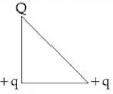
- 1Three charges $Q, +q$ and $+q$ are placed at the vertices of a right -angle isosceles triangle as shown below. The net electrostatic energy of the configuration is zero, if the value of $Q$ isView Solution
- 2Two charged spherical conductors of radius $R_{1}$ and $\mathrm{R}_{2}$ are connected by a wire. Then the ratio of surface charge densities of the spheres $\left(\sigma_{1} / \sigma_{2}\right)$ is :View Solution
- 3View SolutionOne plate of parallel plate capacitor is smaller than other, then charge on smaller plate will be
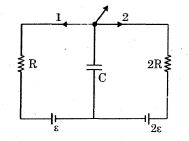
- 4In the circuit shown, the switch is shifted from position $1 \rightarrow 2$ at $t = 0$. The switch was initially in position $1$ since a long time. The graph between charge on capacitor $C$ and time $'t'$ isView Solution
- 5A point dipole $\vec p = - {p_0}\hat x$ is kept at the origin. The potential and electric field due to this dipole on the $y-$ axis at a distance $d$ are, respectively : (Take $V = 0$ at infinity)View Solution
- 6A hollow conducting sphere of radius $R$ has a charge $( + Q)$ on its surface. What is the electric potential within the sphere at a distance $r = \frac{R}{3}$ from its centreView Solution
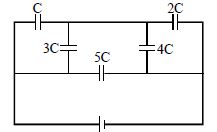
- 7In the given circuit, ratio of charge stored in the capacitors $C, 2C, 3C, 4C, 5C$ isView Solution
- 8In the circuit shown, the energy stored in $1$ $ \mu F$ capacitor is......$\mu J$View Solution
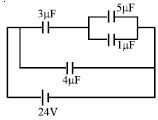
- 9View SolutionThe resultant capacitance of given circuit is
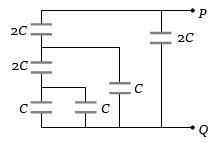
- 10Three capacitors of capacitances $3\,\mu F,\;9\,\mu F$ and $18\,\mu F$ are connected once in series and another time in parallel. The ratio of equivalent capacitance in the two cases $\left( {\frac{{{C_s}}}{{{C_p}}}} \right)$ will beView Solution