Question
Match the intermediates given in Column I with their probable structure in Column II.
 
Column I
 
Column II
(i)
Free radical
(a)
Trigonal planar
(ii)
Carbocation
(b)
Pyramidal
(iii)
Carbanion
(c)
Linear
 

Answer

 
Column I
 
Column II
(i)
Free radical
(a)
Trigonal planar
(ii)
Carbocation
(a)
Trigonal planar
(iii)
Carbanion
(b)
Pyramidal

Need a full question paper?

Generate a complete, print-ready paper with questions like this in minutes — across 16+ boards, with answer keys.

Start Generating Free

Similar questions

Hydrogen atom has only one electron, so mutual repulsion between electrons is absent. However, in multielectron atoms mutual repulsion between the electrons is significant. How does this affect the energy of an electron in the orbitals of the same principal quantum number in multielectron atoms?
Electrons are emitted with zero velocity from a metal surface when it is exposed to radiation of wavelength $6800$ $\mathring{\text{A}}.$ Calculate threshold frequency ($ν_0 $) and work function ($W_0$​​​​​​​ ) of the metal.
  1. What happens when magnesium is heated with Boron?
  2. What happens when lithium borohydride is treated with iodine?
  3. What is formula of meta boric acid?
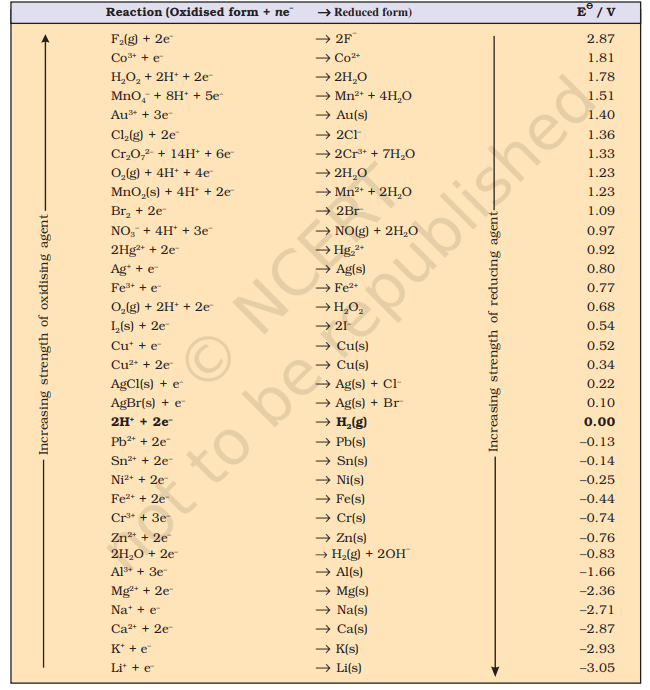
Using the standard electrode potentials given in the Table, predict if the reaction between the following is feasible:
$\mathrm{Ag}^{+}(\mathrm{aq})$ and $\mathrm{Cu}(\mathrm{s})$.
Calculate the number of atoms in each of the following
1. 52 mole of Ar
2. 52 u of He
3. 52 g of He .
Describe the change in hybridisation (if any) of the Al atom in the following reaction.
$
AlCl_3+Cl^{-} \rightarrow AlCl_4^{-}
$
Calculate the volume occupied by $8.8 \mathrm{~g}$ of $\mathrm{CO}_2$ at $31.1^{\circ} \mathrm{C}$ and 1 bar pressure. $\mathrm{R}=0.083$ bar $\mathrm{LK}^{-1} \mathrm{~mol}^{-1}$.
If $4g$ of $NaOH$ dissolves in 36g of $H_2O$, calculate the mole fraction of each component in the solution. Also, determine the molarity of solution (specific gravity of solution is $1g mL^{–1}).$
Balance the following ionic equations. $\text{Cr}_2\text{O}^{2-}_7+\text{H}^++\text{I}^-\xrightarrow{ \ \ \ \ \ \ \ \ \ }\text{Cr}^{3+}+\text{I}_2+\text{H}_2\text{O}$
The value of $\mathrm{K}_{\mathrm{c}}$ for the reaction $3 \mathrm{O}_2(\mathrm{~g}) \rightleftharpoons 2 \mathrm{O}_3(\mathrm{~g})$ is $2.0 \times 10^{-50}$ at $25^{\circ} \mathrm{C}$. If the equilibrium concentration of $\mathrm{O}_2$ in air at $25^{\circ} \mathrm{C}$ is $1.6 \times 10^{-2}$, what is the concentration of $\mathrm{O}_3$ ?