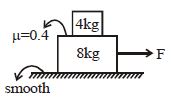
........ $N$ the maximum force for which both the block will move with same acceleration.
Medium
Download our app for free and get started
Pseudo force on 4 kg block $=\mathrm{ma}$
$\therefore \mathrm{ma}=\mu \mathrm{mg} \Rightarrow \mathrm{a}=0.4 \times 10=4 \mathrm{m} / \mathrm{s}^{2}$
as both the blocks will move with same
acc$”a”$
${F=(4+8) a}$
${=12 \times 4=48 \mathrm{N}}$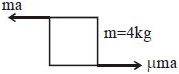

Download our appand get started for free
Experience the future of education. Simply download our apps or reach out to us for more information. Let's shape the future of learning together!No signup needed.*
Similar Questions
- 1Assuming the coefficient of friction between the road and tyres of a car to be $0.5$, the maximum speed with which the car can move round a curve of $40.0\, m$ radius without slipping, if the road is unbanked, should be ......... $m/s$View Solution
- 2A body of mass $'m '$ is tied to one end of a spring and whirled round in a horizontal plane with a constant angular velocity. The elongation in the spring is $1\, cm$. If the angular velocity is doubled, the elongation in the spring is $5\, cm$. The original length of the spring is ......... $cm$View Solution
- 3A vehicle is moving with a velocity $v$ on a curved road of width $b$ and radius of curvature $R.$ For counteracting the centrifugal force on the vehicle, the difference in elevation required in between the outer and inner edges of the road isView Solution
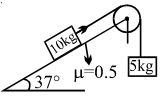
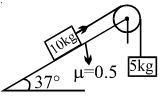
- 4The blocks are in equilibrium. The friction force acting on $10 kg$ block is :View Solution
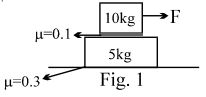
- 5The maximum acceleration of $5\, kg$ block ...... $m/s^2$View Solution
- 6A mass of $100\, gm$ is tied to one end of a string $2 \,m$ long. The body is revolving in a horizontal circle making a maximum of $200$ revolutions per min. The other end of the string is fixed at the centre of the circle of revolution. The maximum tension that the string can bear is .......... $N$. (approximately)View Solution
- 7View SolutionMaximum value of static friction is called
- 8The blocks are in equilibrium. The friction force acting on $10 kg$ block is :View Solution
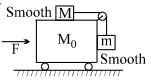
- 9Imagine $a$ situation in which the horizontal surface of block $M_0$ is smooth and its vertical surface is rough with $a$ coefficient of friction $\mu$ Consider a special situation in which both the faces of the block $M_0$ are smooth, as shown in adjoining figure. Mark out the correct statement $(s)$View Solution
- 10On the horizontal surface of a truck a block of mass $1 \;kg$ is placed $(\mu=0.6)$ and truck is moving with acceleration $5\; m / sec ^2$ then the frictional force on the block will beView Solution