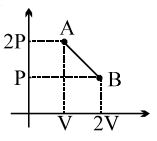
One mole of a gas expands obeying the relation as shown in the $P/V$ diagram. The maximum temperature in this process is equal to
Advanced
Download our app for free and get started
This question can be solved by maxima
and minima.
since the graph shown here is a straight line, we can write it's equation in the form of $:$
$y=m x+c$
here $y=P, x=V, m=\frac{P_{2}-P_{1}}{V_{2}-V_{1}}=\frac{\frac{P_{0}}{2}-P_{0}}{2 V_{0}-V_{0}}$
$\Rightarrow m=\frac{-P_{0}}{2 V_{0}}$
$c$ is the intercept and $c=\frac{3 P_{0}}{2}$
We can find $c$ by extra polating the graph Now
$P=\frac{-P_{0}}{2 V_{0}} V+\frac{3 P_{0}}{2}$ $...(1)$
Also, from equation of state, we know the $P V=n R T$
for $1$ mole $P V=R T$
or $P=\frac{R T}{V}$
substituting this in equation $( 1)$
$\frac{R T}{V}=\frac{-P_{0}}{2 V_{0}} V+\frac{3 P_{0}}{2}$
$T=\frac{-\bar{P}_{0}}{2 R V_{0}} \cdot V^{2}+\frac{3 P_{0}}{2 R} V$
To find the minimum temperature, we will differentiate the above equation
i.e., $\frac{d T}{d V}=-\frac{2 P_{0}}{2 R V_{0}} \cdot V+\frac{3 P_{0}}{2 R}$
for $\frac{d T}{d V}=0 \Rightarrow \frac{P_{0}}{R V_{0}} \cdot V=\frac{3 P_{0}}{2 R}$
$\Rightarrow V=\frac{3 V_{0}}{2}$
This is the critical point.
$\frac{d^{2} T}{d V^{2}}=-\frac{P_{0}}{R V_{0}}$
which is negative since pressure and volume can't be negative.
$\Rightarrow$ pt of maximum
Now at $V=\frac{3 V_{0}}{2}$
maximum temperature $=T_{\max }=\frac{-P_{0}}{2 R V_{0}} \frac{9 V_{0}^{2}}{4}+\frac{3 P_{0}}{2 R} \cdot \frac{3 V_{0}}{2}$
$\Rightarrow T_{\max }=\frac{9 P_{0} V_{0}}{8 R}$

Download our appand get started for free
Experience the future of education. Simply download our apps or reach out to us for more information. Let's shape the future of learning together!No signup needed.*
Similar Questions
- 1View SolutionThe internal energy of an ideal gas increases during an isothermal process when the gas is
- 2A sample of $1$ mole gas at temperature $\mathrm{T}$ is adiabatically expanded to double its volume. If adiabatic constant for the gas is $\gamma=\frac{3}{2}$, then the work done by the gas in the process is:View Solution
- 3A piece of hot copper at $100^{\circ} C$ is plunged into a pond at $30^{\circ} C$. The copper cools down to $30^{\circ} C$, while the pond being huge stays at its initial temperature. Then,View Solution
- 4A gas ($\gamma = 1.3)$ is enclosed in an insulated vessel fitted with insulating piston at a pressure of ${10^5}\,N/{m^2}$. On suddenly pressing the piston the volume is reduced to half the initial volume. The final pressure of the gas isView Solution
- 5Answer the following by appropriately matching the lists based on the information given in the paragraph.View Solution
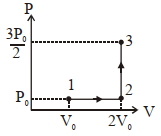
In a thermodynamics process on an ideal monatomic gas, the infinitesimal heat absorbed by the gas is given by $T \Delta X$, where $T$ is temperature of the system and $\Delta X$ is the infinitesimal change in a thermodynamic quantity $X$ of the system. For a mole of monatomic ideal gas
$X=\frac{3}{2} R \ln \left(\frac{T}{T_A}\right)+R \ln \left(\frac{V}{V_A}\right)$. Here, $R$ is gas constant, $V$ is volume of gas, $T_A$ and $V_A$ are constants.
The $List-I$ below gives some quantities involved in a process and $List-II$ gives some possible values of these quantities.
List-$I$ List-$II$ $(I)$ Work done by the system in process $1 \rightarrow 2 \rightarrow 3$ $(P)$ $\frac{1}{3} R T_0 \ln 2$ $(II)$ Change in internal energy in process $1 \rightarrow 2 \rightarrow 3$ $(Q)$ $\frac{1}{3} RT _0$ $(III)$ Heat absorbed by the system in process $1 \rightarrow 2 \rightarrow 3$ $(R)$ $R T _0$ $(IV)$ Heat absorbed by the system in process $1 \rightarrow 2$ $(S)$ $\frac{4}{3} RT _0$ $(T)$ $\frac{1}{3} RT _0(3+\ln 2)$ $(U)$ $\frac{5}{6} RT _0$ If the process carried out on one mole of monatomic ideal gas is as shown in figure in the PV-diagram with $P _0 V _0=\frac{1}{3} RT _0$, the correct match is,
$(1)$$I \rightarrow Q, II \rightarrow R , III \rightarrow P , IV \rightarrow U$
$(2)$ $I \rightarrow S , II \rightarrow R , III \rightarrow Q , IV \rightarrow T$
$(3)$ $I \rightarrow Q , II \rightarrow R , III \rightarrow S , IV \rightarrow U$
$(4)$ $I \rightarrow Q , II \rightarrow S , III \rightarrow R , IV \rightarrow U$
($2$) If the process on one mole of monatomic ideal gas is an shown is as shown in the $TV$-diagram with $P _0 V _0=\frac{1}{3} RT _0$, the correct match is
$(1)$ $I \rightarrow S, II \rightarrow T, III \rightarrow Q , IV \rightarrow U$
$(2)$ $I \rightarrow P , II \rightarrow R, III \rightarrow T , IV \rightarrow S$
$(3)$ $I \rightarrow P, II \rightarrow, III \rightarrow Q, IV \rightarrow T$
$(4)$ $I \rightarrow P, II \rightarrow R, III \rightarrow T, IV \rightarrow P$
Give the answer or quetion $(1)$ and $(2)$
- 6The pressure and volume of an ideal gas are related as $\mathrm{PV}^{3 / 2}=\mathrm{K}$ (Constant). The work done when the gas is taken from state $A\left(P_1, V_1, T_1\right)$ to state $\mathrm{B}\left(\mathrm{P}_2, \mathrm{~V}_2, \mathrm{~T}_2\right)$ is :View Solution
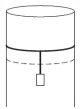
- 7A long cylindrical pipe of radius $20 \,cm$ is closed at its upper end and has an airtight piston of negligible mass as shown. When a $50 \,kg$ mass is attached to the other end of the piston, it moves down. If the air in the enclosure is cooled from temperature $T$ to $T-\Delta T$, the piston moves back to its original position. Then $\Delta T / T$ is close to (Assuming air to be an ideal gas, $g=10 \,m / s ^2$, atmospheric pressure is $10^5 \,Pa$ )View Solution
- 8View Solution“Heat cannot by itself flow from a body at lower temperature to a body at higher temperature” is a statement or consequence of
- 9Half mole of an ideal monoatomic gas is heated at constant pressure of $1\, atm$ from $20\,^oC$ to $90\,^oC$. Work done by has is close to ..... $J$ (Gas constant $R = 8.31\, J/mol.K$)View Solution
- 10A Container having $1$ mole of a gas at a temperature $27°C$ has a movable piston which maintains at constant pressure in container of $1 \,atm.$ The gas is compressed until temperature becomes $127°C$. The work done is ........ $J$ ($C_P$ for gas is $7.03\, cal/mol-K)$View Solution