Question
Out of the two magnetic materials, 'A' has relative permeability slightly greater than unity while 'B' has less than unity. Identify the nature of the materials 'A' and 'B'. Will their susceptibilities be positive or negative?

Answer

A: Paramagnetic
B: Diamagnetic
Susceptibility:
For A: positive
For B: negative.

Need a full question paper?

Generate a complete, print-ready paper with questions like this in minutes — across 16+ boards, with answer keys.
Start Generating Free

Similar questions

A magnetic needle is free to rotate in a vertical plane which makes an angle of 60° with the magnetic meridian. If the needle stays in a direction making an angle of $\tan^{-1}\Big(\frac{2}{\sqrt{3}}\Big)$ with the horizontal, what would be the dip at that place?
A magnetic field can be produced by moving, charges or electric currents. The basic equation governing the magnetic field due to a current distribution is the Biot-Savart law. Finding the magnetic field resulting from a current distribution involves the vector product, and is inherently a calculas problem when the distance from the current to the field point is continuously changing. According to this law, the magnetic field at a point due to a current element of length $\text{d}\vec{\text{I}}$ carrying current I, at a distance r from the element is $\text{dB}=\frac{\mu_0}{4\pi}\frac{\text{I}(\text{d}{\vec{\text{I}}\times\vec{\text{r}}})}{\text{r}^3}$Biot-Savart law has certain similarities as well as difference with Coloumb's law for electrostatic field e.g., there is an angle dependence in Biot-Savart law which is not present in electrostatic case.
  1. The direction of magnetic field $\text{d}\vec{\text{B}}$ due to a current element $\text{Id}\vec{\text{l}}$ at a point of distance $\vec{\text{r}}$ from it, when a current I passes through a long conductor is in the direction
  1. Of position vector $\vec{\text{r}}$ of the point.
  2. Of current element $\text{Id}\vec{\text{l}}$
  3. Perpendicular to both $\text{d}\vec{\text{l}}$ and $\vec{\text{r}}$
  4. Perpendicular to $\text{d}\vec{\text{l}}$ only.
  1. The magnetic field due to a current in a straight wire segment of length Lat a point on its perpendicular bisector at a distance r (r >> L)
  1. Decreases as $\frac{1}{\text{r}}$
  2. Decreases as $\frac{1}{\text{r}^2}$
  3. Decreases as $\frac{1}{\text{r}^3}$
  4. approaches a finite limit as $\text{r}\rightarrow\infty$
  1. Two long straight wires are set parallel to each other. Each carries a current i in the same direction and the separation between them is 2r. The intensity of the magnetic field midway between them is:
  1. $\mu_0\frac{\text{i}}{\text{r}}$
  2. $4\mu_0\frac{\text{i}}{\text{r}}$
  3. $\text{Zero}$
  4. $\mu_0\frac{\text{i}}{\text{4r}}$
  1. A long straight wire carries a current along the z-axis for any two points in the x - y plane. Which of the following is always false?
  1. The magnetic fields are equal.
  2. The directions of the magnetic fields are the same.
  3. The magnitudes of the magnetic fields are equal.
  4. The field at one point is opposite to that at the other point.
  1. Biot-Savart law can be expressed alternatively as:
  1. Coulomb's Law.
  2. Ampere's circuital law.
  3. Ohm's Law.
  4. Gauss's Law.
When a ferromagnetic material goes through a hysteresis loop, its thermal energy is increased. Where does this energy come from?
If an automobile engine is overheated, it is cooled by putting water on it. It is advised that the water should be put slowly with engine running. Explain the reason.
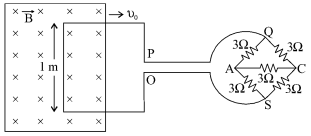
A square loop of a metallic wire of side 10 cm whose resistance is 1 ohm is moving with a constant velocity of as shown in the figure in a uniform magnetic field of $200 Wb / m ^2$. The magnetic field is normal to the plane of paper inwards. This loop is connected to a network of resistors of magnitude 3 ohms. Resistance of wire OS and PQ are negligible. What will be the magnitude of velocity, $v_0$ to flow one ampere of direct current in the loop? Also, what will be the direction of current?
Image
A simple pendulum of length I is suspended from the ceiling of a car moving with a speed v on a circular horizontal road of radius r.
  1. Find the tension in the string when it is at rest with respect to the car.
  2. Find the time period of small oscillation.
Write one-one use of the following waves: (i) Micro waves (ii) Infrared waves (iii) Ultraviolet waves (iv) Radio waves
An elevator is descending with uniform acceleration. To measure the acceleration, a person in the elevator drops a coin at the moment the elevator starts. The coin is 6ft above the floor of the elevator at the time it is dropped. The person observes that the coin strikes the floor in 1 second. Calculate from these data the acceleration of the elevator.
According to de-Broglie, a moving material particle sometimes acts as a wave and sometimes as a particle or a wave associated with moving material particle which controls the particle in every respect. The wave associated with moving particle is called matter wave or de-Broglie wave where wavelength called de-Broglie wavelength, rs given by $\lambda=\frac{\text{h}}{\text{mv}}$.
  1. If a proton and an electron have the same de Broglie wavelength, then:
  1. Kinetic energy of electron < kinetic energy of proton.
  2. Kinetic energy of electron = kinetic energy of proton.
  3. Momentum of electron = momentum of proton.
  4. momentum of electron < momentum of proton.
  1. Which of these particles having the same kinetic energy has the largest de Broglie wavelength?
  1. Electron
  2. Alpha particle
  3. Proton
  4. Neutron
  1. Two particles $A_1$ and $A_2$ of masses $m_1, m_2 (m_1 > m_2)$ have the same de Broglie wavelength. Then:
  1. Their momenta are the same.
  2. Their energies are the same.
  3. Momentum of $A_1$ is less than the momentum of $A_1$.
  4. Energy of $A_1$ is more than the energy of $A_2.$
  1. When the velocity of an electron increases, its de Broglie wavelength:
  1. Increases.
  2. Decreases.
  3. Remains same.
  4. May increase or decrease.
  1. Proton and $\alpha$ - particle have the same de-Broglie wavelength. What is same for both of them?
  1. Time period
  2. Energy
  3. Frequency
  4. Momentum