Question

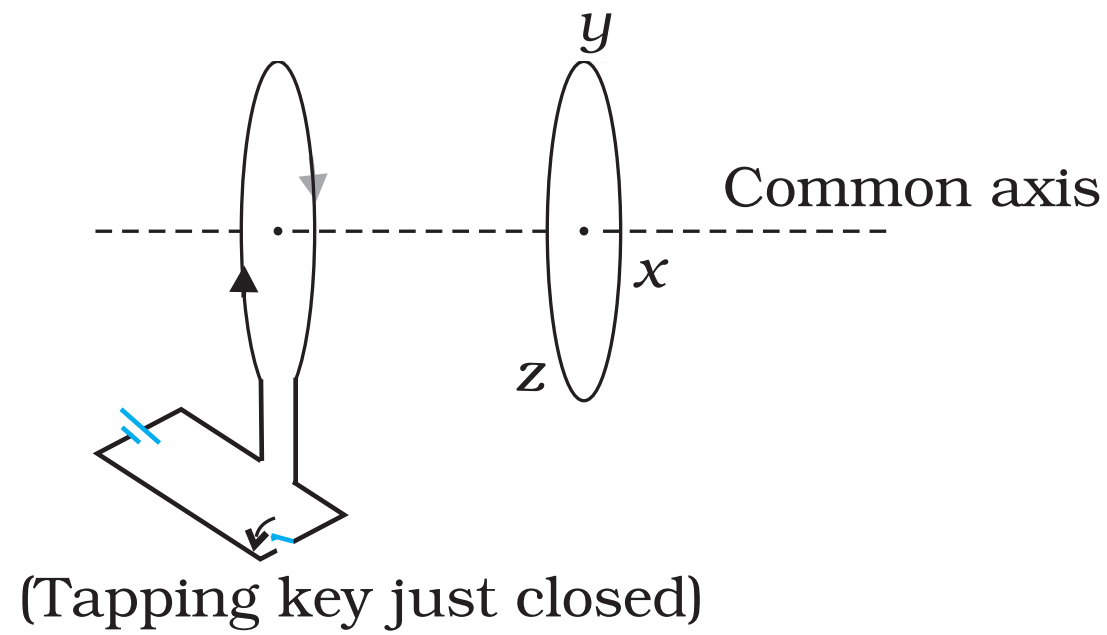
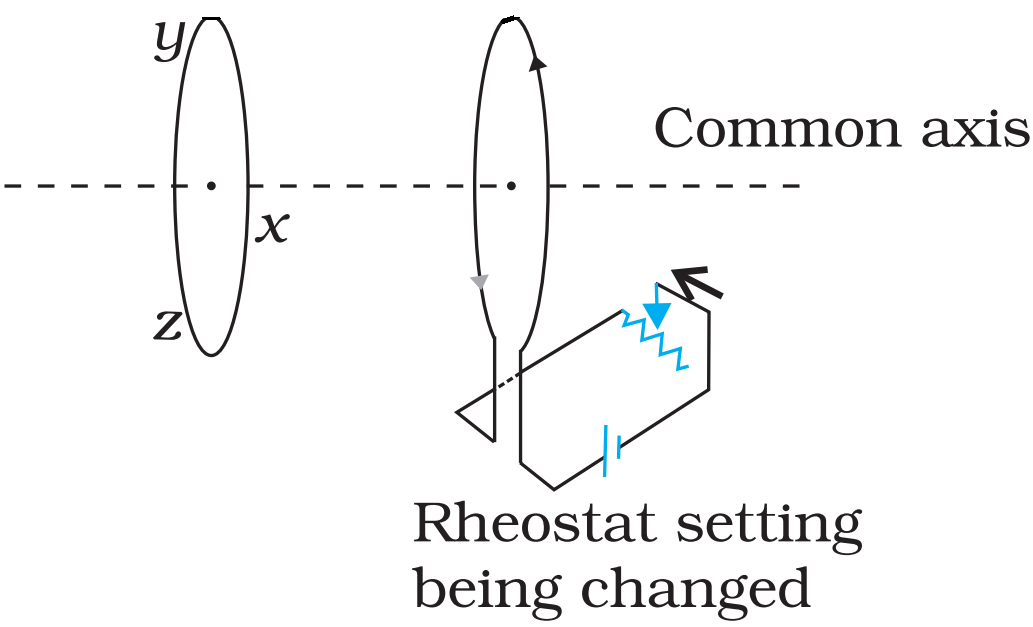
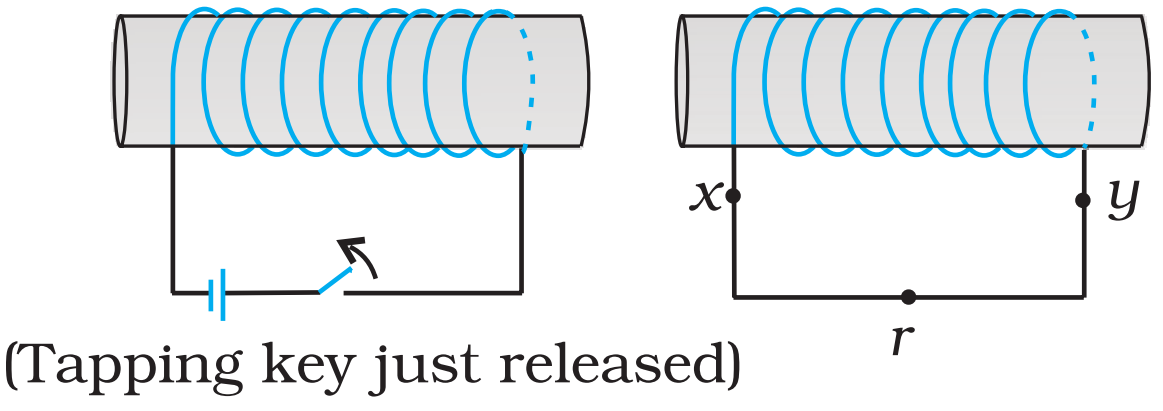
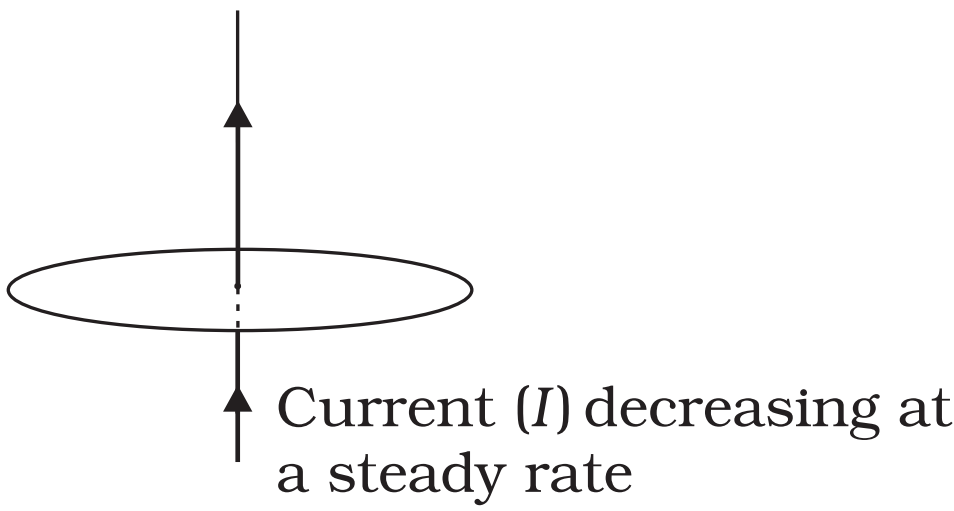
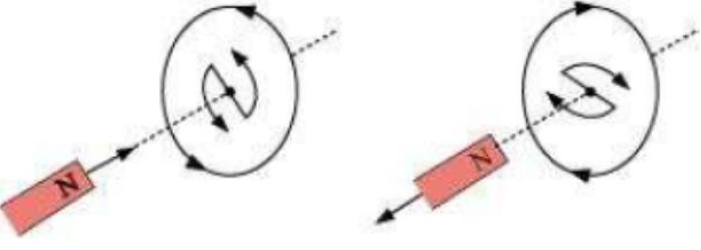
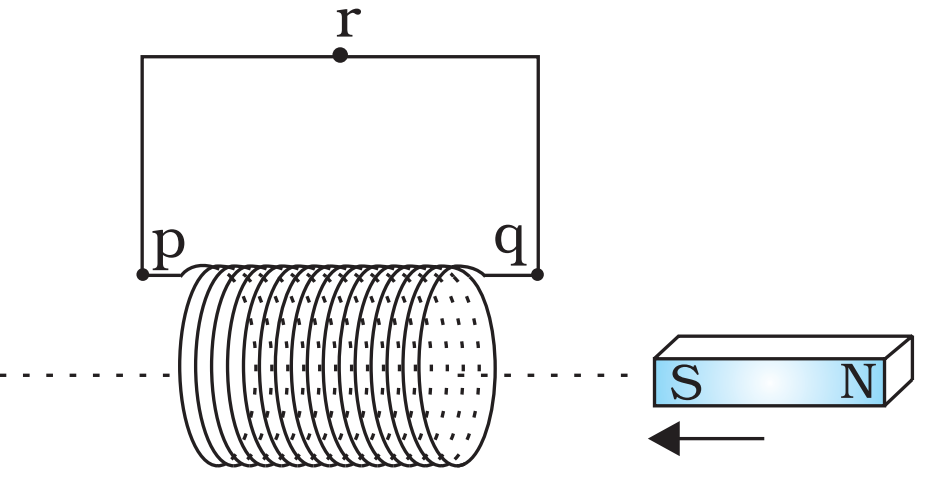
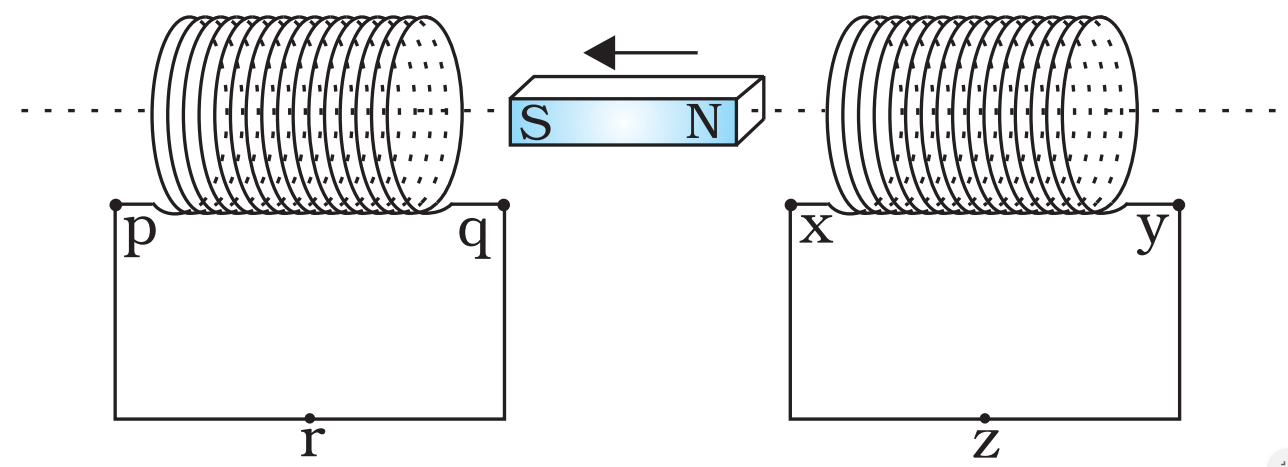
Predict the direction of induced current in the situations described by the following Figs. (a) to (f).
  1.  
  1.  
  1.  
  1.  
  1.  
  1.  

Answer

The direction of the induced current in a closed loop is given by Lenz's law. The given pairs of figures show the direction of the induced current when the North pole of a bar magnet is moved towards and away from a closed loop respectively.
Using Lenz's rule, the direction of the induced current in the given situations can be predicted as follows:
  1. The direction of the induced current is along qrpq.
  2. The direction of the induced current is along prqp.
  3. The direction of the induced current is along yzxy.
  4. The direction of the induced current is along zyxz.
  5. The direction of the induced current is along xryx.
  6. No current is induced since the field lines are lying in the plane of the closed loop.

Need a full question paper?

Generate a complete, print-ready paper with questions like this in minutes — across 16+ boards, with answer keys.
Start Generating Free

Similar questions

A small block of superdense material has a mass of $3 \times 10^{24}kg.$ It is situated at a height h (much smaller than the earth's radius) from where it falls on the earth's surface. Find its speed when its height from the earth's surface has reduced to $\frac{\text{h}}{2}.$ The mass of the earth is $6 \times 10^{24}kg.$
$a.$ Explain why, for any charge configuration, the equipotential surface through a point is normal to the electric field at that point.
Draw a sketch of equipotential surfaces due to a single charge $(-q)$, depicting the electric field lines due to the charge.
$b.$ Obtain an expression for the work done to dissociate the system of three charges placed at the vertices of an equilateral triangle of side a as shown alongside.
An air bubble of radius 2.0mm is formed at the bottom of a 3.3m deep river. Calculate the radius of the bubble as it comes to the surface. Atmospheric pressure $= 1.0 \times 10^5$ Pa and density of water $= 1000kg/m^{-3}.$
A gravitational lens may be assumed to have a varying width of the form
$\text{w}(\text{b})=\text{k}_1\text{ In }\Big(\frac{\text{k}_2}{\text{b}}\Big)\ \ \text{b}_\text{min}<\text{b}<\text{b}_\text{max}$
$=\text{k}_1\text{ In }\Big(\frac{\text{k}_2}{\text{b}_\text{min}}\Big)\ \ \text{b}<\text{b}_\text{min}$
Show that an observer will see an image of a point object as a ring about the center of the lens with an angular radius
$\beta=\sqrt{\frac{(\text{n}-1)\text{k}_1\frac{\text{u}}{\text{v}}}{\text{u}+\text{v}}}$
A pendulum bob of mass 50g is suspended from the ceiling of an elevator. Find the tension in the string if the elevator:
  1. Goes up with acceleration $1.2m/s^2.$
  2. Goes up with deceleration $1.2m/s^2.$
  3. Goes up with uniform velocity.
  4. Goes down with acceleration $1.2m/s^2.$
  5. Goes down with deceleration $1.2m/s^2.$
  6. Goes down with uniform velocity.
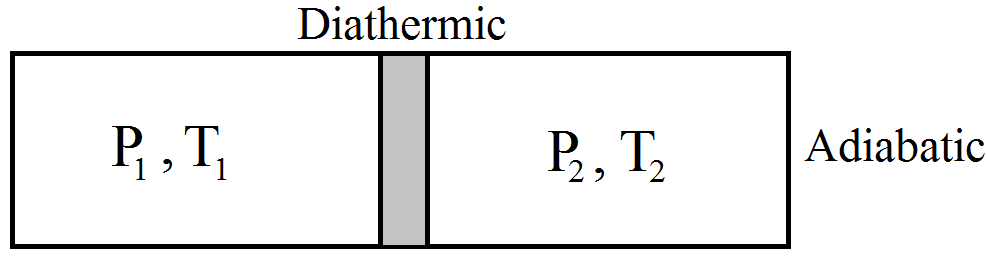
Figure. shows a cylindrical tube of volume V with adiabatic walls containing an ideal gas. The internal energy of this ideal gas is given by 1.5nRT. The tube is divided into two equal parts by a fixed diathermic wall. Initially, the pressure and the temperature are $P_1, T_1$ on the left and $p_2, T_2$ on the right. The system is left for sufficient time so that the temperature becomes equal on the two sides.
  1. How much work has been done by the gas on the left part?
  2. Find the final pressures on the two sides.
  3. Find the final equilibrium temperature.
  4. How much heat has flown from the gas on the right to the gas on theleft?
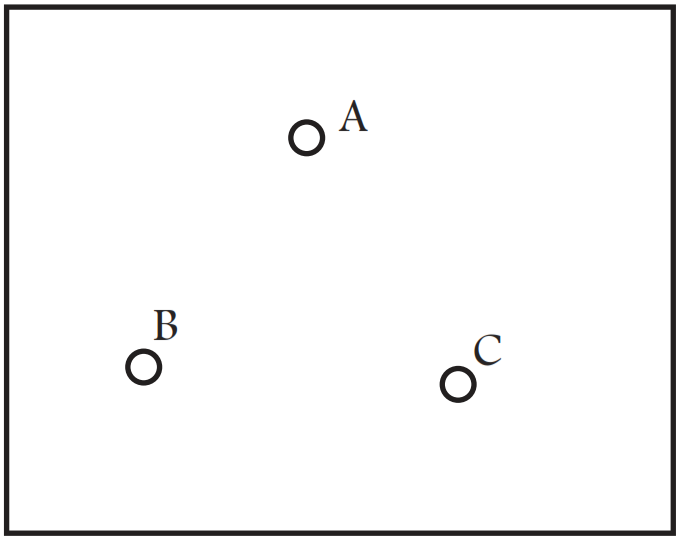
Consider a box with three terminals on top of it as shown in Fig (a):

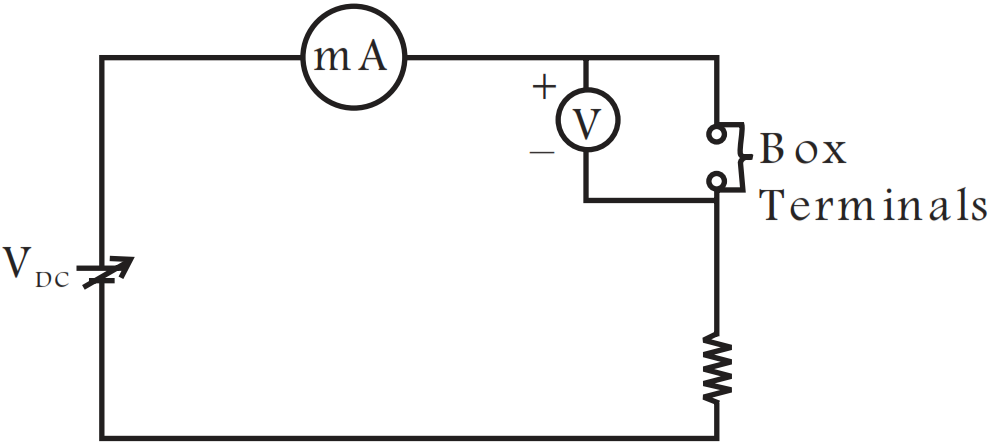
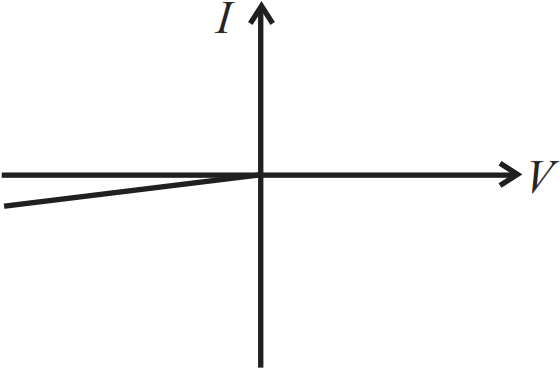
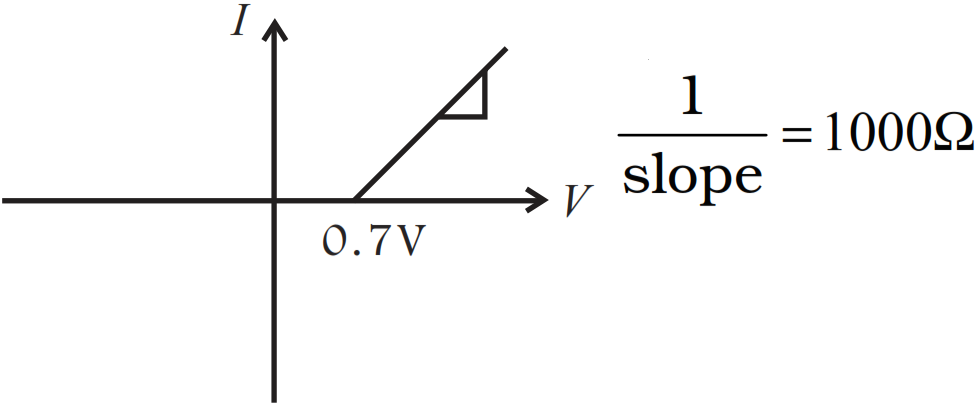
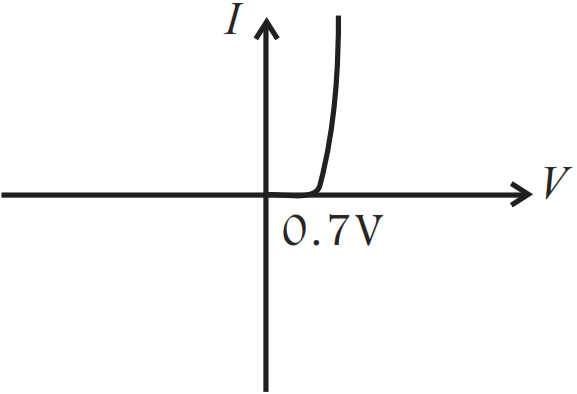
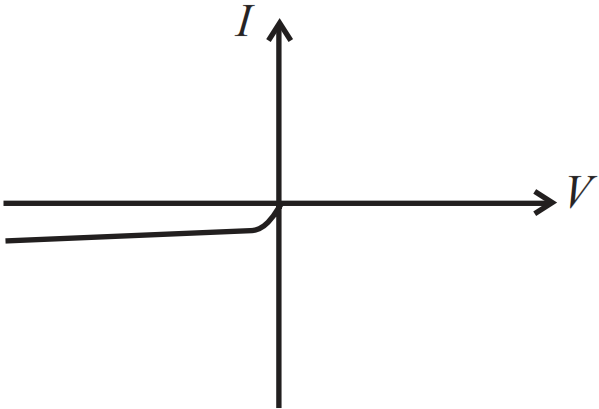
Three components namely, two germanium diodes and one resistor are connected across these three terminals in some arrangement. A student performs an experiment in which any two of these three terminals are connected in the circuit shown in Fig. (b).

The student obtains graphs of current-voltage characteristics for unknown combination of components between the two terminals connected in the circuit. The graphs are
  1. When A is positive and B is negative,
  1. When A is negative and B is positive,
  1. When B is negative and C is positive,
  1. When B is positive and C is negative,
  1. When A is positive and C is negative,
  1. When A is negative and C is positive,

From these graphs of current - voltage characteristic shown in Fig. (c) to (h), determine the arrangement of components between A, B and C.
A particle is fired vertically upward with a speed of 15km/s. With what speed will it move in intersteller space. Assume only earth's gravitational field.
Define the terms (i) capacitance of a capacitor (ii) dielectric strength of a dielectric. When a dielectric is inserted between the plates of a charged parallel plate capacitor, fully occupying the intervening region, how does the polarization of the dielectric medium affect the net electric field? For linear dielectrics, show that the introduction of a dielectric increases its capacitance by a factor $\kappa$, characteristic of the dielectric.
State Gauss theorem in electrostatics. Apply this theorem to obtain the expression for the electric field at a point due to an infinitely long, thin, uniformly charged straight wire of linear charge density $\lambda\text{Cm}^{-1}.$