A gravitational lens may be assumed to have a varying width of the form
$\text{w}(\text{b})=\text{k}_1\text{ In }\Big(\frac{\text{k}_2}{\text{b}}\Big)\ \ \text{b}_\text{min}<\text{b}<\text{b}_\text{max}$
$=\text{k}_1\text{ In }\Big(\frac{\text{k}_2}{\text{b}_\text{min}}\Big)\ \ \text{b}<\text{b}_\text{min}$
Show that an observer will see an image of a point object as a ring about the center of the lens with an angular radius
$\beta=\sqrt{\frac{(\text{n}-1)\text{k}_1\frac{\text{u}}{\text{v}}}{\text{u}+\text{v}}}$
$\text{w}(\text{b})=\text{k}_1\text{ In }\Big(\frac{\text{k}_2}{\text{b}}\Big)\ \ \text{b}_\text{min}<\text{b}<\text{b}_\text{max}$
$=\text{k}_1\text{ In }\Big(\frac{\text{k}_2}{\text{b}_\text{min}}\Big)\ \ \text{b}<\text{b}_\text{min}$
Show that an observer will see an image of a point object as a ring about the center of the lens with an angular radius
$\beta=\sqrt{\frac{(\text{n}-1)\text{k}_1\frac{\text{u}}{\text{v}}}{\text{u}+\text{v}}}$
Download our app for free and get started
It this case, differentiating expression of time taken t w.r.t.b.
$\text{t}=\frac{1}{\text{c}}\bigg(\text{u}+\text{v}+\frac{1}{2}\frac{\text{b}^2}{\text{D}}+(\text{n}-1)\text{k}_1\text{ In }\Big(\frac{\text{k}_2}{\text{b}}\Big)\bigg)$
$\frac{\text{dt}}{\text{db}}=0=\frac{\text{b}}{\text{D}}-(\text{n}-1)\frac{\text{k}_1}{\text{b}}$
$\Rightarrow\ \text{b}^2=(\text{n}-1)\text{k}_1\text{D}$
$\therefore\ \text{b}=\sqrt{(\text{n}-1)\text{k}_1\text{D}}$
Thus, all rays passing at a height b shall contribute to the image. They ray paths make an angle.
$\beta=\frac{\text{b}}{\text{v}}=\frac{\sqrt{(\text{n}-1)\text{k}_1\text{D}}}{\text{v}}=\sqrt{\frac{(\text{n}-1)\text{k}_1\text{uv}}{\text{v}^2(\text{u}+\text{v})}}=\sqrt{\frac{(\text{n}-1)\text{k}_1\text{u}}{(\text{u}+\text{v})\text{v}}}$. This is the required expression.
$\text{t}=\frac{1}{\text{c}}\bigg(\text{u}+\text{v}+\frac{1}{2}\frac{\text{b}^2}{\text{D}}+(\text{n}-1)\text{k}_1\text{ In }\Big(\frac{\text{k}_2}{\text{b}}\Big)\bigg)$
$\frac{\text{dt}}{\text{db}}=0=\frac{\text{b}}{\text{D}}-(\text{n}-1)\frac{\text{k}_1}{\text{b}}$
$\Rightarrow\ \text{b}^2=(\text{n}-1)\text{k}_1\text{D}$
$\therefore\ \text{b}=\sqrt{(\text{n}-1)\text{k}_1\text{D}}$
Thus, all rays passing at a height b shall contribute to the image. They ray paths make an angle.
$\beta=\frac{\text{b}}{\text{v}}=\frac{\sqrt{(\text{n}-1)\text{k}_1\text{D}}}{\text{v}}=\sqrt{\frac{(\text{n}-1)\text{k}_1\text{uv}}{\text{v}^2(\text{u}+\text{v})}}=\sqrt{\frac{(\text{n}-1)\text{k}_1\text{u}}{(\text{u}+\text{v})\text{v}}}$. This is the required expression.

Download our appand get started for free
Experience the future of education. Simply download our apps or reach out to us for more information. Let's shape the future of learning together!No signup needed.*
Similar Questions
- 1View SolutionDraw a ray diagram to show the formation of real image of the same size as that of the object placed in front of a converging lens. Using this ray diagram establish the relation between u, v and f for this lens.
- 2View Solution
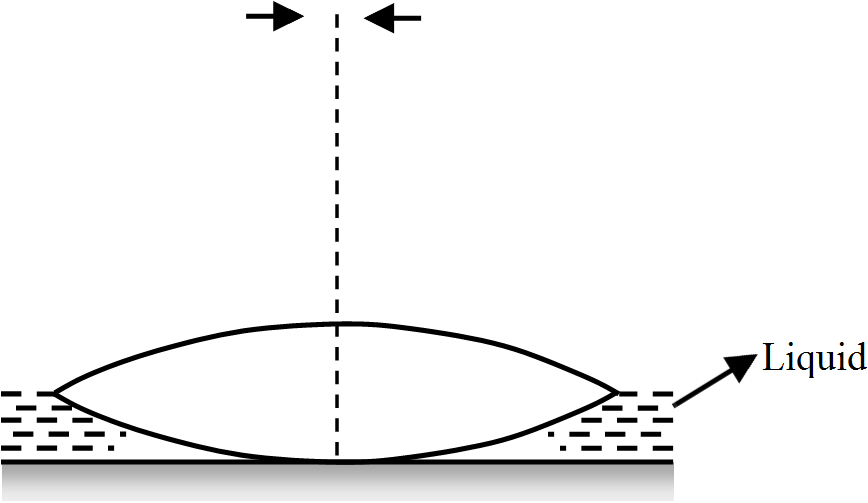
- An equiconvex lens with radii of curvature of magnitude r each, is put over a liquid layer poured on top of a plane mirror. A small needle, with its tip on the principal axis of the lens, is moved along the axis until its inverted real image coincides with the needle itself. The distance of the needle from the lens is measured to be 'a'. On removing the liquid layer and repeating the experiment the distance is found to be 'b'.
- If r = 10cm, a = 15cm, b = 10cm, find the refractive index of the liquid.
- 3View SolutionA 4.5 cm needle is placed 12 cm away from a convex mirror of focal length 15 cm. Give the location of the image and the magnification. Describe what happens as the needle is moved farther from the mirror.
- 4View SolutionHow is the working of a telescope different from that of a microscope?
The focal lengths of the objective and eyepiece of a microscope are 1.25 cm and 5 cm respectively. Find the position of the object relative to the objective in order to obtain an angular magnification of 30 in normal adjustment. - 5Light is incident from glass $(\mu=1.50)$ to water $(\mu=1.33).$ Find the range of the angle of deviation for which there are two angles of incidence.View Solution
- 6View Solution
- Draw a labelled ray diagram to show the formation of image in an astronomical telescope for a distant object.
- Write three distinct advantages of a reflecting type telescope over a refracting type telescope.
- A convex lens of focal length 10 cm is placed coaxially 5 cm away from a concave lens of focal length 10 cm. If an object is placed 30 cm in front of the convex lens, find the position of the final image formed by the combined system.
- 7View SolutionA person with a normal near point (25 cm) using a compound microscope with objective of focal length 8.0 mm and an eyepiece of focal length 2.5 cm can bring an object placed at 9.0 mm from the objective in sharp focus. What is the separation between the two lenses? Calculate the magnifying power of the microscope.
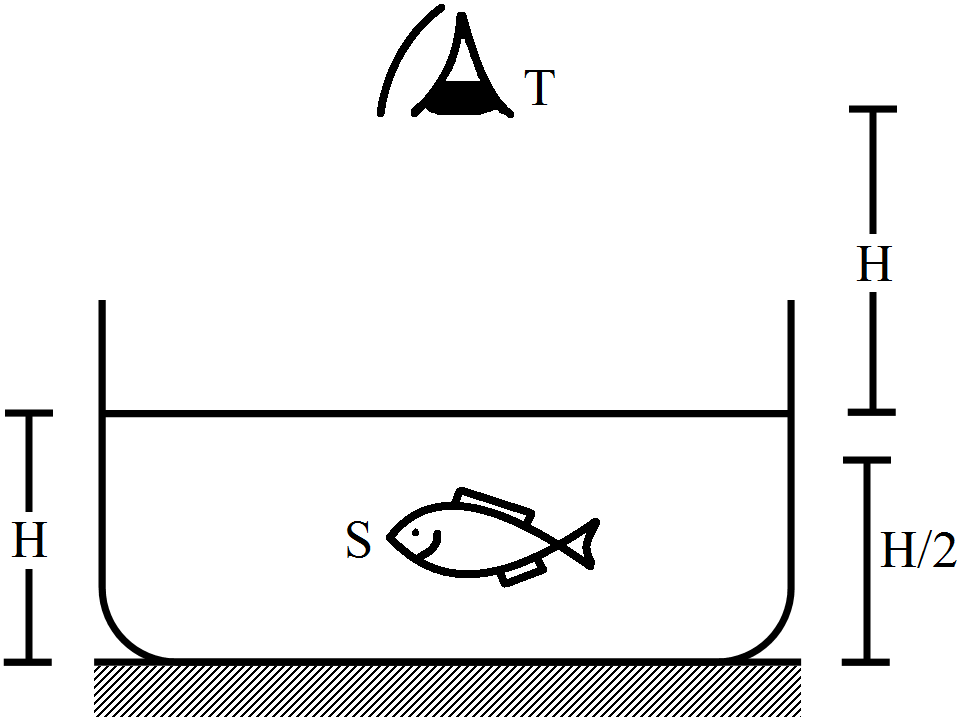
- 8View SolutionConsider the situation in figure. The bottom of the pot is a reflecting plane mirror, S is a small fish and T is a human eye. Refractive index of water is.
- At what distance(s) from itself will the fish see the image(s) of the eye?
- At what distance(s) from itself will the eye see the image(s) of the fish.
- 9For a glass prism $(\mu=\sqrt{3})$ the angle of minimum deviation is equal to the angle of the prism. Find the angle of the prism.View Solution
- 10A thin lens made of a material of refractive index $\mu_2$ has a medium of refractive index $\mu_1$ on one side and a medium of refractive index $\mu_3$ on the other side. The lens is biconvex and the two radii of curvature have equal magnitude R. A beam of light travelling parallel to the principal axis is incident on the lens. Where will the image be formed if the beam is incident from:View Solution
- The medium $\mu_1$
- From the medium $\mu_3?$