MCQ
Pressure gradient has the same dimension as that of
  • A
    Velocity gradient
  • B
    Potential gradient
  • C
    Energy gradient
  • None of these

Answer

Correct option: D.
None of these
d
(d) Velocity gradient $ = \frac{v}{x} = \frac{{[L{T^{ - 1}}]}}{{[L]}} = [{T^{ - 1}}]$

Potential gradient$ = \frac{V}{x} = \frac{{[M{L^2}{T^{ - 3}}{A^{ - 1}}]}}{{[L]}}$$ = [ML{T^{ - 3}}{A^{ - 1}}]$

Energy gradient $ = \frac{E}{x} = \frac{{[M{L^2}{T^2}]}}{{[L]}} = [ML{T^{ - 2}}]$

and pressure gradient$ = \frac{P}{x} = \frac{{[M{L^{ - 1}}{T^{ - 2}}]}}{{[L]}} = [M{L^{ - 2}}{T^{ - 2}}]$

Need a full question paper?

Generate a complete, print-ready paper with questions like this in minutes — across 16+ boards, with answer keys.
Start Generating Free

Similar questions

 A lorry and a car moving with the same $K.E.$  are brought to rest by applying the same retarding force, then
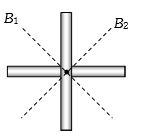
Two identical rods each of mass $M$. and length $l$ are joined in crossed position as shown in figure. The moment of inertia of this system about a bisector would be 
A ball is projected at an angle $45^o$ with horizontal. It passes through a wall of height $h$  at horizontal distance $d_1$ from the point of projection and strikes the ground at a  horizontal distance $(d_1 + d_2)$ from the point of projection, then $h$ is
At a given temperature if ${V_{rms}}$ is the root mean square velocity of the molecules of a gas and ${V_s}$ the velocity of sound in it, then these are related as $\left( {\gamma = \frac{{{C_P}}}{{{C_v}}}} \right)$
In case of a freely falling body, the ratio of kinetic energy at the end of the third second increase in kinetic energy in the next three seconds is:
A closed organ pipe and an open pipe of same length produce $4$ beats when they are set into vibrations simultaneously. If the length of each of them were twice their initial lengths, the number of beats produced will be
Given : $\vec A\, = \,2\hat i\, + \,p\hat j\, + q\hat k$ and $\vec B\, = \,5\hat i\, + \,7\hat j\, + 3\hat k,$ if $\vec A\,||\,\vec B,$ then the values of $p$ and $q$ are, respectively
$Assertion :$ Melting of solid causes no change in internal energy.
$Reason :$ Latent heat is the heat required to melt a unit mass of solid.
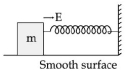
A block of mass ' $m$ ' (as shown in figure) moving with kinetic energy $E$ compresses a spring through a distance $25\,cm$ when, its speed is halved. The value of spring constant of used spring will be $nE\; Nm ^{-1}$ for $n=$
Internal forces can change: