Question
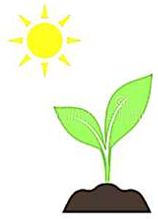
Read the following passage and answer the questions given below: elation between the height of the plant $\left(y^{\prime}\right.$ in cm $)$ with respect to its exposure to is governed by the following equation $y=4 x-\frac{1}{2} x^2$, where ' $x$ ' is the number of days exposed to the sunlight, for $x \leq 3$
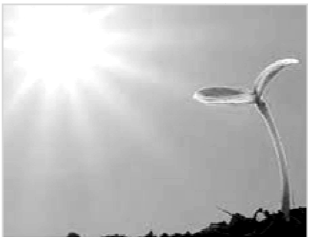
Image

(i) Find the rate of growth of the plant with respect to the number of days exposed to the sunlight.

(ii) Does the rate of growth of the plant increase or decrease in the first three days?
What will be the height of the plant after 2 days?
Answer

$y=4 x-\frac{1}{2} x^2$

(i) The rate of growth of the plant with respect to the number of days exposed to sunlight is given by $\frac{d y}{d x}=4-x$

(ii) Let rate of growth be represented by the function $g(x)=\frac{d y}{d x}$

Now, $g^{\prime}(x)=\frac{d}{d x}\left(\frac{d y}{d x}\right)=-1<0$

$\Rightarrow g(x)$ decreases.

So the rate of growth of the plant decreases for the first three days.

Height of the plant after 2 days is $y=4 \times 2-\frac{1}{2}(2)^2=6 \mathrm{~cm}$.

Need a full question paper?

Generate a complete, print-ready paper with questions like this in minutes — across 16+ boards, with answer keys.

Start Generating Free

Similar questions

Consider the mapping $f: A \rightarrow B$ is defined by $f(x) = x - $1 such that $f$ is a bijection.
Based on the above information, answer the following questions.
  1. Domain of $f$ is:
  1. $R - \{2\}$
  2. $R$
  3. $R -\{1, 2\}$
  4. $R - \{0\}$
  1. Range of $f$ is:
  1. $R$
  2. $R - \{2\}$
  3. $R -\{0\}$
  4. $R - \{1, 2\}$
  1. If $g: R - \{2\} \rightarrow R - \{1\}$ is defined by $g(x) = 2f(x) - 1,$ then $g(x)$ in terms of $x$ is:
  1. $\frac{\text{x}+2}{\text{x}}$
  2. $\frac{\text{x}+1}{\text{x}-2}$
  3. $\frac{\text{x}-2}{\text{x}}$
  4. $\frac{\text{x}}{\text{x}-2}$
  1. The function g defined above, is:
  1. One-one
  2. Many-one
  3. into
  4. None of these
  1. A function $f(x)$ is said to be one-one iff.
  1. $f(x_1) = f(x_2) \Rightarrow -x_1= x_2$ 
  2. $f(-x_1) = f(-x_2) \Rightarrow -x_1 = x_2$ 
  3. $f(x_1) = f(x_2) \Rightarrow x_1 = x_2$ 
  4. None of these
Read the following text carefully and answer the questions that follow:
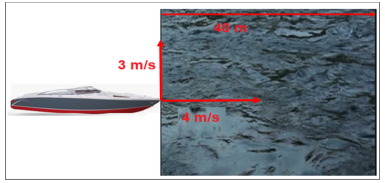
Once Ramesh was going to his native place at a village near Agra. From Delhi and Agra he went by flight, In the way, there was a river. Ramesh reached the river by taxi. Then Ramesh used a boat for crossing the river. The boat heads directly across the river $40 m$ wide at $4 m/s$. The current was flowing downstream at $3 m/s.$
Image
$i.$ What is the resultant velocity of the boat? $(1)$
$ii$. How much time does it take the boat to cross the river? $(1)$
$iii$. How far downstream is the boat when it reaches the other side? $(2)$​​​​​​​
OR
If speeds of boat and current were $1.5 m/s$ and $2.0 m/s$ then what will be resultant velocity? $(2)$
If y = f(u) is a differentiable function of u and u = g(x) is a differentiable function of x, then y = f(g(x)] is a differentiable function of x and $\frac{\text{dy}}{\text{dx}}=\frac{\text{dy}}{\text{du}}\times\frac{\text{du}}{\text{dx}}.$ This rule is also known as CHAIN RULE.
Based on the above information, find the derivative of functions w.r.t. x in the following questions.
  1. $\cos\sqrt{\text{x}}$
  1. $\frac{-\sin\sqrt{\text{x}}}{2\sqrt{\text{x}}}$
  2. $\frac{\sin\sqrt{\text{x}}}{2\sqrt{\text{x}}}$
  3. $\sin\sqrt{\text{x}}$
  4. $-\sin\sqrt{\text{x}}$
  1. $7^{\text{x}+\frac{1}{\text{x}}}$
  1. $\Big(\frac{\text{x}^2-1}{\text{x}^2}\Big)\cdot7^{\text{x}+\frac{1}{\text{x}}}\cdot\log7$
  2. $\Big(\frac{\text{x}^2+1}{\text{x}^2}\Big)\cdot7^{\text{x}+\frac{1}{\text{x}}}\cdot\log7$
  3. $\Big(\frac{\text{x}^2-1}{\text{x}^2}\Big)\cdot7^{\text{x}-\frac{1}{\text{x}}}\cdot\log7$
  4. $\Big(\frac{\text{x}^2+1}{\text{x}^2}\Big)\cdot7^{\text{x}-\frac{1}{\text{x}}}\cdot\log7$
  1. $\sqrt\frac{{1-\cos\text{x}}}{1+\cos\text{x}}$
  1. $\frac{1}{2}\sec^2\frac{\text{x}}{2}$
  2. $-\frac{1}{2}\sec^2\frac{\text{x}}{2}$
  3. $\sec^2\frac{\text{x}}{2}$
  4. $-\sec^2\frac{\text{x}}{2}$
  1. $\frac{1}{\text{b}}\tan^{-1}\Big(\frac{\text{x}}{\text{b}}\Big)+\frac{1}{\text{a}}\tan^{-1}\Big(\frac{\text{x}}{\text{a}}\Big)$
  1. $\frac{-1}{\text{x}^2+\text{b}^2}+\frac{1}{\text{x}^2+\text{a}^2}$
  2. $\frac{1}{\text{x}^2+\text{b}^2}+\frac{1}{\text{x}^2+\text{a}^2}$
  3. $\frac{1}{\text{x}^2+\text{b}^2}-\frac{1}{\text{x}^2+\text{a}^2}$
  4. None of these.
  1. $\sec^{-1}\text{x}+\text{cosec}^{-1}\frac{\text{x}}{\sqrt{\text{x}^2-1}}$
  1. $\frac{2}{\sqrt{\text{x}^2-1}}$
  2. $\frac{-2}{\sqrt{\text{x}^2-1}}$
  3. $\frac{1}{|\text{x}|\sqrt{\text{x}^2-1}}$
  4. $\frac{2}{|\text{x}|\sqrt{\text{x}^2-1}}$
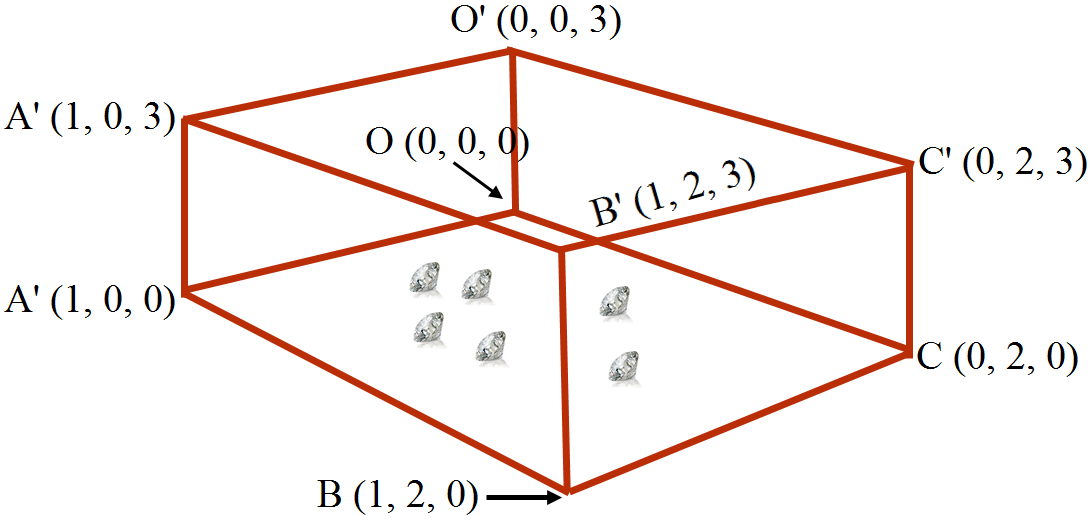
In a diamond exhibition, a diamond is covered in cubical glass box having coordinates O(0, 0, 0), A(1, 0, 0), B(1, 2, 0), C(0, 2, 0), O'(0, 0, 3), A'(1, 0, 3), B'(1, 2, 3) and C'(0, 2, 3). Based on the above information, answer the following questions.
  1. Direction ratios of OA are:
  1. < 0, 1, 0 >
  2. < 1, 0, 0 >
  3. < 0, 0, 1 >
  4. None of these
  1. Equation of diagonal OB' is:
  1. $\frac{\text{x}}{1}=\frac{\text{y}}{2}=\frac{\text{z}}{3}$
  2. $\frac{\text{x}}{0}=\frac{\text{y}}{1}=\frac{\text{z}}{2}$
  3. $\frac{\text{x}}{1}=\frac{\text{y}}{0}=\frac{\text{z}}{2}$
  4. None of these
  1. Equation of plane OABC is:
  1. x = 0
  2. y = 0
  3. z = 0
  4. None of these
  1. Equation of plane O' A' B' C' is:
  1. x = 3
  2. y = 3
  3. z = 3
  4. z = 2
  1. Equation of plane ABB' A' is:
  1. x = 1
  2. y = 1
  3. z = 2
  4. x = 3
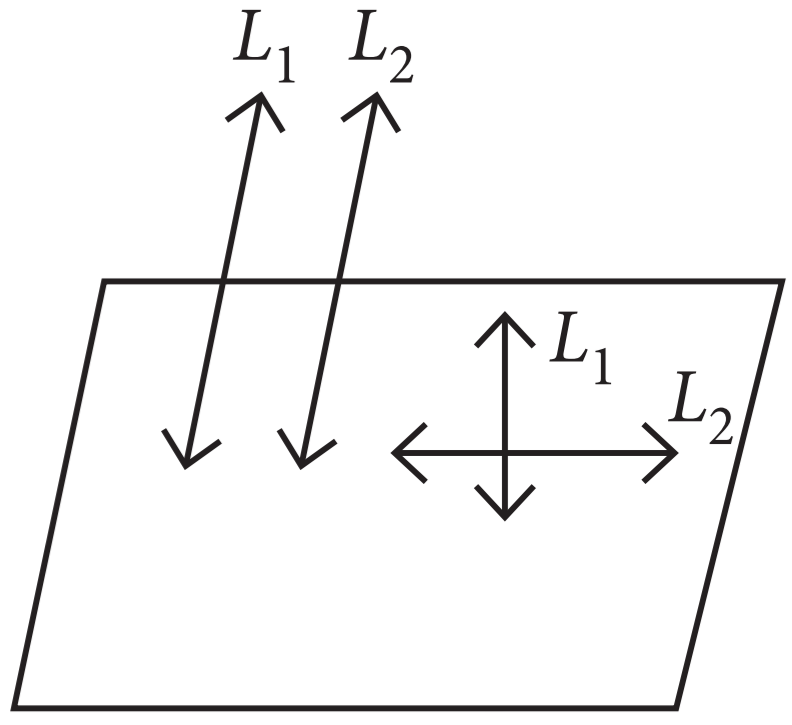
If $a_{1,} b_{1,} c_{1,}$ and $a_{2,}b_{2,} c_2$ are direction ratios of two lines say $L_1$ and $L_2$ respectively. Then $L_1 || L_2$ iff $\frac{\text{a}_1}{\text{a}_2}=\frac{\text{b}_1}{\text{b}_2}=\frac{\text{c}_1}{\text{c}_2}$ and $\text{L}_1\perp\text{L}_2$ iff $a_1a_2 + b_1b_2 + c_1c_2 = 0.$

 Based on the above information, answer the following questions.
  1. If $l_{1,} m_1, n_{1,}$ and $l_2, m_2, n_2$ are the direction cosines of $L_1$ and $L_2$ respectively, then $L_1$ will be perpendicular to $L_2$, iff:
  1. $l_1l_2 + m_1m_2 + n_1n_2 = 0$
  2. $l_1m_2 + m_1l_2 + n_1n_2 = 0$
  3. $\frac{\text{l}_1}{\text{l}_2}=\frac{\text{m}_1}{\text{m}_2}=\frac{\text{n}_1}{\text{n}_2}$
  4. None of these
  1. If $l_1, m_1, n_1$ and $l_2, m_2, n_2$ are direction cosines of $L_1$ and $L_2$ respectively, then $L_1$ will be parallel to $L_2,$ iff:
  1. $l_1l_2 + m_1m_2 + n_1n_2 = 0$
  2. $l_1m_2 + m_1l_2 + n_1n_2 = 0$
  3. $\frac{\text{l}_1}{\text{l}_2}=\frac{\text{m}_1}{\text{m}_2}=\frac{\text{n}_1}{\text{n}_2}$
  4. $m_1n_2 + m_2n_2 + l_1l_2 = 0$
  1. The coordinates of the foot of the perpendicular drawn from the point $A(1, 2, 1)$ to the line joining $B(1, 4, 6)$ and $C(5, 4, 4),$ are:
  1. $(1, 2, 1)$
  2. $(2, 4, 5)$
  3. $(3, 4, 5)$
  4. $(3, 4, 5)$
  1. The direction ratios of the line which is perpendicular to the lines with direction ratios proportional to $(1, -2, -2)$ and $(0, 2, 1)$ are:
  1. $< 1, 2, 1 >$
  2. $< 2,-1, 2 >$
  3. $< -1,2, 2 >$
  4. None of these
  1. The lines $\frac{\text{x}-2}{3}=\frac{\text{y}+1}{-2}=\frac{\text{z}-2}{0}$ and $\frac{\text{x}-1}{1}=\frac{\frac{\text{y}+3}{2}}{\frac{3}{2}}=\frac{\text{z}+5}{2}$ are:
  1. Parallel.
  2. Perpendicular.
  3. Skew lines.
  4. Non-intersecting.
A differential equation is said to be in the variable separable form if it is expressible in the form $f(x) dx = g(y)$ dy.
The solution of this equation is given by
$\int\text{f(x)dx}=\int\text{g(y)dy}+\text{c},$ where c is the constant of integration.
Based on the above information, answer the following questions.
  1. If the solution of the differential equation $\frac{\text{dy}}{\text{dx}}=\frac{\text{ax+3}}{\text{2y+f}}$ represents a circle, then the value of $'a'$ is:
  1. $2$
  2. $-2$
  3. $3$
  4. $-4$
  1. The differential equation $\frac{\text{dy}}{\text{dx}}=\frac{\sqrt{1-\text{y}^2}}{\text{y}}$ determines a family of circle with.
  1. Variable radii and fixed centre $(0, 1)$
  2. Variable radii and fixed centre $(0, -1)$
  3. Fixed radius 1 and variable centre on $x-$axis
  4. Fixed radius 1 and variable centre on $y-$axis
  1. If $= y'+ 1, y(0) = 1,$ then $y ($In $2) =$
  1. $1$
  2. $2$
  3. $3$
  4. $4$
  1. The solution of the differential equation $\frac{\text{dy}}{\text{dx}}=\text{e}^\text{x-y}+\text{x}^2\text{e}^\text{-y}$ is:
  1. $\text{e}^\text{x}=\frac{\text{y}^3}{3}+\text{e}^\text{y}+\text{c}$
  2. $\text{e}^\text{y}=\frac{\text{x}^2}{3}+\text{e}^\text{x}+\text{c}$
  3. $\text{e}^\text{y}=\frac{\text{x}^3}{3}+\text{e}^\text{x}+\text{c}$
  4. None of these
  1. If $\frac{\text{dy}}{\text{dx}}=\text{y}\sin2\text{x},\ \text{y}(0)=1,$ then its solution is:
  1. $\text{y}=\text{e}^{\sin^2}\text{x}$
  2. $\text{y}={\sin^2}\text{x}$
  3. $\text{y}={\cos^2}\text{x}$
  4. $\text{y}=\text{e}^{\cos^2}\text{x}$
The relation between the height of the plant ( $\mathrm{y}$ in $\mathrm{cm}$ ) with respect to exposure to sunlight is governed by the following equation $\mathrm{y}=4 \mathrm{x}-\frac{1}{2} \mathrm{x}^2$ where $\mathrm{x}$ is the number of days exposed to sunlight.

Image

(i) Find the rate of growth of the plant with respect to sunlight.

(ii) What is the number of days it will take for the plant to grow to the maximum height?

(iii) Verify that height of the plant is maximum after four days by second derivative test and find the maximum height of plant.

OR

What will be the height of the plant after 2 days?

If an equation is of the form $\frac{\text{dy}}{\text{dx}}+\text{Py}=\text{Q},$ where P, Qare functions of x, then such equation is known as linear differential equation. Its solution is given by
$\text{y}\times\text{(I.F.)}=\int\text{Q}\times\text{(I.F.)}\text{dx}+\text{c},$ where $\text{I.F.}=\text{e}^{\int\text{pdx}}.$
Now, suppose the given equation is $(1+\sin\text{x})\frac{\text{dy}}{\text{dx}}+\text{y}\cos\text{x}+\text{x}=0.$
Based on the above information, answer the following questions.
  1. The value of P and Q respectively are:
  1. $\frac{\sin\text{x}}{1+\cos\text{x}},\ \frac{\text{x}}{1+\sin\text{x}}$
  2. $\frac{\cos\text{x}}{1+\sin\text{x}},\ \frac{\text{-x}}{1+\sin\text{x}}$
  3. $\frac{-\cos\text{x}}{1+\sin\text{x}},\ \frac{\text{x}}{1+\sin\text{x}}$
  4. $\frac{\cos\text{x}}{1+\sin\text{x}},\ \frac{\text{x}}{1+\sin\text{x}}$
  1. The value of I.F is:
  1. $1-\sin\text{x}$
  2. $\cos\text{x}$
  3. $1+\sin\text{x}$
  4. $1-\cos\text{x}$
  1. Solution of given equation is:
  1. $\text{y}(1-\sin\text{x})=\text{x+c}$
  2. $\text{y}(1+\sin\text{x})=-\text{x}^2+\text{c}$
  3. $\text{y}(1-\sin\text{x})=\frac{\text{-x}^2}{2}\text{+c}$
  4. $\text{y}(1+\sin\text{x})=\frac{\text{-x}^2}{2}\text{+c}$
  1. If y(0) = 1, then y equals
  1. $\frac{2-\text{x}^2}{2(1+\sin\text{x})}$
  2. $\frac{2+\text{x}^2}{2(1+\sin\text{x})}$
  3. $\frac{2-\text{x}^2}{2(1-\sin\text{x})}$
  4. $\frac{2+\text{x}^2}{2(1-\sin\text{x})}$
  1. Value of is $\text{y}\Big(\frac{\pi}{2}\Big)$ is:
  1. $\frac{4-\pi^2}{2}$
  2. $\frac{8-\pi^2}{16}$
  3. $\frac{8-\pi^2}{4}$
  4. $\frac{4+\pi^2}{2}$
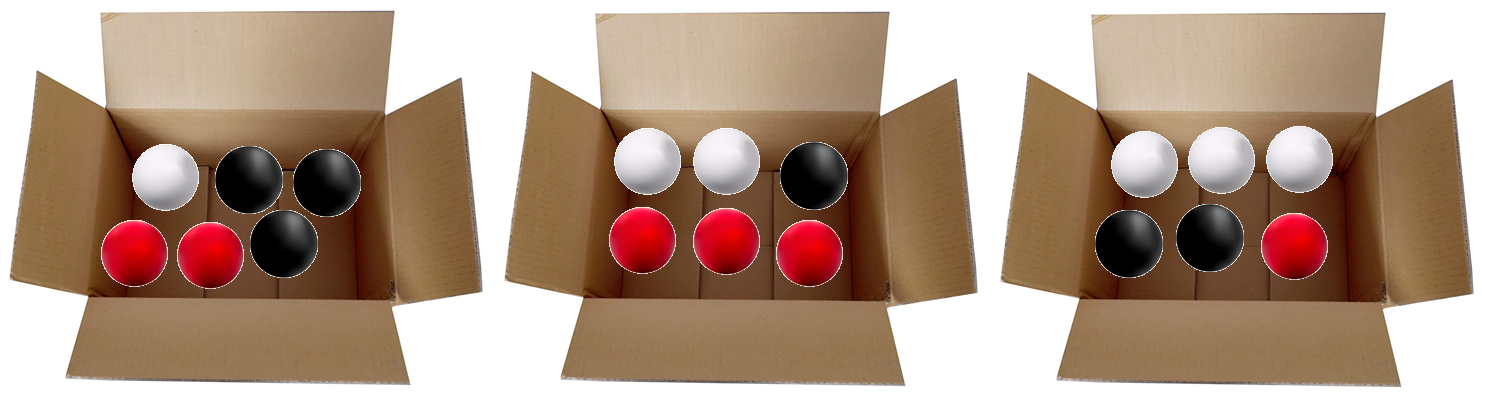
Box I contains $1$ white, $3$ black and $2$ red balls. Box II contains $2$ white, $1$ black and $3$ red balls. Box III contains $3$ white, $2$ black and $1$ red balls. One box is chosen at random and two balls are drawn with replacement.


If $E_1, E_2, E_3$ be the events that the balls drawn from box $I,$ box $II$ and box $III$ respectively and $E$ be the event that balls drawn are one white and one red, then answer the following questions.
  1. Probability of occurrence of event $E$ given that the balls drawn are from box I, is:
  1. $\frac{1}{9}$
  2. $\frac{2}{6}$
  3. $\frac{3}{5}$
  4. $\frac{1}{7}$
  1. Probability of occurrence of event $E$, given that the balls drawn are from box II, is:
  1. $\frac{1}{3}$
  2. $\frac{1}{4}$
  3. $\frac{3}{4}$
  4. $\frac{3}{5}$
  1. Probability of occurrence of event $E,$ given that balls drawn are from box III, is:
  1. $\frac{1}{12}$
  2. $\frac{3}{11}$
  3. $\frac{1}{6}$
  4. $\frac{4}{11}$
  1. The value of $\displaystyle{\sum^3_{\text{i}=1}}\text{P(E}|\text{E}_\text{i})$ is equal to.
  1. $\frac{5}{18}$
  2. $\frac{1}{2}$
  3. $\frac{1}{18}$
  4. $\frac{11}{18}$
  1. The probability that the balls drawn are from box II, given that event $E$ has already occurred, is:
  1. $\frac{1}{11}$
  2. $\frac{6}{11}$
  3. $\frac{5}{11}$
  4. None of these
DETERMINANTS: A determinant is a square array of numbers (written within a pair of vertical lines) which represents a certain sum of We can solve a system of equations using determinants, but it becomes very tedious for large systems. We will only do 2 × 2 and 3 × 3 systems using determinants. Using the properties of determinants solve the problem given below and answer the questions that follow:
Three shopkeepers Ram Lal, Shyam Lal, and Ghansham are using polythene bags, handmade bags (prepared by prisoners), and newspaper's envelope as carry bags. It is found that the shopkeepers Ram Lal, Shyam Lal, and Ghansham are using (20, 30, 40), (30, 40, 20), and (40, 20, 30) polythene bags, handmade bags, and newspapers envelopes respectively. The shopkeepers Ram Lal, Shyam Lal, and Ghansham spent ₹250, ₹270, and ₹200 on these carry bags respectively.
  1. What is the cost of one polythene bag?
  1. ₹ 1
  2. ₹ 2
  3. ₹ 3
  4. ₹ 5
  1. What is the cost of one handmade bag?
  1. ₹1
  2. ₹2
  3. ₹3
  4. ₹5
  1. What is the cost of one newspaper bag?
  1. ₹1
  2. ₹2
  3. ₹3
  4. ₹5
  1. Keeping in mind the social conditions, which shopkeeper is better?
  1. Ram Lal
  2. Shyam Lal
  3. Ghansham
  4. None of these
  1. Keeping in mind the environmental conditions, which shopkeeper is better?
  1. Ram Lal
  2. Shyam Lal
  3. Ghansham
  4. None of these