Question
Read the passage given below and answer the following questions from (i) to (v).
First complete data on pressure-volume-Temperature relations of a substance in bothGaseous and liquid state was obtained byThomas Andrews on Carbon dioxide. He plottedlsotherms of carbon dioxide at variousTemperatures.
Later on it was found That real gases behave in the same manner asCarbon dioxide. Andrews noticed that at highTemperatures isotherms look like that of anldeal gas and the gas cannot be liquified even atVery high pressure. As the temperature isLowered, shape of the curve changes and dataShow considerable deviation from idealBehaviour. At $30.98^{\circ} C$ carbon dioxide remainsGas upto 73 atmospheric pressure. At 73 atmospheric pressure, liquidCarbon dioxide appears for the first time. TheTemperature $30.98^{\circ} C$ is called criticalTemperature (TC) of carbon dioxide. This is theHighest temperature at which liquid carbonDioxide is observed. Above this temperature itls gas. Volume of one mole of the gas at criticalTemperature is called critical volume $\left( V _{ c }\right)$ andPressure at this temperature is called criticalPressure (pc). The critical temperature, pressureand volume are called critical constants. A gasBelow the critical temperature can be liquifiedBy applying pressure, and is called vapour ofThe substance. Carbon dioxide gas below itsCritical temperature is called carbon dioxideVapour.
Intermolecular forces are stronger in liquidState than in gaseous state. Molecules in liquidsAre so close that there is very little empty space between them and under normal conditionsLiquids are denser than gases.Molecules of liquids are held together byAttractive intermolecular forces. Liquids haveDefinite volume because molecules do notSeparate from each other. However, moleculesOf liquids can move past one another freely, Therefore, liquids can flow, can be poured andCan assume the shape of the container in whichThese are stored. If an evacuated container is partially filled withA liquid, a portion of liquid evaporates to fillthe remaining volume of the container withVapour. Initially the liquid evaporates andPressure exerted by vapours on the walls of The container (vapour pressure) increases. AfterSome time it becomes constant, an equilibriumls established between liquid phase andVapour phase. Vapour pressure at this stagels known as equilibrium vapour pressure orSaturated vapour pressure.. Since process ofVapourisation is temperature dependent; the Temperature must be mentioned whilereporting the vapour pressure of a liquid.
When a liquid is heated in an open vessel,The liquid vapourises from the surface. At theTemperature at which vapour pressure of theLiquid becomes equal to the external pressure,Vapourisation can occur throughout the bulkOf the liquid and vapours expand freely intoThe surroundings. The condition of freeVapourisation throughout the liquid is calledBoiling. The temperature at which vapourPressure of liquid is equal to the externalPressure is called boiling temperature at thatPressure. At 1 atm pressure boilingTemperature is called normal boiling point.If pressure is 1 bar then the boiling point isCalled standard boiling point of the liquid. Standard boiling point of the liquid is slightlyLower than the normal boiling point because 1 bar pressure is slightly less than 1 atmPressure . The normal boiling point of water is $100^{\circ} C (373 K)$, its standard boiling point is $99.6^{\circ} C (372.6 K)$.At high altitudes atmospheric pressure isLow. Therefore liquids at high altitudes boil atLower temperatures in comparison to that atSea level. Since water boils at low temperatureOn hills, the pressure cooker is used forCooking food. In hospitals surgical instrumentsAre sterilized in autoclaves in which boilingPoint of water is increased by increasing thePressure above the atmospheric pressure byUsing a weight covering the vent.Boiling does not occur when liquid isHeated in a closed vessel. On heatingContinuously vapour pressure increases.
AtFirst a clear boundary is visible between liquidAnd vapour phase because liquid is more denseThan vapour. As the temperature increases more and more molecules go to vapour phaseAnd density of vapours rises. At the same timeLiquid becomes less dense. It expands becauseMolecules move apart. When density of liquidAnd vapours becomes the same; the clearBoundary between liquid and vapoursDisappears. This temperature is called critical Temperature.
  1. First complete data on Pressure-Volume-Temperature relations of a substance in both Gaseous and liquid state was obtained by:
  1. Thomas Andrews
  2. Fritz London
  3. Robert Boyle
  4. Joseph Lewis Gay Lussac
  1. Critical Temperature (TC) of carbon dioxide is.....
  1. $24^\circ C$
  2. $30.8^\circ C$
  3. $56^\circ C$
  4. $29^\circ C$
  1. The condition of free Vapourisation throughout the liquid is called …
  1. Evaporation
  2. Melting
  3. Boiling
  4. None of above
  1. Standard boiling point of Water is....
  1. $100^\circ C$
  2. $3^\circ C$
  3. $105^\circ C$
  4. $99.6^\circ C$
  1. Boundary between liquid and vapours Disappears,This temperature is called
  1. Critical temperature
  2. Absolute temperature
  3. Normal temperature
  4. Boiling temperature

Answer

  1. (a) Thomas Andrews
  1. (b) $30.8^\circ C$
  1. (c) Boiling
  1. (d) $99.6^\circ C$
  1. (a) Critical temperature

Need a full question paper?

Generate a complete, print-ready paper with questions like this in minutes — across 16+ boards, with answer keys.

Start Generating Free

Similar questions

Read the passage given below and answer the following questions from (i) to (vi).
The atomic theory of matter was first proposed on afirm scientific basis by JohnDalton, a British schoolteacher in 1808. His theory, called Dalton’s atomictheory, regarded the atom as the ultimate particle ofmatter Dalton’s atomic theory was able to explainthe law of conservation of mass, law of constantcomposition and law of multiple proportion verysuccessfully. However, it failed to explain the results ofmany experiments.In mid 1850s many scientists mainlyFaraday began to study electrical dischargein partially evacuated tubes, known ascathode ray discharge tubes.Electrical discharge carried out in the modifiedcathode ray tube led to the discovery of canalrays carrying positively charged particles. Thecharacteristics of these positively chargedparticles are listed below.
  1. Unlike cathode rays, mass of positivelycharged particles depends upon thenature of gas present in the cathode raytube. These are simply the positivelycharged gaseous ions.
  2. The charge to mass ratio of the particlesdepends on the gas from which theseoriginate.
  3. Some of the positively charged particlescarry a multiple of the fundamental unitof electrical charge.
  4. The behaviour of these particles in themagnetic or electrical field is opposite tothat observed for electron or cathoderays.
The smallest and lightest positive ion wasobtained from hydrogen and was called
proton. This positively charged particle wascharacterised in 1919. Later, a need was feltfor the presence of electrically neutral particleas one of the constituent of atom. Theseparticles were discovered by Chadwick (1932)by bombarding a thin sheet of beryllium byα-particles. When electrically neutral particleshaving a mass slightly greater than that ofprotons were emitted. He named theseparticles as neutrons.J. J. Thomson, in 1898, proposed that an atom possesses a spherical shape (radiusapproximately 10–10 m) in which the positivecharge is uniformly distributed. The electronsare embedded into it in such a manner as togive the most stable electrostatic arrangementMany different names are given tothis model, for example, plum pudding, raisinpudding or watermelon. This model can be visualised as a pudding or watermelon ofpositive charge with plums or seeds (electrons)embedded into it. An important feature of thismodel is that the mass of the atom is assumed to be uniformly distributed over theatom.Rutherford and his students (Hans Geiger andErnest Marsden) bombarded very thin gold foilwith α–particles. Rutherford’s famous α–particle scattering experiment.The observations of Scattering experiment are as follows-:
  1. most of the α–particles passed throughthe gold foil undeflected.
  2. a small fraction of the α–particles wasdeflected by small angles.
  3. a very few α–particles (∼1 in 20,000)bounced back, that is, were deflected bynearly 180°.
On the basis of observations andconclusions from this experiment, Rutherford proposed the nuclearmodel of atom. According to this model:
  1. The positive charge and most of the massof the atom was densely concentrated inextremely small region. This very smallportion of the atom was called nucleusby Rutherford.
  2. The nucleus is surrounded by electronsthat move around the nucleus with a veryhigh speed in circular paths called orbits.Thus, Rutherford’s model of atomresembles the solar system in which thenucleus plays the role of sun and theelectrons that of revolving planets.
  3. Electrons and the nucleus are held together by electrostatic forces of attraction.
  1. The atomic theory of matter was first proposed on afirm scientific basis by:
  1. John Dalton
  2. Ernest Rutherford
  3. J.Thomson
  4. Henry Moseley
  1. The cathode rays start from … and move towards the….
  1. Anode, Cathode
  2. Centre, Anode
  3. Cathod, Anode
  4. Cathod, Centre
  1. Negativelycharged particles in atoms, called…
  1. Protons
  2. Electrons
  3. Neutron
  4. Positron
  1. The smallest and lightest positive ion wasobtained from …. and was called proton.
  1. Oxygen
  2. Nitrogen
  3. Carbon
  4. Hydrogen
  1. Electrically neutral particles having a mass slightly greater than that of protons, these particles termed as:
  1. Protons
  2. Electrons
  3. Neutron
  4. Positron
  1. J.J. Thomson’s atomic model is also named as:
  1. Plum pudding
  2. Raisin pudding
  3. Watermelon
  4. All the above
Read the passage given below and answer the following questions from $1$ to $5.$
Quantitative measurement of properties isreaquired for scientific investigation. Earlier, two different systems of measurement, i.e., the English System and the Metric System were being used indifferent parts of the world. The metric system, which originated in France in late eighteenth century. The SI system has seven base units. these are listed as follow.
 
Base Physical Quantities
Unit
1
Length
Metre – m
2
Mass
Kilogram – kg
3
Time
Second – s
4
Electric current
Ampere- A
5
Thermodynamic Temperature
Kelvin – K
6
Amount of substance
Mole – mol
7
Luminous intensity
Candela- cd
Here, Mass of a substance is the amount of matter present in it, while weight is the force exerted by gravity on an object. Density of a substance is its amount of mass per unit volume. The mole, symbol mol, is the SI unit of amount of substance. One mole contains exactly $6.02214076 \times 10^{23}$ elementary entities. This number is the fixed numerical value of the Avogadro constant, NA, when expressed in the unit per moland is called the Avogadro number. The amount of substance, symbol $n$, of a system is a measure of the number of specified elementary entities. An elementary entity may be an atom, a molecule, an ion, an electron, any other particle or specified group of particles.There are three common scales to measure temperature - ${ }^{\circ} C$ (degree celsius), ${ }^{\circ} F$ (degree fahrenheit) and K (kelvin). Here, K is the Slunit. Generally, the thermometer with celsius scale are calibrated from $0^{\circ}$ to $100^{\circ}$, where these two temperatures are the freezing point and the boiling point of water, respectively. The fahrenheit scale is represented between $32^{\circ}$ to $212^{\circ}$.
The temperatures on two scales are related to each other by the following relationship:
$^\circ{F} = 9 (^\circ{C}) + 32$
$5$
The kelvin scale is related to celsius scaleas follows:
$K = ^\circ{C} + 273.15$
  1. The metric system,which originated in … in late eighteenthcentury.
  1. Ukraine
  2. German
  3. Russia
  4. France
  1. The SI system has …. base units.
  1. $7$
  2. $3$
  3. $9$
  4. $1$
  1. The symbol for SI unit of thermodynamic temperature is …
  1. Kelvin
  2. $K$
  3. Degree Celsius
  4. ${}^\circ C$
  1. A prefix giga equivalents to:
  1. $10^9$
  2. $10^{10}$
  3. $10^{11}$
  4. $10^{12}$
  1. The fahrenheit scale is represented between..
  1. $0^\circ F \ to\ 100^\circ F$
  2. $32^\circ F \ to\ 212^\circ .F$
  3. $15^\circ F \ to\ 373^\circ F$
Read the passage given below and answer the following questions from (i) to (v).
Relation between Ka and Kb – Ka and Kb represent the strength of an acid and a base, respectively. In case of a conjugate acid-base pair, they are related in a simple manner so that if one is known, the other can be deduced. Considering the example of $NH_4^+$ and $NH_3$ we see,
${\text{NH}_4}^+{_{(\text{aq})}+\text{H}_2\text{O}_{(\text{l})}}\rightleftharpoons{\text{H}_3\text{O}}{^+}_{(\text{aq})}+\text{NH}_{3(\text{aq})}$
$\text{Ka}=\frac{[\text{H}_3\text{O}^+][\text{NH}_3]}{{[\text{NH}_4}^{+}]}=5.6\times10^{-10}$
$\text{NH}_{3(\text{aq})}+\text{H}_2\text{O}_{(\text{l})}\rightleftharpoons{{\text{NH}_4}^+}_{(\text{aq})}+{\text{OH}^-}_{(\text{aq})}$
$\text{Kb}=\frac{[{\text{NH}_4}^+][\text{OH}^-]}{[\text{NH}_3]}=1.8\times10^{-5}$
$\text{Net}:2{\text{H}_2\text{O}_{(\text{l})}}\rightleftharpoons{\text{H}_3\text{O}}{^+}_{(\text{aq})}+{\text{OH}^-}_{(\text{aq})}$
$\text{Kw}=[\text{H}_3\text{O}^+][\text{OH}^-]=1.0\times10^{-14}\text{M}$
Where, Ka represents the strength of $NH_4^+$ as an acid and Kb represents the strength of $NH_3$ as a base. It can be seen from the net reaction that the equilibrium constant is equal to the product of equilibrium constants Ka and Kb for the reactions added. Thus,
$\text{Ka}\times\text{Kb}=\Big\{\frac{[\text{H}_3\text{O}^+][\text{NH}_3]}{[{\text{NH}_4}^+]}\Big\}\times\Big\{\frac{[{\text{NH}_4}^+][\text{OH}^-]}{[\text{NH}_3]}\Big\}$
$= [H_3O^+ ][ OH^– ] = Kw = (5.6\times 10^{–10}) \times (1.8 \times 10^{–5}) = 1.0 \times 10^{–14} M$
This can be extended to make a generalisation. The equilibrium constant for a net reaction obtained after adding two (or more) reactions equals the product of the equilibrium constants for individual reactions:
$K_{NET} = K1 \times K2 \times$ ……
Similarly, in case of a conjugate acid-base pair,
Ka × Kb = Kw
Knowing one, the other can be obtained. It should be noted that a strong acid will have a weak conjugate base and vice-versa. Alternatively, the above expression
Kw = Ka × Kb, can also be obtained by considering the base-dissociation equilibrium reaction:
$\text{B}_{(\text{aq})}+\text{H}_2\text{O}_{(\text{l})}\rightleftharpoons{\text{BH}^+}_{(\text{aq})}+{\text{OH}^-}_{(\text{aq})}$
$\text{Kb}=\frac{[\text{BH}^+][\text{OH}^-]}{[\text{B}]}$
As the concentration of water remains constant it has been omitted from the denominator and incorporated within the dissociation constant. Then multiplying and dividing the above expression by $[H^+]$, we get:
$\text{Kb}=\frac{[\text{BH}^+][\text{OH}^-][\text{H}^+]}{[\text{B}][\text{H}^+]}$
$=\frac{[\text{OH}^-][\text{H}^+][\text{BH}^+]}{[\text{B}][\text{H}^+]}$
$=\frac{\text{Kw}}{\text{Ka}}$
or Ka × Kb = Kw
It may be noted that if we take negative logarithm of both sides of the equation, then pK values of the conjugate acid and base are related to each other by the equation:
pKa + pKb = pKw = 14 (at 298K)
Factors Affecting Acid Strength Having discussion on quantitatively the strengths of acids and bases, we come to a stage where we can calculate the pH of a given acid solution. But, the curiosity rises about why should some acids be stronger than others? What factors are responsible for making them stronger? The answer lies in its being a complex phenomenon. But, broadly speaking we can say that the extent of dissociation of an acid depends on the strength and polarity of the H-A bond. In general, when strength of H-A bond decreases, that is, the energy required to break the bond decreases, HA becomes a stronger acid. Also, when the H-A bond becomes more polar i.e., the electronegativity difference between the atoms H and A increases and there is marked charge separation, cleavage of the bond becomes easier thereby increasing the acidity. But it should be noted that while comparing elements in the same group of the periodic table, H-A bond strength is a more important factor in determining acidity than its polar nature. As the size of A increases down the group, H-A bond strength decreases and so the acid strength increases. For example,
Size increases
$HF << HCl << HBr << HI$
Acid strength increases
Similarly, $H_2S$ is stronger acid than $H_2O$. But, when we discuss elements in the same row of the periodic table, H-A bond polarity becomes the deciding factor for determining the acid strength. As the electronegativity of A increases, the strength of the acid also increases. For example,
Electronegativity of A increases
$CH4 < NH_3 < H_2O < HF$
Acid strength increases
Common Ion Effect in the Ionization of Acids and Bases Consider an example of acetic acid dissociation equilibrium represented as:
$CH3COOH_{(aq)} H^+_{(aq)} + CH3COO^–_{(aq)}$
or $HAc_{(aq)} H^+_{(aq)} + Ac^–_{(aq)}$
$\text{Ka}=\frac{[\text{H}^+][\text{Ac}^-]}{[\text{HAc}]}$
Addition of acetate ions to an acetic acid solution results in decreasing the concentration of hydrogen ions, $[H^+ ]$. Also, if $H^+$ ions are added from an external source then the equilibrium moves in the direction of undissociated acetic acid i.e., in a direction of reducing the concentration of hydrogen ions, $[H^+]$. This phenomenon is an example of common ion effect. It can be defined as a shift in equilibrium on adding a substance that provides more of an ionic species already present in the dissociation equilibrium. Thus, we can say that common ion effect is a phenomenon based on the Le Chatelier’s principle discussed earlier. In order to evaluate the pH of the solution resulting on addition of 0.05M acetate ion to 0.05M acetic acid solution, we shall consider the acetic acid dissociation equilibrium once again,
$\text{HAc}_{(\text{aq})}\rightleftharpoons{\text{H}^+}_{(\text{aq})}+{\text{Ac}^-}_{(\text{aq})}$
Initial concentration (M)
0.05 0 0.05
Let x be the extent of ionization of acetic acid.
Change in concentration (M)
-x +x +x
Equilibrium concentration (M)
0.05-x. x 0.05+x
Therefore, $\text{Ka}=\frac{[\text{H}^+][\text{Ac}^-]}{\text{HAc}}=\Big\{\frac{(0.05+\text{x})(\text{x})}{(0.05-\text{x})}\Big\}$
As Ka is small for a very weak acid, x<<0.05.
Hence, $(0.05+\text{x})\approx(0.05-\text{x})\approx0.05$
Thus, $=1.8\times10-5=\frac{(\text{x})(0.05+\text{x})}{(0.05-\text{x})}$
$=\frac{\text{x}(0.05)}{(0.05)}=\text{x}=[\text{H}^+]=1.8\times10^{-5}\text{M}$
$\text{pH}=-\log(1.8\times10^{-5})=4.74$
Buffer Solutions Many body fluids e.g., blood or urine have definite pH and any deviation in their pH indicates malfunctioning of the body. The control of pH is also very important in many chemical and biochemical processes. Many medical and cosmetic formulations require that these be kept and administered at a particular pH. The solutions which resist change in pH on dilution or with the addition of small amounts of acid or alkali are called Buffer Solutions. Buffer solutions.
Common Ion Effect on Solubility of Ionic Salts– It is expected from Le Chatelier’s principle that if we increase the concentration of any one of the ions, it should combine with the ion of its opposite charge and some of the salt will be precipitated till once again Ksp = Qsp . Similarly, if the concentration of one of the ions is decreased, more salt will dissolve to increase the concentration of both the ions till once again Ksp = Qsp . This is applicable even to soluble salts like sodium chloride except that due to higher concentrations of the ions, we use their activities instead of their molarities in the expression for Qsp . Thus if we take a saturated solution of sodium chloride and pass HCl gas through it, then sodium chloride is precipitated due to increased concentration (activity) of chloride ion available from the dissociation of HCl. Sodium chloride thus obtained is of very high purity and we can get rid of impurities like sodium and magnesium sulphates. The common ion effect is also used for almost complete precipitation of a particular ion as its sparingly soluble salt, with very low value of solubility product for gravimetric estimation. Thus we can precipitate silver ion as silver chloride, ferric ion as its hydroxide (or hydrated ferric oxide) and barium ion as its sulphate for quantitative estimations.
  1. H-A bond strength … and so the acid strength:
  1. Decreases, increases
  2. Increases, increases
  3. Increases, decreases
  4. Decreases, decreases
  1. As the electronegativity of A … the strength of the acid also:
  1. Decreases, increases
  2. Increases, increases
  3. Increases, decreases
  4. Decreases, decreases
  1. If the concentration of one of the ions is … more salt will dissolve to … the concentration of both the ions till once again Ksp = Qsp.
  1. Decreases, increases
  2. Increases, increases
  3. Increases, decreases
  4. Decreases, decreases
  1. The solutions which resist change in pH on dilution or with the addition of small amounts of acid or alkali are called:
  1. Neutral solution
  2. Basic solution
  3. Acidic solution
  4. Buffer solution
  1. When the H-A bond becomes more polar then the cleavage of the bond becomes easier thereby increasing the:
  1. Acidity
  2. Basicity
  3. Aromaticity
  4. Alkalinity
Read the passage given below and answer the following questions from (i) to (v).
In a chemical reaction, reactants are converted into products and is represented by, Reactants → Products The enthalpy change accompanying a reaction is called the reaction enthalpy. The enthalpy change of a chemical reaction, is given by the symbol $\triangle\text{rH}.$
$\triangle\text{rH}$ = (sum of enthalpies of products) – (sum of enthalpies of reactants)
$\sum\limits_\text{t}\text{a}_{\text{t}}\text{H}_\text{products}-\sum\limits_\text{t}\text{b}_\text{t}\text{H}_\text{reactants}$
Here symbol ∑ (sigma) is used for summation and ai and bi are the stoichiometric coefficients of the products and reactants respectively in the balanced chemical equation. For example, for the reaction
$\text{CH}_4(\text{g})+2\text{O}_2(\text{g})\rightarrow\text{CO}_2(\text{g})+2\text{H}_2\text{O}(\text{l})$
$\triangle_\text{r}\text{H}=\sum\limits_\text{t}\text{a}_{\text{t}}\text{H}_\text{products}-\sum\limits_\text{t}\text{b}_\text{t}\text{H}_\text{reactants}$
$=[\text{H}_\text{m}(\text{CO}_2,\text{g})+2\text{H}_\text{m}(\text{H}_2\text{O},\text{l})]-[\text{H}_\text{m}(\text{CH}_4,\text{g})+2\text{H}_\text{m}(\text{O}_2,\text{g})]$
where $H_m$ is the molar enthalpy. Enthalpy change is a very useful quantity. Knowledge of this quantity is required when one needs to plan the heating or cooling required to maintain an industrial chemical reaction at constant temperature. It is also required to calculate temperature dependence of equilibrium constant.
Standard Enthalpy of Reactions Enthalpy of a reaction depends on the conditions under which a reaction is carried out. It is, therefore, necessary that we must specify some standard conditions. The standard enthalpy of reaction is the enthalpy change for a reaction when all the participating substances are in their standard states. The standard state of a substance at a specified temperature is its pure form at 1 bar. For example, the standard state of liquid ethanol at 298K is pure liquid ethanol at 1 bar; standard state of solid iron at 500K is pure iron at 1 bar. Usually data are taken at 298K. Standard conditions are denoted by adding the superscript 0 to the symbol $\triangle\text{H},$ e.g., $\triangle\text{H}^\phi$
Enthalpy Changes during Phase Transformations Phase transformations also involve energy changes. Ice, for example, requires heat for melting. Normally this melting takes place at constant pressure (atmospheric pressure) and during phase change, temperature remains constant (at 273K).
$\text{H}_2\text{O}(\text{s})\rightarrow\text{H}_2\text{O}(\text{l});\triangle_{\text{fus}}\text{H}^\phi=6.00\text{kJ}\ \text{mol}^{-1}$
Here $\triangle\text{vap}\text{H}^\phi$ is enthalpy of fusion in standard state. If water freezes, then process is reversed and equal amount of heat is given off to the surroundings. The enthalpy change that accompanies melting of one mole of a solid substance in standard state is called standard enthalpy of fusion or molar enthalpy of fusion, $\triangle\text{fus}\text{H}0.$Melting of a solid is endothermic, so all enthalpies of fusion are positive. Water requires heat for evaporation. At constant temperature of its boiling point Tb and at constant pressure:
$\text{H}_2\text{O}(\text{l})\rightarrow\text{H}_2\text{O}(\text{g});\triangle_{\text{vap}}\text{H}^\phi=+40.79\text{kJ}\ \text{mol}^{-1}$
$\triangle\text{vap}\text{H}^\phi$ is the standard enthalpy of vaporisation. Amount of heat required to vaporize one mole of a liquid at constant temperature and under standard pressure (1bar) is called its standard enthalpy of vaporization or molar enthalpy of vaporization, $\triangle\text{vap}\text{H}^\phi.$ Sublimation is direct conversion of a solid into its vapour. Solid $CO_2 $or ‘dry ice’ sublimes at 195K with $\triangle\text{sub}\text{H}^\phi=25.2\text{kJ}\text{mol}^{–1};$ naphthalene sublimes slowly and for this $\triangle\text{sub}\text{H}0= 73.0\text{kJ}\text{mol}^{–1}.$ Standard enthalpy of sublimation, $\triangle\text{sub}\text{H}^\phi$ is the change in enthalpy when one mole of a solid substance sublimes at a constant temperature and under standard pressure (1bar). The magnitude of the enthalpy change depends on the strength of the intermolecular interactions in the substance undergoing the phase transfomations. For example, the strong hydrogen bonds between water molecules hold them tightly in liquid phase. For an organic liquid, such as acetone, the intermolecular dipole-dipole interactions are significantly weaker. Thus, it requires less heat to vaporise 1 mol of acetone than it does to vaporize 1mol of water.
Standard Enthalpy of Formation The standard enthalpy change for the formation of one mole of a compound from its elements in their most stable states of aggregation (also known as reference states) is called Standard Molar Enthalpy of Formation. Its symbol is $\triangle\text{f}\text{H}^\phi$ where the subscript ‘ f ’ indicates that one mole of the compound in question has been formed in its standard state from its elements in their most stable states of aggregation. The reference state of an element is its most stable state of aggregation at $25^\circ C$ and 1 bar pressure.
Hess’s Law of Constant Heat Summation We know that enthalpy is a state function, therefore the change in enthalpy is independent of the path between initial state (reactants) and final state (products). In other words, enthalpy change for a reaction is the same whether it occurs in one step or in a series of steps. This may be stated as follows in the form of Hess’s Law. If a reaction takes place in several steps then its standard reaction enthalpy is the sum of the standard enthalpies of the intermediate reactions into which the overall reaction may be divided at the same temperature. Let us understand the importance of this law with the help of an example. Consider the enthalpy change for the reaction
$\text{C}(\text{graphite,s})+\frac{1}{2}\text{O}_2(\text{g})\rightarrow\text{CO}(\text{g});\triangle_\text{r}\text{H}^{\ominus}=?$
Although CO(g) is the major product, some $CO_2 $gas is always produced in this reaction. Therefore, we cannot measure enthalpy change for the above reaction directly. However, if we can find some other reactions involving related species, it is possible to calculate the enthalpy change for the above reaction. Let us consider the following reactions:
$\text{C}(\text{graphite,s})+\text{O}_2(\text{g}) \rightarrow\text{CO}_2(\text{g});\triangle\text{r}\text{H}^{\phi}=–393.5\text{kJ}\text{mol}^{–1}(\text{i})$
$\text{CO}(\text{g})+\frac{1}{2}\text{O}_2(\text{g})\rightarrow\text{CO}_2(\text{g})\triangle_\text{r}\text{H}^{\phi}=-283.0\text{kJ}\text{mol}^{-1}(\text{ii})$
We can combine the above two reactions in such a way so as to obtain the desired reaction. To get one mole of CO(g) on the right, we reverse equation (ii). In this, heat is absorbed instead of being released, so we change sign of $\triangle\text{r}\text{H}^\phi$ value
$\text{CO}_2(\text{g})\rightarrow\text{CO}(\text{g})+\frac{1}{2}\text{O}_2(\text{g});\triangle\text{r}\text{H}^{\phi}=+283.0\text{kJ}\text{mol}^{-1}...(\text{iii})$
Adding equation (i) and (iii), we get the desired equation,
$\text{C}(\text{graphite,s})+\frac{1}{2}\text{O}_2(\text{g})\rightarrow\text{CO}(\text{g});$
for which $\triangle_\text{r}\text{H}^{\phi}=(-393.5+283.0)=-110.5\text{kJ}\text{mol}^{-1}$
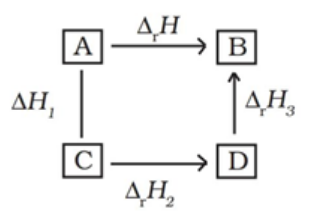
In general, if enthalpy of an overall reaction A → B along one route is $\triangle\text{rH}$ and$​​\triangle\text{rH}_1,\triangle\text{rH}_2,\triangle\text{rH}_3$ representing enthalpies of reactions leading to same product, B along another route, then we have
$\triangle\text{rH}=​​\triangle\text{rH}_1+\triangle\text{rH}_2+\triangle\text{rH}_3$

It can be represented as:
  1. The enthalpy change of a chemical reaction, is given by the symbol …
  1. $\triangle\text{rH}$
  2. $\triangle\text{rG}$
  3. $\triangle\text{rF}$
  4. $\triangle\text{rR}$'
  1. The molar enthalpy is denoted by:
  1. $H_k$
  2. $H_m$
  3. $H_l$
  4. $H_n$
  1. …is enthalpy of fusion in standard state.
  1. $\triangle\text{fus}\text{H}^{\phi}$
  2. $\triangle_\text{r}\text{H}^{\phi}$
  3. $\triangle\text{vap}\text{H}^{\phi}$
  4. $\triangle\text{w}\text{H}^{\phi}$
  1. Solid $CO_2$or ‘dry ice’ sublimes at..
  1. $100K$
  2. $195K$
  3. $150K$
  4. $200K$
  1. … is the standard enthalpy of vaporisation.
  1. $\triangle\text{fus}\text{H}^{\phi}$
  2. $\triangle_\text{r}\text{H}^{\phi}$
  3. $\triangle\text{vap}\text{H}^{\phi}$
  4. $\triangle\text{w}\text{H}^{\phi}$
Read the passage given below and answer the following questions from 1 to 5.
Hydrogen Peroxide $(H_2O_2)$ Hydrogen peroxide is an important chemical used in pollution control treatment of domestic and industrial effluents.It can be prepared by the following methods.
i) Acidifying barium peroxide and removing excess water by evaporation under reduced pressure gives hydrogen.
$\text{BaO}_2.8\text{H}_2\text{O}(\text{s})+\text{H}_2\text{SO}_4\text{(aq)}\rightarrow\text{BaSO}_4\text{(s)}+\text{H}_2\text{O}_2\text{(aq)}+8\text{H}_2\text{O}\text{l}$
ii) Peroxodisulphate, obtained by electrolytic oxidation of acidified sulphate solutions at high current density, on hydrolysis yields hydrogen.
$2\text{HSO}_\bar{4}(\text{aq})\xrightarrow{\text{Electrolysis}}\text{HO}_3\text{SOOSO}_3\text{H}(\text{aq})\xrightarrow{\text{Hydrolysis}}2\text{HSO}_\bar{4}\text{(aq)}+2\text{H}^+\text{(aq)}+\text{H}_2\text{O}_2\text{aq}$
This method is now used for the laboratory preparation of $D_2O_{2.}$
_{$\text{K}_2\text{S}_2\text{O}_8(\text{s})+2\text{D}_2\text{O}\text{(l)}\rightarrow2\text{KDSO}_4(\text{aq})+\text{D}_2\text{O}_2\text{(l)}$}
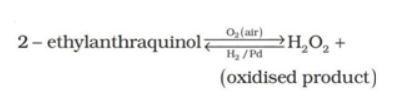
iii) Industrially it is prepared by the auto- oxidation of 2-alklylanthraquinols. 2 ethylanthraquinol H O oxidised product.

In this case 1% $H_2O_2$ is formed. It is extracted with water and concentrated to $\sim30\%$ (by mass) by distillation under reduced pressure. It can be further concentrated to $\sim85\%$ by careful distillation under low pressure. The remaining water can be frozen out to obtain pure $H_2O_2$. Physical Properties of the pure state $H_2O_2$ is an almost colourless (very pale blue) liquid. Its important physical properties. $H_2O_2$ is miscible with water in all proportions and forms a hydrate $H_2O_2.$ $H_2O$ (mp 221K). A 30% solution of $H_2O_2$ is marketed as ‘100 volume’ hydrogen peroxide. It means that one millilitre of 30% $H_2O_2$ solution will give 100 mL of oxygen at STP. Commercially marketed sample is 10 V, which means that the sample contains 3% $H_2O_2$ . Structure Hydrogen peroxide has a non-planar structure.
$H_2O_2$ decomposes slowly on exposure to light.
$2\text{H}_2\text{O}_2\text{(l)}\rightarrow2\text{H}_2\text{O}(\text{l})+\text{O}_2\text{(g)}$
In the presence of metal surfaces or traces of alkali (present in glass containers), the above reaction is catalysed. It is, therefore, stored in wax-lined glass or plastic vessels in dark. Urea can be added as a stabiliser. It is kept away from dust because dust can induce explosive decomposition of the compound.
Its wide scale use has led to tremendous increase in the industrial production of $H_2O_2$. Some of the uses are listed below:
i) In daily life it is used as a hair bleach and as a mild disinfectant. As an antiseptic it is sold in the market as
ii) It is used to manufacture chemicals like sodium perborate and per – carbonate, which are used in high quality detergents.
iii) It is used in the synthesis of hydroquinone, tartaric acid and certain food products and pharmaceuticals (cephalosporin)
iv) It is employed in the industries as a bleaching agent for textiles, paper pulp, leather, oils, fats,
v) Nowadays it is also used in Environmental (Green) Chemistry. For example, in pollution control treatment of domestic and industrial effluents, oxidation of cyanides, restoration of aerobic conditions to sewage wastes,
Heavy water, $D_2O$ It is extensively used as a moderator in nuclear reactors and in exchange reactions for the study of reaction mechanisms. It can be prepared by exhaustive electrolysis of water or as a by-product in some fertilizer industries. It is used for the preparation of other deuterium compounds, for example:
Dihydrogen can be used as a fuel .Dihydrogen releases large quantities of heat on combustion. The data on energy released by combustion of fuels like dihydrogen, methane, LPG etc. are compared in terms of the same amounts in mole, mass and volume Hydrogen Economy is an alternative. The basic principle of hydrogen economy is the transportation and storage of energy in the form of liquid or gaseous dihydrogen. Advantage of hydrogen economy is that energy is transmitted in the form of dihydrogen and not as electric power. It is for the first time in the history of India that a pilot project using dihydrogen as fuel was launched in October 2005 for running automobiles. Initially 5% dihydrogen has been mixed in CNG for use in four-wheeler vehicles. The percentage of dihydrogen would be gradually increased to reach the optimum level. Nowadays, it is also used in fuel cells for generation of electric power. It is expected that economically viable and safe sources of dihydrogen will be identified in the years to come, for its usage as a common source of energy.
  1. In India, a pilot project using dihydrogen as fuel was launched in… for running automobiles.
  1. October 2005
  2. May 2004
  3. August 2014
  4. February 2010
  1. Structure Hydrogen peroxide has a … structure.
  1. Bilateral
  2. Non-planar
  3. Planar
  4. Cubic
  1. One millilitre of 30% $H_2O_2$ solution will give … mL of oxygen at STP.
  1. 30
  2. 10
  3. 100
  4. 300
  1. …. is extensively used as a moderator in nuclear reactors and in exchange reactions for the study of reaction mechanisms.
  1. $H_2O_2$
  2. $T_2O$
  3. $H_2O$
  4. $D_2O$
  1. Colour of pure state $H_2O_2$ is ..
  1. Very Pale red
  2. Very Pale yellow
  3. Very Pale green
  4. Very Pale blue
The molecular orbital theory is based on the principle of a linear combination of atomic orbitals. According to this approach when atomic orbitals of the atoms come closer, they undergo constructive interference as well as destructive interference giving molecular orbitals, i.e., two atomic orbitals overlap to form two molecular orbitals, one of which lies at a lower energy level (bonding molecular orbital). Each molecular orbital can hold one or two electrons in accordance with Pauli's exclusion principle and Hund's rule of maximum multiplicity.
For molecules up to $N _2$, the order of filling of orbitals is:
Image
Bond order $=\frac{1}{2}$ [bonding electrons - antibonding electrons]
Bond order gives the following information:
I. If bond order is greater than zero, the molecule/ion exists otherwise not.
II. Higher the bond order, higher is the bond dissociation energy.
III. Higher the bond order, greater is the bond stability.
IV. Higher the bond order, shorter is the bond length.

1. Arrange the following negative stabilities of $CN , CN ^{+}$and $CN ^{-}$in increasing order of bond. (1)
2. The molecular orbital theory is preferred over valence bond theory. Why? (1)
3. Ethyne is acidic in nature in comparison to ethene and ethane. Why is it so? (2)
OR
Bonding molecular orbital is lowered by a greater amount of energy than the amount by which antibonding molecular orbital is raised. Is this statement correct? (2)
Read the passage given below and answer the following questions from (i) to (v).
The first concreteexplanation for the phenomenon of the blackbody radiation was given byMax Planck in 1900.An ideal body, which emits and absorbs radiations of allfrequencies uniformly, is called a black bodyand the radiation emitted by such a body is called black body radiation. Max Planck arrived at a satisfactory relationshipbymaking an assumption that absorption andemmission of radiation arises from oscillatori.e., atoms in the wall of black body.He suggested that atoms andmolecules could emit or absorb energy onlyin discrete quantities and not in a continuousmanner. He gave the name quantum to thesmallest quantity of energy that can be emitted or absorbed in the form of electromagnetic radiation. The energy (E) of aquantum of radiation is proportionalto its frequency (ν) and is expressed byequation .
$E = hυ.$
The proportionality constant, ‘h’ is knownas Planck’s constant and has the value6.$626\times 10^{–34}$ Js.In 1887, H. Hertz performed a very interestingexperiment in which electrons (or electriccurrent) were ejected when certain metals (forexample potassium, rubidium, caesium etc.)were exposed to a beam of light. The phenomenon is calledPhotoelectric effect. The results observed inthis experiment were:
  1. The electrons are ejected from the metalsurface as soon as the beam of light strikesthe surface, i.e., there is no time lagbetween the striking of light beam and theejection of electrons from the metal surface.
  2. The number of electrons ejected is proportional to the intensity or brightness of light.
  3. For each metal, there is a characteristicminimum frequency,ν0(also known asthreshold frequency) below which photoelectric effect is not observed. At afrequency $ν >ν_0$, the ejected electrons comeout with certain kinetic energy. The kineticenergies of these electrons increase withthe increase of frequency of the light used.
The particle nature of light posed a dilemmafor scientists. Theonly way to resolve the dilemma was to acceptthe idea that light possesses both particle andwave-like properties, i.e., light has dualbehaviour. Depending on the experiment, wefind that light behaves either as a wave or as astream of particles. Whenever radiationinteracts with matter, it displays particle likeproperties in contrast to the wavelike properties (interference and diffraction), whichit exhibits when it propagates. This conceptwas totally alien to the way the scientiststhought about matter and radiation and it tookthem a long time to become convincedof itsvalidity.
The study of emission or absorption spectra is referred to as spectroscopy.The emission spectra of atoms inthe gas phase, on the other hand, do not showa continuous spread of wavelength from redto violet, rather they emit light only at specificwavelengths with dark spaces between them.Such spectra are called line spectra or atomicspectra.The Swedishspectroscopist, Johannes Rydberg, noted that
all series of lines in the hydrogen spectrumcould be described by the following expression:
$\bar{\text{v}}=109,677\big(\frac{1}{\text{n}^2_1}-\frac{1}{\text{n}^2_2}\big)\text{cm}^{-1}$
The value $109,677 cm^{–1}$​​​​​​​ is called theRydberg constant for hydrogen. The first fiveseries of lines that correspond to $n_1= 1, 2, 3,4, 5$ are known as Lyman, Balmer, Paschen,Bracket and Pfund series, respectively.Neils Bohr (1913) was the first to explainquantitatively the general features of thestructure of hydrogen atom and its spectrum.He used Planck’s concept of quantisation ofenergy. Though the theory is not the modernquantum mechanics, it can still be used to rationalize many points in the atomic structureand spectra. Bohr’s model for hydrogen atomis based on the following postulates:
  1. The electron in the hydrogen atom canmove around the nucleus in a circular pathof fixed radius and energy. These paths arecalled orbits, stationary states or allowedenergy states. These orbits are arrangedconcentrically around the nucleus.
  2. The energy of an electron in the orbit doesnot change with time. However, theelectron will move from a lower stationarystate to a higher stationary state whenrequired amount of energy is absorbedby the electron or energy is emitted when electron moves from higher stationarystate to lower stationary state. The energychange does not takeplace in a continuous manner.
  3. The frequency of radiation absorbed oremitted when transition occurs between two stationary states that differ in energyby $\triangle\text{E},$ is given by:
$\text{v}=\frac{\triangle\text{E}}{\text{h}}=\frac{\text{E}_2-\text{E}_1}{\text{h}}$

Where E1 and E2 are the energies of the lower and higher allowed energy statesrespectively. This expression is commonly known as Bohr’s frequency rule.
  1. The angular momentum of an electron isquantised. In a given stationary state itcan be expressed as in equation
$\text{m}_{\text{e}}\text{vr}=\text{n}.\frac{\text{h}}{2\pi}\text{n}=1,2,3.....$
  1. The first concrete explanation for the phenomenon of the black body radiation was given by ….in 1900.
  1. Max Planck
  2. De Broglie
  3. Albert Einstein,
  4. Niels Bohr
  1. Which of the following equation is Planck’s equation?
  1. $E= mc^2​​​​​​​$
  2. $E = hυ$
  3. $E= hc^2​​​​​​​$
  4. $E= vc^2.$
  1. What is nature of light?
  1. Wave
  2. Particle
  3. Wave and Particle
  4. None of above
  1. The value …. is called theRydberg constant for hydrogen.
  1. $109,674cm^{–1}​​​​​​​$
  2. $109,675cm^{–1}​​​​​​​$
  3. $109,676cm^{–1}​​​​​​​$
  4. $109,677cm^{–1}$​​​​​​​
  1. …was the first to explain quantitatively the general features of the structure of hydrogen atom and its spectrum.
  1. Max Planck
  2. De Broglie
  3. Albert Einstein,
  4. Niels Bohr
The ionic character of metallic halides tends toward covalent nature as per Fajan's rule. Such covalent halides behave as non-metal in their higher oxidation states. The property to hydrolyse to give oxy-acids of the element and corresponding hydro halogen acid for most non-metallic elements proceeds exceptionally in the way, keeping oxidation number of element and halide sam in oxo-acids.
Non-polar halides are immiscible in water, as they do not show hydrolysis, but halides of some elements with empty d-orbital undergo hydrolysis. Stability of halides of the higher state is governed by the inert-pair effect.

1. How does halide undergo hydrolysis to give oxy-acids of underlined element $PCl _3$ ? (1)
2. Out of $NCl _3$ and $BCl _3$ undergoes hydrolysis to form oxy-acids? Write the chemical reaction for the correct answer. (1)
3. Out of $PbCl _4, PbF _4, PbI _4$ and $PbBr _4$ which one doesn't exist? (2)
OR
Non-Polar halides are immiscible in water. Why? (2)
Covalent molecules formed by heteroatoms bound to have some ionic character. The ionic character is due to shifting of the electron pair towards A or B in the molecule AB . Hence, atoms acquire small and equal charge but opposite in sign. Such a bond which has some ionic character is described as a polar covalent bond. Polar covalent molecules can exhibit a dipole moment. The dipole moment is equal to the product of charge separation, q and the bond length, d for the bond. The unit of dipole moment is Debye. One Debye is equal to $10^{-18}$ esu cm.
The dipole moment is a vector quantity. It has both magnitude and direction. Hence, the dipole moment of molecules depends upon the relative orientation of the bond dipole, but not the polarity of bonds alone. The symmetrical structure shows a zero dipole moment. Thus, a dipole moment help to predict the geometry of the molecules. Dipole moment values can be used to distinguish between cis- and trans-isomers; ortho-, meta- and para-forms of a substance, etc. The percentage of ionic character of a bond can be calculated by the application of the following formula:
$
\% \text { ionic character }=\frac{\text { Experimental value dipole moment }}{\text { Theoretical value of dipole moment }} \times 100
$
Image
ii. A diatomic molecule has a dipole moment of 1.2 D . If the bond length is $1.0 \times 10^{-8} cm$, what fraction of charge does exist on each atom? (1)
iii. The dipole moment of $NF _3$ is very much less that of $NH _3$. Why? (2)
OR
A covalent molecule, $x-y$, is found to have a dipole moment of $1.5 \times 10^{-29} cm$ and a bond length 150 pm . What will be the percentage of ionic character of the bond? (2)
We must bear in mind that when Mendeleev developed his Periodic Table, chemists knew nothing about the internal structure of atom. However, the beginning of the 20th century witnessed profound developments in theories about sub-atomic particles. In 1913, the English physicist, Henry Moseley observed regularities in the characteristic X-ray spectra of the elements. A plot of ν (whereν is frequency of X-rays emitted) against atomic number (Z ) gave a straight line and not the plot of ν vs atomic mass. He thereby showed that the atomic number is a more fundamental property of an element than its atomic mass. Mendeleev’s Periodic Law was, therefore, accordingly modified. This is known as the Modern Periodic Law and can be stated as : The physical and chemical properties of the elements are periodic functions of their atomic numbers.Numerous forms of Periodic Table have been devised from time to time. Some forms emphasise chemical reactions and valence, whereas others stress the electronic configuration of elements. A modern version, the so-called “long form” of the Periodic Table of the elements , is the most convenient and widely used. The horizontal rows (which Mendeleev called series) are called periods and the vertical columns, groups. Elements having similar outer electronic configurations in their atoms are arranged in vertical columns, referred to as groups or families. According to the recommendation of International Union of Pure and Applied Chemistry (IUPAC), the groups are numbered from 1 to 18 replacing the older notation of groups IA … VIIA, VIII, IB … VIIB and 0. There are altogether seven periods. The period number corresponds to the highest principal quantum number (n) of the elements in the period. The first period contains 2 elements. The subsequent periods consists of 8, 8, 18, 18 and 32 elements, respectively. The seventh period is incomplete and like the sixth period would have a theoretical maximum (on the basis of quantum numbers) of 32 elements. In this form of the Periodic Table, 14 elements of both sixth and seventh periods (lanthanoids and actinoids, respectively) are placed in separate panels at the bottom. the IUPAC has made recommendation that until a new element’s discovery is proved, and its name is officially recognised, a systematic nomenclature be derived directly from the atomic number of the element using the numerical roots for 0 and numbers 1-9. The roots are put together in order of digits which make up the atomic number and “ium” is added at the end.Groupwise Electronic Configurations Elements in the same vertical column or group have similar valence shell electronic configurations, the same number of electrons in the outer orbitals, and similar properties. theoretical foundation for the periodic classification. The elements in a vertical column of the Periodic Table constitute a group or family and exhibit similar chemical behaviour. This similarity arises because these elements have the same number and same distribution of electrons in their outermost orbitals. We can classify the elements into four blocks viz., s-block, p-block, d-block and f-block depending on the type of atomic orbitals that are being filled with electrons. Two exceptions to this categorisation. Strictly, helium belongs to the s-block but its positioning in the p-block along with other group 18 elements is justified because it has a completely filled valence shell (1s) and as a result, exhibits properties characteristic of other noble gases. The other exception is hydrogen. It has only one s-electron and hence can be placed in group 1 (alkali metals). It can also gain an electron to achieve a noble gas arrangement and hence it can behave similar to a group 17 (halogen family) elements. Because it is a special case, we shall place hydrogen separately at the top of the Periodic Table.
  1. In 1913, the English physicist, ….observed regularities in the characteristic X-ray spectra of the elements.
  1. Johann Dobereiner
  2. John Alexander Newlands
  3. Demitri Mendeleev
  4. Henry Moseley
  1. Horizontal row in periodic table called:
  1. Group
  2. Period
  3. Triad
  4. Octave
  1. Vertical Column in periodic table called:
  1. Group
  2. Period
  3. Triad
  4. Octave
  1. According to Modern Periodic Law the physical and chemical properties of the elements are periodic functions of their ….
  1. Atomic mass
  2. Atomic numbers
  3. Atomic structure
  4. Atomic size
  1. What is IUPAC name of element having atomic number 107.
  1. Unnilpentium
  2. Unnilhexium
  3. Unnilseptium
  4. Unniloctium