Question
Read the passage given below and answer the following questions from (i) to (v).
In a chemical reaction, reactants are converted into products and is represented by, Reactants → Products The enthalpy change accompanying a reaction is called the reaction enthalpy. The enthalpy change of a chemical reaction, is given by the symbol $\triangle\text{rH}.$
$\triangle\text{rH}$ = (sum of enthalpies of products) – (sum of enthalpies of reactants)
$\sum\limits_\text{t}\text{a}_{\text{t}}\text{H}_\text{products}-\sum\limits_\text{t}\text{b}_\text{t}\text{H}_\text{reactants}$
Here symbol ∑ (sigma) is used for summation and ai and bi are the stoichiometric coefficients of the products and reactants respectively in the balanced chemical equation. For example, for the reaction
$\text{CH}_4(\text{g})+2\text{O}_2(\text{g})\rightarrow\text{CO}_2(\text{g})+2\text{H}_2\text{O}(\text{l})$
$\triangle_\text{r}\text{H}=\sum\limits_\text{t}\text{a}_{\text{t}}\text{H}_\text{products}-\sum\limits_\text{t}\text{b}_\text{t}\text{H}_\text{reactants}$
$=[\text{H}_\text{m}(\text{CO}_2,\text{g})+2\text{H}_\text{m}(\text{H}_2\text{O},\text{l})]-[\text{H}_\text{m}(\text{CH}_4,\text{g})+2\text{H}_\text{m}(\text{O}_2,\text{g})]$
where $H_m$ is the molar enthalpy. Enthalpy change is a very useful quantity. Knowledge of this quantity is required when one needs to plan the heating or cooling required to maintain an industrial chemical reaction at constant temperature. It is also required to calculate temperature dependence of equilibrium constant.
Standard Enthalpy of Reactions Enthalpy of a reaction depends on the conditions under which a reaction is carried out. It is, therefore, necessary that we must specify some standard conditions. The standard enthalpy of reaction is the enthalpy change for a reaction when all the participating substances are in their standard states. The standard state of a substance at a specified temperature is its pure form at 1 bar. For example, the standard state of liquid ethanol at 298K is pure liquid ethanol at 1 bar; standard state of solid iron at 500K is pure iron at 1 bar. Usually data are taken at 298K. Standard conditions are denoted by adding the superscript 0 to the symbol $\triangle\text{H},$ e.g., $\triangle\text{H}^\phi$
Enthalpy Changes during Phase Transformations Phase transformations also involve energy changes. Ice, for example, requires heat for melting. Normally this melting takes place at constant pressure (atmospheric pressure) and during phase change, temperature remains constant (at 273K).
$\text{H}_2\text{O}(\text{s})\rightarrow\text{H}_2\text{O}(\text{l});\triangle_{\text{fus}}\text{H}^\phi=6.00\text{kJ}\ \text{mol}^{-1}$
Here $\triangle\text{vap}\text{H}^\phi$ is enthalpy of fusion in standard state. If water freezes, then process is reversed and equal amount of heat is given off to the surroundings. The enthalpy change that accompanies melting of one mole of a solid substance in standard state is called standard enthalpy of fusion or molar enthalpy of fusion, $\triangle\text{fus}\text{H}0.$Melting of a solid is endothermic, so all enthalpies of fusion are positive. Water requires heat for evaporation. At constant temperature of its boiling point Tb and at constant pressure:
$\text{H}_2\text{O}(\text{l})\rightarrow\text{H}_2\text{O}(\text{g});\triangle_{\text{vap}}\text{H}^\phi=+40.79\text{kJ}\ \text{mol}^{-1}$
$\triangle\text{vap}\text{H}^\phi$ is the standard enthalpy of vaporisation. Amount of heat required to vaporize one mole of a liquid at constant temperature and under standard pressure (1bar) is called its standard enthalpy of vaporization or molar enthalpy of vaporization, $\triangle\text{vap}\text{H}^\phi.$ Sublimation is direct conversion of a solid into its vapour. Solid $CO_2 $or ‘dry ice’ sublimes at 195K with $\triangle\text{sub}\text{H}^\phi=25.2\text{kJ}\text{mol}^{–1};$ naphthalene sublimes slowly and for this $\triangle\text{sub}\text{H}0= 73.0\text{kJ}\text{mol}^{–1}.$ Standard enthalpy of sublimation, $\triangle\text{sub}\text{H}^\phi$ is the change in enthalpy when one mole of a solid substance sublimes at a constant temperature and under standard pressure (1bar). The magnitude of the enthalpy change depends on the strength of the intermolecular interactions in the substance undergoing the phase transfomations. For example, the strong hydrogen bonds between water molecules hold them tightly in liquid phase. For an organic liquid, such as acetone, the intermolecular dipole-dipole interactions are significantly weaker. Thus, it requires less heat to vaporise 1 mol of acetone than it does to vaporize 1mol of water.
Standard Enthalpy of Formation The standard enthalpy change for the formation of one mole of a compound from its elements in their most stable states of aggregation (also known as reference states) is called Standard Molar Enthalpy of Formation. Its symbol is $\triangle\text{f}\text{H}^\phi$ where the subscript ‘ f ’ indicates that one mole of the compound in question has been formed in its standard state from its elements in their most stable states of aggregation. The reference state of an element is its most stable state of aggregation at $25^\circ C$ and 1 bar pressure.
Hess’s Law of Constant Heat Summation We know that enthalpy is a state function, therefore the change in enthalpy is independent of the path between initial state (reactants) and final state (products). In other words, enthalpy change for a reaction is the same whether it occurs in one step or in a series of steps. This may be stated as follows in the form of Hess’s Law. If a reaction takes place in several steps then its standard reaction enthalpy is the sum of the standard enthalpies of the intermediate reactions into which the overall reaction may be divided at the same temperature. Let us understand the importance of this law with the help of an example. Consider the enthalpy change for the reaction
$\text{C}(\text{graphite,s})+\frac{1}{2}\text{O}_2(\text{g})\rightarrow\text{CO}(\text{g});\triangle_\text{r}\text{H}^{\ominus}=?$
Although CO(g) is the major product, some $CO_2 $gas is always produced in this reaction. Therefore, we cannot measure enthalpy change for the above reaction directly. However, if we can find some other reactions involving related species, it is possible to calculate the enthalpy change for the above reaction. Let us consider the following reactions:
$\text{C}(\text{graphite,s})+\text{O}_2(\text{g}) \rightarrow\text{CO}_2(\text{g});\triangle\text{r}\text{H}^{\phi}=–393.5\text{kJ}\text{mol}^{–1}(\text{i})$
$\text{CO}(\text{g})+\frac{1}{2}\text{O}_2(\text{g})\rightarrow\text{CO}_2(\text{g})\triangle_\text{r}\text{H}^{\phi}=-283.0\text{kJ}\text{mol}^{-1}(\text{ii})$
We can combine the above two reactions in such a way so as to obtain the desired reaction. To get one mole of CO(g) on the right, we reverse equation (ii). In this, heat is absorbed instead of being released, so we change sign of $\triangle\text{r}\text{H}^\phi$ value
$\text{CO}_2(\text{g})\rightarrow\text{CO}(\text{g})+\frac{1}{2}\text{O}_2(\text{g});\triangle\text{r}\text{H}^{\phi}=+283.0\text{kJ}\text{mol}^{-1}...(\text{iii})$
Adding equation (i) and (iii), we get the desired equation,
$\text{C}(\text{graphite,s})+\frac{1}{2}\text{O}_2(\text{g})\rightarrow\text{CO}(\text{g});$
for which $\triangle_\text{r}\text{H}^{\phi}=(-393.5+283.0)=-110.5\text{kJ}\text{mol}^{-1}$
In general, if enthalpy of an overall reaction A → B along one route is $\triangle\text{rH}$ and$​​\triangle\text{rH}_1,\triangle\text{rH}_2,\triangle\text{rH}_3$ representing enthalpies of reactions leading to same product, B along another route, then we have
$\triangle\text{rH}=​​\triangle\text{rH}_1+\triangle\text{rH}_2+\triangle\text{rH}_3$
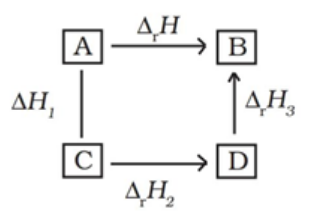
It can be represented as:
  1. The enthalpy change of a chemical reaction, is given by the symbol …
  1. $\triangle\text{rH}$
  2. $\triangle\text{rG}$
  3. $\triangle\text{rF}$
  4. $\triangle\text{rR}$'
  1. The molar enthalpy is denoted by:
  1. $H_k$
  2. $H_m$
  3. $H_l$
  4. $H_n$
  1. …is enthalpy of fusion in standard state.
  1. $\triangle\text{fus}\text{H}^{\phi}$
  2. $\triangle_\text{r}\text{H}^{\phi}$
  3. $\triangle\text{vap}\text{H}^{\phi}$
  4. $\triangle\text{w}\text{H}^{\phi}$
  1. Solid $CO_2$or ‘dry ice’ sublimes at..
  1. $100K$
  2. $195K$
  3. $150K$
  4. $200K$
  1. … is the standard enthalpy of vaporisation.
  1. $\triangle\text{fus}\text{H}^{\phi}$
  2. $\triangle_\text{r}\text{H}^{\phi}$
  3. $\triangle\text{vap}\text{H}^{\phi}$
  4. $\triangle\text{w}\text{H}^{\phi}$
Answer

  1. (a) $\triangle\text{rH}$
  1. (b) $H_m$
  1. (a) $\triangle\text{fus}\text{H}^{\phi}$
  1. (b) $195K$
  1. (c) $\triangle\text{vap}\text{H}^{\phi}$

Need a full question paper?

Generate a complete, print-ready paper with questions like this in minutes — across 16+ boards, with answer keys.

Start Generating Free

Similar questions

Read the passage given below and answer the following questions from (i) to (v).
The presence of positive charge on thenucleus is due to the protons in the nucleus.As established earlier, the charge on the proton is equal but opposite to that of electron.Atomic number $(Z)=$ number of protons inthe nucleus of an atom = number of electrons in a nuetral atom. protons and neutrons present in thenucleus are collectively known as nucleons. The total number of nucleons is termed asmass number $(A)$ of the atom.
mass number $(A)=$ number of protons $(Z)+$ number of neutrons $( n )$.
Isobars are the atoms with same massnumber but different atomic number forexample, ${ }_6^4 C$ and ${ }_7^{14} N$. On the other hand, atomswith identical atomic number but differentatomic mass number are known as Isotopes. For example, considering of hydrogen atom again, $99.985 \%$ of hydrogen atoms contain only one proton.This isotope is called protium $\left(1^1 H \right)$. Rest of thepercentage of hydrogen atom contains two otherisotopes, the one containing 1 proton and 1 neutron is called deuterium ( ${ }^2{ }_1 D , 0.015 \%$ )and the other one possessing 1 proton and 2 neutrons is called tritium ( ${ }^3 T$ )..the studies of interactions of radiations with matter haveprovided immense information regarding thestructure of atoms and molecules. Neils Bohrutilised these results to improve upon themodel proposed by Rutherford. Twodevelopments played a major role in theformulation of Bohr's model of atom. Thesewere:
1. Dual character of the electromagneticradiation which means that radiations possess both wave like and particle likeproperties, and
2. Experimental results regarding atomicspectra.

James Maxwell (1870) was the first to givea comprehensive explanation about theinteraction between the charged bodies andthe behaviour of electrical and magnetic fieldson macroscopic level. He suggested that whenelectrically charged particle moves underaccelaration, alternating electrical and magnetic fields are produced and transmitted.These fields are transmitted in the forms ofwaves called electromagnetic waves orelectromagnetic radiation.radiations are characterised by theproperties, namely, frequency $(v)$ and wavelength $(\lambda)$.The SI unit for frequency $(v)$ is hertz $\left( Hz , s ^{-1}\right)$, after Heinrich Hertz. It is defined asthe number of waves that pass a given pointin one second. Wavelength should have the units of lengthand as you know that the SI units of length ismeter ( m ). Since electromagnetic radiationconsists of different kinds of waves of muchsmaller wavelengths, smaller units are used.In vaccum all types of electromagneticradiations, regardless of wavelength, travel atthe same speed, i.e., $3.0 \times 10^8 m s ^{-1}$ ( $2.997925 \times 10^8 ms^{-1}$, to be precise). This is called speedof light and is given the symbol ' c '. Thefrequency $( V )$, wavelength $(\lambda)$ and velocity of light(c) are related by the following equation.
$c=v \lambda$
The other commonly used quantityspecially in spectroscopy, is the wavenumber.It is defined as the number of wavelengthsper unit length. Its units are reciprocal ofwavelength unit, i.e., $m^{–1}$​​​​​​​. However commonlyused unit is $cm^{–1}​​​​​​​$​​​​​​​
  1. The presence of positive charge on the nucleus is due to the …. in the nucleus.
  1. Protons
  2. Neutrons
  3. Electron
  4. Nucleons
  1. Atomic Number is denoted by:
  1. $A$
  2. $Z$
  3. $N$
  4. $M$
  1. Atomic Mass number is denoted by:
  1. $M$
  2. $Z$
  3. $N$
  4. $A$
  1. … are the atoms with same mass number but different atomic number.
  1. Isotopes
  2. Allotropes
  3. Isobars
  4. None of above
  1. Atoms with identical atomic number but different atomic mass number are known as ..
  1. Isotopes
  2. Allotropes
  3. Isobars
  4. None of above
Read the passage given below and answer the following questions from 1 to 5. Since the isotopes have the same electronic Configuration, they have almost the same Chemical properties.The only difference is in Their rates of reactions, mainly due to their Different enthalpy of bond dissociation . However, in physical properties these Isotopes differ considerably due to their large Mass differences. There are a number of methods for preparing Dihydrogen from metals and metal hydrides. 1.) Laboratory Preparation of Dihydrogen – It is usually prepared by the reaction of Granulated zinc with dilute hydrochloric. $Zn + 2H + \rightarrow Zn_2+ + H_2$ It can also be prepared by the reaction of Zinc with aqueous alkali. $Zn + 2NaOH \rightarrow Na_2ZnO_2 + H_2$ Commercial Production of Dihydrogen – The commonly used processes are outlined Below: i) Electrolysis of acidified water using Platinum electrodes gives hydrogen. ii) High purity (> 99.95%) dihydrogen is Obtained by electrolysing warm aqueous Barium hydroxide solution between nickel iii) It is obtained as a by product in the Manufacture of sodium hydroxide and Chlorine by the electrolysis of brine Solution. During electrolysis, the reactions That take place are: at anode: $2\text{CI}(\text{aq})\rightarrow\text{CI}_2(\text{g})+2\bar{\text{e}}$ at cathode: $2\text{H}_2\text{O}(\text{l})+2\text{e}\rightarrow\text{H}_2(\text{g})+2\text{O}\bar{\text{H}}(\text{aq})$ The overall reaction is $2\text{Na }(\text {aq})+2\text{C}\bar{\text{I}}(\text{aq})+2\text{H}_2\text{O}(\text{l})$ $\text{CI}_2(\text{g})+\text{H}_2(\text{g})+2\text{Na}^+(\text{aq})+2\text{O}\bar{\text{H}}(\text{aq})$ That take place are: iv) Reaction of steam on hydrocarbons or coke At high temperatures in the presence of Catalyst yields hydrogen.

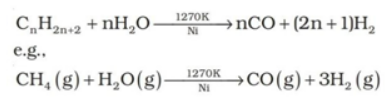
 The mixture of $CO$ and $H_2$ is called water Gas. As this mixture of $CO$ and $H_2$ is used for The synthesis of methanol and a number of Hydrocarbons, it is also called synthesis gas Or ‘syngas’. Nowadays ‘syngas’ is produced From sewage, saw-dust, scrap wood, Newspapers etc. The process of producing ‘syngas’ from coal is called ‘coal gasification’. The production of dihydrogen can be Increased by reacting carbon monoxide of Syngas mixtures with steam in the presence of Iron chromate as catalyst. This is called water-gas shift reaction. Carbon dioxide is removed by scrubbing with Sodium arsenite solution. Presently ~77% of the industrial Dihydrogen is produced from petro-chemicals, 18% from coal, 4% from electrolysis of aqueous Solutions and 1% from other sources. Physical Properties Dihydrogen is a colourless, odourless, Tasteless, combustible gas. It is lighter than Air and insoluble in water. Its other physical Properties are alongwith those of deuterium. The chemical behaviour of dihydrogen (and for That matter any molecule) is determined, to a Large extent, by bond dissociation enthalpy. The H–H bond dissociation enthalpy is the Highest for a single bond between two atoms Of any element. What inferences would you Draw from this fact ? It is because of this factor That the dissociation of dihydrogen into its Atoms is only~0.081% around 2000K which Increases to 95.5% at 5000K. Also, it is Relatively inert at room temperature due to the high H–H bond enthalpy. Thus, the atomic Hydrogen is produced at a high temperature In an electric arc or under ultraviolet Radiations. Since its orbital is incomplete with 1s1 Electronic configuration, it does combine With almost all the elements. It accomplishes Reactions by
i) loss of the only electron to Give H+, ii) gain of an electron to form H–, and iii) Sharing electrons to form a single covalent bond. The chemistry of dihydrogen can be Illustrated by the following reactions: Reaction with halogens: It reacts with Halogens, $X_2$ to give hydrogen halides, $\text{H}_2(\text{g})+\text{x}_2(\text{g})\rightarrow2\text{HX}(\text{g})(\text{x}=\text{F.CI.Br.I})$ While the reaction with fluorine occurs even in The dark, with iodine it requires a catalyst. Reaction with dioxygen: It reacts with Dioxygen to form water. The reaction is highly Exothermic. $2\text{H}_2(\text{g})+\text{O}_2(\text{g})\xrightarrow{\text{catalyst or beading}}2\text{H}_2\text{O}(\text{l}):$ $\triangle\text{H}^-=-285.9\text{kj}\text{mol}^-1$ This is the method for the manufacture of Ammonia by the Haber process. Reactions with metals: With many metals it Combines at a high temperature to yield the Corresponding hydrides $H_2$ (g) + 2M (g) → 2 MH (s); Where M is an alkali metal Reactions with metal ions and metal Oxides: It reduces some metal ions in aqueous Solution and oxides of metals (less active than Iron) into corresponding metals. $\text{H}_2(\text{g})+\text{Pd}^{2+}\text{(aq)}\rightarrow\text{Pd}(\text{s})+2\text{H}^+(\text{aq})$ $\text{y}\text{H}_2(\text{g})+\text{M}_\text{x}\text{O}_\text{y}(\text{S})\rightarrow\text{xM}(\text{s})+\text{y}\text{H}_2\text{O}\text{(l)}$ Reactions with organic compounds: It Reacts with many organic compounds in the Presence of catalysts to give useful Hydrogenated products of commercial Importance. For example: Hydrogenation of vegetable oils using Nickel as catalyst gives edible fats (margarine and vanaspati ghee) Hydroformylation of olefins yields Aldehydes which further undergo Reduction to give alcohols. $\text{H}_2+\text{CO}+\text{RCH}=\text{CH}_2\rightarrow\text{RCH}_2\text{CH}_2\text{CHO}$ $\text{H}_2+\text{RCH}_2\text{CH}_2\text{CHO}\rightarrow\text{RCH}_2\text{CH}_2\text{CH}_2\text{OH}$
  1. The mixture of CO and H2 is called …
  1. water Gas
  2. Dry ice
  3. Dry carbon
  4. Dry hydrogen
  1. Which of the following is not physical property of Dihydrogen.
  1. colourless
  2. Highest dissociation enthalpy
  3. odourless
  4. Tasteless
  1. Dihydrogen is reacts with dioxygen to get ….
  1. $H_2O_2$
  2. $2H_2O_2$
  3. $2H_2O$
  4. $H_2O$
  1. High purity dihydrogen is obtained by electrolysing warm aqueous barium hydroxide solution between… electrodes.
  1. Chromium
  2. Copper
  3. Platinum
  4. Nickel
The idea of oxidation number has been invariably applied to define oxidation, reduction, oxidising agent (oxidant), reducing agent (reductant) and the redox reaction. To summarise, we may say that:
Oxidation: An increase in the oxidation number of the element in the given substance.
Reduction: A decrease in the oxidation number of the element in the given substance.
Oxidising agent: A reagent which can increase the oxidation number of an element in a given substance. These reagents are called as oxidants also.
Reducing agent: A reagent which lowers the oxidation number of an element in a given substance. These reagents are also called as reductants.
Redox reactions: Reactions which involve change in oxidation number of the interacting species.
Types of Redox Reactions
1.) Combination reactions -A combination reaction may be denoted in the manner:
$A + B → C$
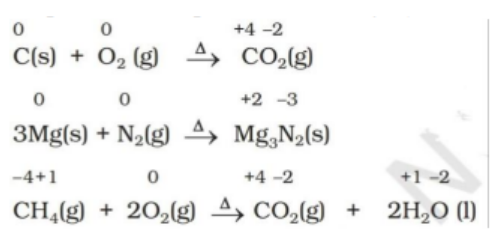
Either A and B or both A and B must be in the elemental form for such a reaction to be a redox reaction. All combustion reactions, which make use of elemental dioxygen, as well as other reactions involving elements other than dioxygen, are redox reactions. Some important examples of this category are:

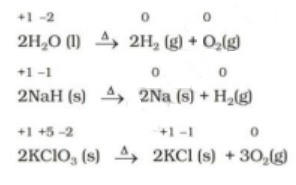
2.) Decomposition reactions- Decomposition reactions are the opposite of combination reactions. Precisely, a decomposition reaction leads to the breakdown of a compound into two or more components at least one of which must be in the elemental state.
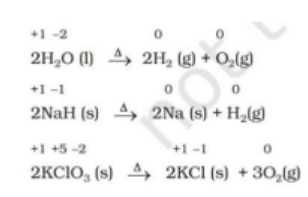
Examples of this class of reactions are:

It may carefully be noted that there is no change in the oxidation number of hydrogen in methane under combination reactions and that of potassium in potassium chlorate in reaction. This may also be noted here that all decomposition reactions are not redox reactions. For example, decomposition of calcium carbonate is not a redox reaction.
3.) Displacement reactions- In a displacement reaction, an ion (or an atom) in a compound is replaced by an ion (or an atom) of another element. It may be denoted as:
$X + YZ → XZ + Y$
Displacement reactions fit into two categories: metal displacement and non-metal displacement.
(a) Metal displacement: A metal in a compound can be displaced by another metal in the uncombined state. Metal displacement reactions find many applications in metallurgical processes in which pure metals are obtained from their compounds in ores.
(b) Non-metal displacement: The non-metal displacement redox reactions include hydrogen displacement and a rarely occurring reaction involving oxygen displacement. All alkali metals and some alkaline earth metals (Ca, Sr, and Ba) which are very good reductants, will displace hydrogen from cold water. Many metals, including those which do not react with cold water, are capable of displacing hydrogen from acids. Dihydrogen from acids may even be produced by such metals which do not react with steam. Cadmium and tin are the examples of such metals.
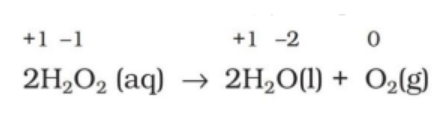
4.) Disproportionation reactions – Disproportionation reactions are a special type of redox reactions. In a disproportionation reaction an element in one oxidation state is simultaneously oxidised and reduced. One of the reacting substances in a disproportionation reaction always contains an element that can exist in at least three oxidation states. The element in the form of reacting substance is in the intermediate oxidation state; and both higher and lower oxidation states of that element are formed in the reaction. The decomposition of hydrogen peroxide is a familiar example of the reaction, where oxygen experiences disproportionation.

Here the oxygen of peroxide, which is present in –1 state, is converted to zero oxidation state in $O2$ and decreases to –2 oxidation state in $H_2O$.
  1. In … an ion (or an atom) in a compound is replaced by an ion (or an atom) of another element.
  1. displacement reaction
  2. decomposition reaction
  3. disproportionation reaction
  4. combination reaction
  1. leads to the breakdown of a compound into two or more components at least one of which must be in the elemental state.
  1. displacement reaction
  2. decomposition reaction
  3. disproportionation reaction
  4. combination reaction
  1. In …. an element in one oxidation state is simultaneously oxidised and reduced.
  1. displacement reaction
  2. decomposition reaction
  3. disproportionation reaction
  4. combination reaction
  1. Reactions which involve change in oxidation number of the interacting species…
  1. Exothermic reaction
  2. Endothermic reaction
  3. Neutralization reaction
  4. Redox reaction
  1. One of the reacting substances in a disproportionation reaction always contains an element that can exist in at least … oxidation states.
  1. 1
  2. 2
  3. 3
  4. 4
Read the passage given below and answer the following questions from (i) to (v).
When covalent bond is formed betweentwo similar atoms, for example in $H _2, O _2, Cl _2, N_2 Or F _2$, the shared pair of electrons is equally Attracted by the two atoms. As a result electronPair is situated exactly between the twoldentical nuclei. The bond so formed is calledNonpolar covalent bond. As a result of polarisation, the moleculePossesses the dipole moment which can be defined as the productof the magnitude of the charge and theDistance between the centres of positive andNegative charge. It is usually designated by aGreek letter ' $\mu$ '. Mathematically, it is expressedAs follows :Dipole moment $(\mu)=$ charge $( Q ) \times$ distance ofSeparationDipole moment is usually expressed inDebye units (D). The conversion factor is $1 D =3.33564 \times 10^{-30} C$ mWhere C is coulomb and m is meter. Just as all the covalent bonds haveSome partial ionic character, the ionicBonds also have partial covalentCharacter. The partial covalent character of ionic bonds was discussed by Fajans in terms of the following rules:
- The smaller the size of the cation and theLarger the size of the anion, the greater theCovalent character of an ionic bond.
- The greater the charge on the cation, theGreater the covalent character of the ionic bond.
- For cations of the same size and charge, The one, with electronic configuration( $n -1) d ^0 n s ^0$, typical of transition metals, isMore polarising than the one with a nobleGas configuration, ns2 np6, typical of alkali and alkaline earth metal cations.

Sidgwick and Powell in 1940, proposed a simple theoryBased on the repulsive interactions of theElectron pairs in the valence shell of the atoms.It was further developed and redefined byNyholm and Gillespie (1957).The main postulates of VSEPR theory areAs follows:
- The shape of a molecule depends uponThe number of valence shell electron pairs(bonded or nonbonded) around the centralAtom.
- Pairs of electrons in the valence shell repelone another since their electron clouds arenegatively charged.
- These pairs of electrons tend to occupySuch positions in space that minimiseRepulsion and thus maximise distanceBetween them.
- The valence shell is taken as a sphere withThe electron pairs localising on theSpherical surface at maximum distanceFrom one another.
- A multiple bond is treated as if it is a singleElectron pair and the two or three electronPairs of a multiple bond are treated as aSingle super pair.
- Where two or more resonance structuresCan represent a molecule, the VSEPRModel is applicable to any such structure.
 The arrangement of electron pairs and the atoms around the central atom can be : linear,Trigonal planar, tetrahedral, trigonal-Bipyramidal and octahedral. Valence bond theory was introduced byHeitler and London (1927) and developedFurther by Pauling and others. A discussionOf the valence bond theory is based on the knowledge of atomic orbitals, electronicConfigurations of elements.partialmerging of atomic orbitals is called overlappingof atomic orbitals which results in the pairingof electrons. The extent of overlap decides thestrength of a covalent bond. according toorbital overlap concept, the formation of acovalent bond between two atoms results bypairing of electrons present in the valence shellhaving opposite spins. When orbitals of two atoms come close to formbond, their overlap may be positive, negativeor zero depending upon the sign anddirection of orientation of amplitude of orbitalwave function in space. Positive andnegative sign on boundary surface diagramsin the show the sign (phase) of orbitalwave function and are not related to charge.Orbitals forming bond should have same sign(phase) and orientation in space. This is calledpositive overlap. The criterion of overlap, as the main factorfor the formation of covalent bonds appliesuniformly to the homonuclear/heteronucleardiatomic molecules and polyatomic molecules.
  1. Dipole moment is usually expressed in….
  1. Debye
  2. Centimeter
  3. Columbs
  4. Ergs
  1. 1D = .....
  1. $33564\times 10^{–28}Cm$
  2. $3.3564\times 10^{–30}Cm$
  3. $33564\times 10^{–32}Cm$
  4. $33564\times 10^{–34}Cm$
  1. Valence bond theory was introduced by ….
  1. Pauling and lewis
  2. Nyholm and Gillespie
  3. Heitler and London
  4. Sidgwick and Powell
  1. Pair is situated exactly between the two Identical nuclei the bond so formed is called …. covalent bond.
  1. Unipolar
  2. Bipolar
  3. Polar
  4. Nonpolar
  1. Pairs of electrons in the valence shell … one another since their electron clouds are negatively charged.
  1. Attract
  2. Repel
  3. Both a) & b)
  4. None if above
Read the passage given below and answer the following questions from 1 to 5.
A reagent that brings an electron pair to the reactive site is called a nucleophile (Nu:) i.e., nucleus seeking and the reaction is then called nucleophilic. A reagent that takes away an electron pair from reactive site is called electrophile (E+) i.e., electron seeking and the reaction is called electrophilic.
Electron Displacement Effects in Covalent Bonds The electron displacement in an organic molecule may take place either in the ground state under the influence of an atom or a substituent group or in the presence of an appropriate attacking reagent. The electron displacements due to the influence of an atom or a substituent group present in the molecule cause permanent polarlisation of the bond. Inductive effect and resonance effects are examples of this type of electron displacements. Temporary electron displacement effects are seen in a molecule when a reagent approaches to attack it. This type of electron displacement is called electrometric effect or polarisability effect.
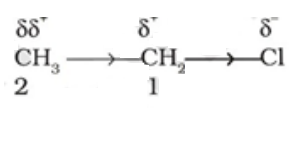
Inductive Effect When a covalent bond is formed between atoms of different electronegativity, the electron density is more towards the more electronegative atom of the bond. Such a shift of electron density results in a polar covalent bond. Bond polarity leads to various electronic effects in organic compounds. Let us consider cholorethane $(CH_3CH_2Cl)$ in which the C–Cl bond is a polar covalent bond. It is polarised in such a way that the carbon-1 gains some positive charge $(\delta+)$ and the chlorine some negative charge $(\delta-)$ The fractional electronic charges on the two atoms in a polar covalent bond are denoted by symbol (delta) and the shift of electron density is shown by an arrow that points from$(\delta+)$ to $(\delta-)$ end of the polar bond.

In turn carbon-1, which has developed partial positive charge $(\delta+)$draws some electron density towards it from the adjacent C-C bond. Consequently, some positive charge$(\delta\delta+)$develops on carbon-2 also, where $(\delta\delta+)$ symbolises relatively smaller positive charge as compared to that on carbon – 1. In other words, the polar C – Cl bond induces polarity in the adjacent bonds. Such polarisation of σ- bond caused by the polarisation of adjacent $σ-$bond is referred to as the inductive effect.
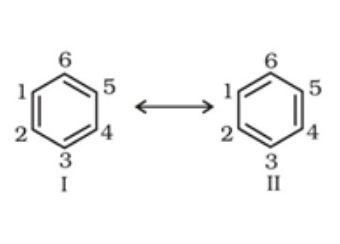
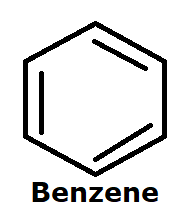
Resonance Structure There are many organic molecules whose behaviour cannot be explained by a single Lewis structure. An example is that of benzene. Its cyclic structure containing alternating C–C single and C=C double bonds shown is inadequate for explaining its characteristic properties.

As per the above representation, benzene should exhibit two different bond lengths, due to C–C single and C=C double bonds. However, as determined experimentally benzene has a uniform C–C bond distances of 139 pm, a value intermediate between the C–C single(154 pm) and C=C double (134 pm) bonds. Thus, the structure of benzene cannot be represented adequately by the above structure. Further, benzene can be represented equally well by the energetically identical structures I and II.

Therefore, according to the resonance theory the actual structure of benzene cannot be adequately represented by any of these structures, rather it is a hybrid of the two structures (I and II) called resonance structures. The resonance structures (canonical structures or contributing structures) are hypothetical and individually do not represent any real molecule. They contribute to the actual structure in proportion to their stability.
Resonance Effect The resonance effect is defined as ‘the polarity produced in the molecule by the interaction of two π-bonds or between a π-bond and lone pair of electrons present on an adjacent atom’. The effect is transmitted through the chain. There are two types of resonance or mesomeric effect designated as R or M effect. (i) Positive Resonance Effect (+R effect) In this effect, the transfer of electrons is away from an atom or substituent group attached to the conjugated system. This electron displacement makes certain positions in the molecule of high electron densities. This effect in aniline is shown as : (ii) Negative Resonance Effect (- R effect) This effect is observed when the transfer of Electrons is towards the atom or substituent Group attached to the conjugated system. For Example in nitrobenzene this electron Displacement can be depicted as : The atoms or substituent groups, which represent +R or –R electron displacement effects are as follows: +R effect: – halogen, –OH, –OR, –OCOR, –NH2, –NHR, –NR2, –NHCOR, – R effect: $– COOH, –CHO, > C = O, – CN, – NO_2$ The presence of alternate single and double bonds in an open chain or cyclic system is termed as a conjugated system. These systems often show abnormal behaviour. The examples are 1,3- butadiene, aniline and nitrobenzene etc. In such systems, the π-electrons are delocalised and the system develops polarity.
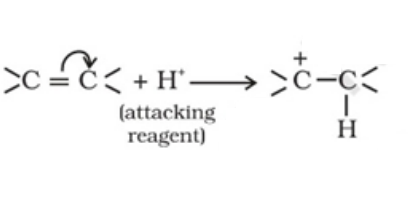
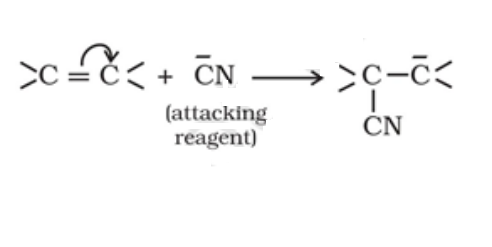
Electromeric Effect (E effect) It is a temporary effect. The organic compounds having a multiple bond (a double or triple bond) show this effect in the presence of an attacking reagent only. It is defined as the complete transfer of a shared pair of π-electrons to one of the atoms joined by a multiple bond on the demand of an attacking reagent. The effect is annulled as soon as the attacking reagent is removed from the domain of the reaction. It is represented by E and the shifting of the electrons is shown by a curved arrow ( ). There are two distinct types of electromeric effect.
a) Positive Electrometric Effect (+E effect)- In this effect the π−electrons of the multiple bond are transferred to that atom to which the reagent gets attached. For example

b) Negative Electromeric Effect (–E effect) -In this effect the $\pi-$ electrons of the multiple bond are transferred to that atom to which the attacking reagent does not get attached. For example: When inductive and electromeric effects operate in opposite directions, the electomeric effect predominates.
  1. A reagent that brings an electron pair to the reactive site is called a …
  1. nucleophile
  2. electrophile
  3. amphoteric
  4. amphophillic
  1. A reagent that takes away an electron pair from reactive site is called ..
  1. nucleophile
  2. electrophile
  3. amphoteric
  4. amphophillic
  1. The … effect is defined as the polarity produced in the molecule by the interaction of two π-bonds or between a π-bond and lone pair of electrons present on an adjacent atom.
  1. hindrance
  2. inductive
  3. resonance
  4. hyperconjunction
  1. –OH group, represent … electron displacement effect.
  1. M+
  2. M-
  3. R-
  4. R+
  1. – COOH group, represent … electron displacement effect.
  1. M+
  2. M-
  3. R-
  4. R+
Read the passage given below and answer the following questions from 1 to 5.
The unusual properties of water in the Condensed phase (liquid and solid states) are Due to the presence of extensive hydrogen Bonding between water molecules. This leads To high freezing point, high boiling point, high Heat of vaporisation and high heat of fusion in Comparison to $H_2S$ and $H_2Se$. In comparison To other liquids, water has a higher specific Heat, thermal conductivity, surface tension, Dipole moment and dielectric constant, etc. these properties allow water to play a key role In the biosphere. In the gas phase water is a bent molecule with a bond angle of $104.5^\circ$ , and O–H bond length Of 95.7 pm
It is a highly polar molecule. Its orbital overlap. In the liquid Phase water molecules are associated together By hydrogen bonds. The crystalline form of water is ice. At Atmospheric pressure ice crystallises in the Hexagonal form, but at very low temperatures It condenses to cubic form.
Density of ice is Less than that of water. Therefore, an ice cube Floats on water. In winter season ice formed On the surface of a lake provides thermal Insulation which ensures the survival of the Aquatic life. This fact is of great ecological Significance. Structure of Ice Ice has a highly ordered three dimensional Hydrogen bonded structure. Examination of ice crystals with X-rays shows that each oxygen atom is Surrounded tetrahedrally by four other oxygen Atoms at a distance of 276 pm.
Hydrogen bonding gives ice a rather open Type structure with wide holes. These holes can Hold some other molecules of appropriate size Interstitially.
Water reacts with a large number of Substances. Some of the important reactions Are given below.
Amphoteric Nature: It has the ability to act as an acid as well as a base i.e., it behaves As an amphoteric substance. In the Brönsted Sense it acts as an acid with $NH_3$ and a base with $H_2S.$
$\text{H}_2\text{O}(\text{l})+\text{NH}_3(\text{aq})\rightleftharpoons\text{OH}^-(\text{aq})+\text{NH}^+_4\text{aq}$
$\text{H}_2\text{O}(\text{l})+\text{H}_2\text{S}(\text{aq})\rightleftharpoons\text{H}_3\text{O}^+(\text{aq})+\text{HS}^-\text{(aq)}$
The auto protolysis (self-ionzation) of water takes palace as follow:
$\text{H}_2\text{O}(\text{l})+\text{H}_2\text{O}(\text{l})\rightleftharpoons\text{H}_3\text{O}^+(\text{aq})+\text{OH}^-(\text{aq})$
$\text{acid-1 base-2 (acid-2) base-1}$
$\text{(acid) (base) (conjugate acid) (conjugate base)}$
Redox Reactions Involving Water: Water Can be easily reduced to dihydrogen by highly Electropositive metals.
$2\text{H}_2\text{O}(\text{l})+2\text{Na}\text{(s)}\rightarrow2\text{NaOH}\text{(aq)}+\text{H}_2\text{g}$
Thus. it is a great source of dihydrogen.
water is oxidished to $O_2$ during photosynthesis.
$6\text{CO}_2\text{g}+12\text{H}_2\text{O}(\text{l})\rightarrow\text{C}_6\text{H}_{12}\text{O}_6(\text{aq})+6\text{H}_2\text{O}{\text{l}}+6\text{O}_2\text{(g)}$
With fluorine also it is oxidised to $O_2.$
$2\text{F}_2\text{g}+2\text{H}_2\text{O}(\text{l})\rightarrow4\text{H}^+(\text{aq})+4\text{F}^-(\text{aq})+\text{O}_2\text{(G)}$
Hydrolysis Reaction: Due to high Dielectric constant, it has a very strong Hydrating tendency. It dissolves many ionic Compounds. However, certain covalent and Some ionic compounds are hydrolysed in water.
$\text{P}_4\text{O}_{10}(\text{s})+6\text{H}_2\text{O}(\text{l})\rightarrow4\text{H}_3\text{PO}_4\text{(aq)}$
$\text{SiCl}_4{\text{l}}+2\text{H}_2\text{O}(\text{l})\rightarrow\text{SiO}_2\text{(s)}+4\text{HCl}\text{(aq)}$
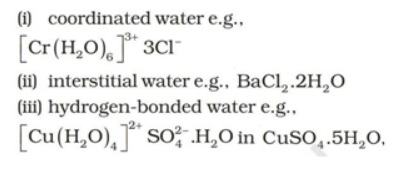
Hydrates Formation: From aqueous Solutions many salts can be crystallised as Hydrated salts. Such an association of water Is of different types viz., Coordinated water e.g.,

Hard and Soft Water- Rain water is almost pure (may contain some Dissolved gases from the atmosphere). Being a Good solvent, when it flows on the surface of The earth, it dissolves many salts. Presence of Calcium and magnesium salts in the form of Hydrogencarbonate, chloride and sulphate in Water makes water ‘hard’. Hard water does Not give lather with soap. Water free from Soluble salts of calcium and magnesium is Called Soft water. It gives lather with soap Easily. Temporary hardness is due to the presence of Magnesium and calcium hydrogen- Carbonates. It can be removed by:
Boiling: During boiling, the soluble $Mg(HCO_3)_2$ is converted into insoluble $Mg(OH)_2$ And $Ca(HCO_3)_2$ is changed to insoluble $CaCO_3$. It is because of high solubility product of $Mg(OH)_2$ as compared to that of $MgCO_3$, that $Mg(OH)_2$ is precipitated. These precipitates can Be removed by filtration. Filtrate thus obtained
Will be soft water.
$\text{Mg}(\text{HCO}_3)_2\xrightarrow{\text{Heating}}\text{Mg}(\text{OH})_2\downarrow+2\text{CO}_2\uparrow$
$\text{Ca}(\text{HCO}_3)_2\xrightarrow{\text{Heating}}\text{CaCO}_3\downarrow+\text{H}_2\text{O}+\text{CO}_2\uparrow$
Clark’s method: In this method calculated Amount of lime is added to hard water. It Precipitates out calcium carbonate and Magnesium hydroxide which can be filtered off.
Permanent Hardness is due to the presence of soluble salts of Magnesium and calcium in the form of Chlorides and sulphates in water. Permanent Hardness is not removed by boiling.
$\text{Ca}(\text{Hco}_3)_2+\text{Ca}(\text{OH)}_2\rightarrow2\text{CaCO}_3\downarrow2\text{H}_2\text{O}$
$\text{Mg}(\text{HCO)}_3+2\text{Ca}\text{(Oh)}_2\rightarrow2\text{CaCO}_3\downarrow+\text{Mg}(\text{OH)}_2\downarrow2\text{H}_2\text{O}$
Permanent Hardness is due to the presence of soluble salts of Magnesium and calcium in the form of Chlorides and sulphates in water. Permanent Hardness is not removed by boiling.
  1. In the gas phase water is a bent molecule with a bond angle of:
  1. $104.5^\circ$
  2. $94.5^\circ$
  3. $110.5^\circ$
  4. $95.5^\circ$
  1. At Atmospheric pressure ice crystallises in the … form.
  1. Cubic
  2. Hexagonal
  3. Octagonal
  4. Pentagonal
  1. Water free from Soluble salts of calcium and magnesium is called …
  1. hard water
  2. dry water
  3. soft water
  4. None of above
  1. Water has…. Nature.
  1. acidic
  2. basic
  3. neutral
  4. amphoteric
  1. Water is…. Molecule.
  1. Polar
  2. Non- Polar
  3. Ionic
  4. All the above
A less obvious example of electron transfer is realised when hydrogen combines with oxygen to form water by the reaction: $2\text{H}_2(\text{g}) + \text{O}_2 (\text{g}) → 2\text{H}_2\text{O} (\text{l})$ Though not simple in its approach, yet we can visualise the H atom as going from a Neutral (zero) state in H2 to a positive state in H2O, the O atom goes from a zero state in O2 To a dinegative state in H2O. It is assumed that There is an electron transfer from H to O and Consequently H2 is oxidised and O2 is reduced. However, as we shall see later, the charge Transfer is only partial and is perhaps better Described as an electron shift rather than a Complete loss of electron by H and gain by O. Two examples of this class Of the reactions are: $\text{H}_2 (\text{s}) + \text{Cl}_2(\text{g}) → 2\text{HCl} (\text{g})$ And, $\text{CH}_4 (\text{g}) + 4\text{Cl}_2 (\text{g}) → \text{CCl}_4(\text{l}) + 4\text{HCl (g)}$ In order to keep track of electron shifts in Chemical reactions involving formation of Covalent compounds, a more practical method Of using oxidation number has been Developed. In this method, it is always Assumed that there is a complete transfer of Electron from a less electronegative atom to a More electonegative atom. For example, we Rewrite equations to show Charge on each of the atoms forming part of The reaction:

It may be emphasised that the assumption Of electron transfer is made for book-keeping Purpose only and it will become obvious at a Later stage in this unit that it leads to the simple Description of redox reactions. Oxidation number denotes the Oxidation state of an element in a Compound ascertained according to a set Of rules formulated on the basis that electron pair in a covalent bond belongs Entirely to more electronegative element. It is not always possible to remember or Make out easily in a compound/ ion, which Element is more electronegative than the other. Therefore, a set of rules has been formulated To determine the oxidation number of an Element in a compound/ion. We may at this stage, state the rules for the Calculation of oxidation number. These rules are: 1.) In elements, in the free or the uncombined State, each atom bears an oxidation Number of zero. Evidently each atom in $H _2, O _2, C _{12}, O _3, P _4, S_8, Na , Mg$, Al has the Oxidation number zero. 2.) For ions composed of only one atom, the Oxidation number is equal to the charge On the ion. Thus $Na +$ lon has an oxidation Number of $+1, Mg _2+$ ion +2 , $Fe _3+$ ion, $+3, Cl -$ Ion, $-1, O _2-$ ion, -2 ; and so on. In their Compounds all alkali metals have Oxidation number of +1 , and all alkaline Earth metals have an oxidation number of +2 . Aluminium is regarded to have an Oxidation number of +3 in all its Compounds. 3.) The oxidation number of oxygen in most Compounds is -2 . However, we come across Two kinds of exceptions here. One arises In the case of peroxides and superoxides, The compounds of oxygen in which oxygen Atoms are directly linked to each other. While in peroxides (e.g., $H _2 O _2, Na _2 O _2$ ), each Oxygen atom is assigned an oxidation Number of -1 , in superoxides (e.g., $K O _2, Rb O _2$ ) each oxygen atom is assigned an Oxidation number of $-(1 / 2)$. The second Exception appears rarely, i.e. when oxygen Is bonded to fluorine. In such compounds e.g., oxygen difluoride $\left( OF _2\right)$ and dioxygen difluoride $\left( O _2 F_2\right)$, the oxygen is assigned an oxidation number of +2 and +1 , respectively. The number assigned to oxygen will depend upon the bonding state of oxygen but this number would now be a positive figure only. 4.)The oxidation number of hydrogen is +1, Except when it is bonded to metals in binary Compounds (that is compounds containing Two elements). For example, in LiH, NaH, And $Ca H_2,$ its oxidation number is –1. 5.) In all its compounds, fluorine has an Oxidation number of –1. Other halogens (Cl, Br, and I) also have an oxidation number Of –1, when they occur as halide ions in Their compounds. Chlorine, bromine and Iodine when combined with oxygen, for Example in oxoacids and oxoanions, have Positive oxidation numbers. 6.) The algebraic sum of the oxidation number Of all the atoms in a compound must be Zero. In polyatomic ion, the algebraic sum Of all the oxidation numbers of atoms of The ion must equal the charge on the ion. Thus, the sum of oxidation number of three Oxygen atoms and one carbon atom in the Carbonate ion, $(CO_3) 2$– must equal –2. A term that is often used interchangeably With the oxidation number is the oxidation State. Thus in $CO_2,$the oxidation state of Carbon is +4 , that is also its oxidation number And similarly the oxidation state as well as Oxidation number of oxygen is -2 . This implies That the oxidation number denotes the Oxidation state of an element in a compound. The oxidation number/state of a metal in a Compound is sometimes presented according To the notation given by German chemist, Alfred Stock. It is popularly known as Stock Notation. According to this, the oxidation Number is expressed by putting a Roman Numeral representing the oxidation number In parenthesis after the symbol of the metal in The molecular formula. Thus aurous chloride And auric chloride are written as $Au ( I ) Cl$ and $Au ( III ) Cl _3$. Similarly, stannous chloride and Stannic chloride are written as $Sn ( II ) Cl _2$ and $Sn ( IV ) Cl _4$. This change in oxidation number Implies change in oxidation state, which in Turn helps to identify whether the species is Present in oxidised form or reduced form. Thus, $Hg _2( I ) Cl _2$ is the reduced form of $Hg ( II ) Cl _2$.
  1. H atom goes from a … state in $H_2$ to a positive state in $H_2O$ in water formation.
  1. Neutral
  2. Positive
  3. Negative
  4. All the above
  1. In oxidation number method, there is a complete transfer of electron from a …. electronegative atom to a … electonegative atom.
  1. more, less
  2. less, more
  3. non, more
  4. non, less
  1. Oxidation number of $Mg_2$ + ion is:
  1. -2
  2. -1
  3. +2
  4. +1
  1. In $Na2O_2$ each oxygen atom is assigned an oxidation number of …
  1. +1
  2. -2
  3. +2
  4. -1
  1. The algebraic sum of the oxidation number of all the atoms in a compound must be…
  1. 0
  2. 1
  3. 2
  4. -2
Read the passage given below and answer the following questions from (i) to (v).
When a liquid evaporates in a closed container, molecules with relatively higher kinetic energy escape the liquid surface into the vapour phase and number of liquid molecules from the vapour phase strike the liquid surface and are retained in the liquid phase. It gives rise to a constant vapour pressure because of an equilibrium in which the number of molecules leaving the liquid equals the number returning to liquid from the vapour. We say that the system has reached equilibrium state at this stage. However, this is not static equilibrium and there is a lot of activity at the boundary between the liquid and the vapour. Thus, at equilibrium, the rate of evaporation is equal to the rate of condensation. It may be represented by
$\text{H}_2\text{O}_{(\text{l})}\rightleftharpoons\text{H}_2\text{O}_{(\text{vap})}$
The double half arrows indicate that the processes in both the directions are going on simultaneously. The mixture of reactants and products in the equilibrium state is called an equilibrium mixture.
Equilibrium can be established for both physical processes and chemical reactions. The reaction may be fast or slow depending on the experimental conditions and the nature of the reactants. When the reactants in a closed vessel at a particular temperature react to give products, the concentrations of the reactants keep on decreasing, while those of products keep on increasing for some time after which there is no change in the concentrations of either of the reactants or products. This stage of the system is the dynamic equilibrium
The chemical equilibrium may be classified in three groups.
  1. The reactions that proceed nearly to completion and only negligible concentrations of the reactants are left. In some cases, it may not be even possible to detect these experimentally.
  2. The reactions in which only small amounts of products are formed and most of the reactants remain unchanged at equilibrium stage.
  3. The reactions in which the concentrations of the reactants and products are comparable, when the system is in equilibrium.
The equilibrium involving ions in aqueous solutions which is called as ionic equilibrium.
Solid-Liquid Equilibrium Ice and water kept in a perfectly insulated thermos flask (no exchange of heat between its contents and the surroundings) at 273K and the atmospheric pressure are in equilibrium state and the system shows interesting characteristic features. We observe that the mass of ice and water do not change with time and the temperature remains constant. However, the equilibrium is not static. The intense activity can be noticed at the boundary between ice and water. Molecules from the liquid water collide against ice and adhere to it and some molecules of ice escape into liquid phase. There is no change of mass of ice and water, as the rates of transfer of molecules from ice into water and of reverse transfer from water into ice are equal at atmospheric pressure and 273 K. It is obvious that ice and water are in equilibrium only at particular temperature and pressure. For any pure substance at atmospheric pressure, the temperature at which the solid and liquid phases are at equilibrium is called the normal melting point or normal freezing point of the substance. The system here is in dynamic equilibrium and we can infer the following:
  1. Both the opposing processes occur simultaneously.
  2. Both the processes occur at the same rate so that the amount of ice and water remains constant.
Solid – Vapour Equilibrium Let us now consider the systems where solids sublime to vapour phase. If we place solid iodine in a closed vessel, after sometime the vessel gets filled up with violet vapour and the intensity of colour increases with time. After certain time the intensity of colour becomes constant and at this stage equilibrium is attained. Hence solid iodine sublimes to give iodine vapour and the iodine vapour condenses to give solid iodine. The equilibrium can be represented as,
$\text{l}_2(\text{solid})\rightleftharpoons\text{l}_2(\text{vapour})$
Other examples showing this kind of equilibrium are,
$\text{Camphor}_{(\text{solid})}\rightleftharpoons\text{Camphor}_{(\text{vapour})}$
$\text{NH}_4\text{CI}_{(\text{solid})}\rightleftharpoons\text{NH}_4\text{CI}_{(\text{vapour})}$
The equilibrium Involving Dissolution of Solid in Liquids Only a limited amount of salt or sugar can dissolves in a given amount of water at room temperature. If we make a thick sugar syrup solution by dissolving sugar at a higher temperature, sugar crystals separate out if we cool the syrup to the room temperature. We call it a saturated solution when no more of solute can be dissolved in it at a given temperature. The concentration of the solute in a saturated solution depends upon the temperature. In a saturated solution, a dynamic equilibrium exits between the solute molecules in the solid state and in the solution: Sugar (solution) Sugar (solid), and the rate of dissolution of sugar = rate of crystallisation of sugar. Equality of the two rates and dynamic nature of equilibrium has been confirmed with the help of radioactive sugar. If we drop some radioactive sugar into saturated solution of non-radioactive sugar, then after some time radioactivity is observed both in the solution and in the solid sugar. Initially there were no radioactive sugar molecules in the solution but due to dynamic nature of equilibrium, there is exchange between the radioactive and non-radioactive sugar molecules between the two phases. The ratio of the radioactive to non- radioactive molecules in the solution increases till it attains a constant value.
  1. Which of the following symbol represents equilibrium.
  1. $\rightleftharpoons$
  2. $\leftrightarrows$
  3. $\nLeftrightarrow$
  4. $\uparrow\downarrow$
  1. When there is no change in the concentrations of either of the reactants or products, this stage of the system is the …
  1. Static equilibrium
  2. Dynamic equilibrium
  3. Physical equilibrium
  4. Chemical equilibrium
  1. A … solution means no more of solute can be dissolved in it at a given temperature.
  1. Unsaturated
  2. Supersaturated
  3. Saturated
  4. None of these.
  1. The equilibrium involving ions in aqueous solutions which is called as …
  1. Static equilibrium
  2. Dynamic equilibrium
  3. Physical equilibrium
  4. Ionic equilibrium
  1. The concentration of the solute in a saturated solution depends upon the …
  1. Solvent
  2. Pressure
  3. Temperature
  4. System
Lewis dot structures, in general, do notrepresent the actual shapes of the molecules.In case of polyatomic ions, the net charge ispossessed by the ion as a whole and not by aparticular atom. It is, however, feasible toassign a formal charge on each atom. Theformal charge of an atom in a polyatomicmolecule or ion may be defined as thedifference between the number of valenceelectrons of that atom in an isolated or freestate and the number of electrons assignedto that atom in the Lewis structure. It isexpressed as :Generally the lowest energystructure is the one with the smallestformal charges on the atoms. The formalcharge is a factor based on a pure covalentview of bonding in which electron pairsare shared equally by neighbouring atoms. The octet rule, though useful, is not universal.It is quite useful for understanding thestructures of most of the organic compoundsand it applies mainly to the second periodelements of the periodic table. There are threetypes of exceptions to the octet rule.
  • The incomplete octet of the central atom
  • Odd-electron molecules
  • The expanded octetFrom the Kössel and Lewis treatment of theformation of an ionic bond, it follows that theformation of ionic compounds wouldprimarily depend upon:
  • The ease of formation of the positive andnegative ions from the respective neutralatoms;
  • The arrangement of the positive andnegative ions in the solid, that is, thelattice of the crystalline compound.
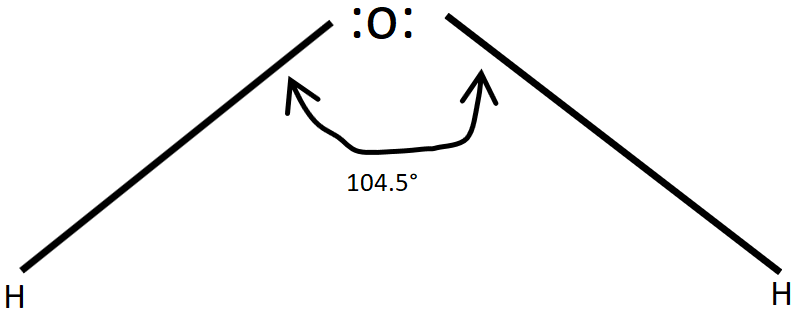
The Lattice Enthalpy of an ionic solid is defined as the energy required to completely separate one mole of a solid ionic compound into gaseous constituent ions. For example, the lattice enthalpy of NaCl is 788 kJ mol–1. This means that 788 kJ of energy is required to separate one mole of solid NaCl into one mole of Na+ (g) and one mole of Cl– (g) to an infinite distance.Bond length is defined as the equilibriumdistance between the nuclei of two bondedatoms in a molecule. Bond lengths aremeasured by spectroscopic, X-ray diffractionand electron-diffraction techniques . The covalent radius is measuredapproximately as the radius of an atom’score which is in contact with the core ofan adjacent atom in a bonded situation. The vander Waals radius represents the overall sizeof the atom which includes its valence shellin a nonbonded situation. Bond Angle is defined as the angle between the orbitalscontaining bonding electron pairs around thecentral atom in a molecule/complex ion. Bondangle is expressed in degree which can beexperimentally determined by spectroscopicmethods. It gives some idea regarding thedistribution of orbitals around the centralatom in a molecule/complex ion and hence ithelps us in determining its shape. Forexample H–O–H bond angle in water can berepresented as under:

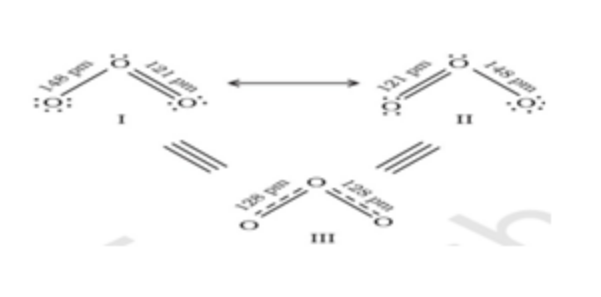
Bond Enthalpy It is defined as the amount of energy required to break one mole of bonds of a particular type between two atoms in a gaseous state. The unit of bond enthalpy is $kJ mol ^{-1}$. For example, the $H - H$ bond enthalpy in hydrogen molecule is $435.8 kJ mol ^{-1} \cdot H _2(g) \rightarrow H ( g )+ H ( g ) ; \Delta_{ a } H =435.8 kJ mol ^{-1}$. Bond Orderln the Lewis description of covalent bond, the Bond Order is given by the number ofbonds between the two atoms in amolecule. The bond order, for example in $H _2$ (with a single shared electron pair), in $O _2$ (with two shared electron pairs) and in $N _2$ (with three shared electron pairs) is 1,2,3respectively. A general correlation useful forunderstanding the stablities of moleculesis that: with increase in bond order, bondenthalpy increases and bond lengthdecreases. The concept of resonance was introducedto deal with the type of difficulty experiencedin the depiction of accurate structures ofmolecules like $O _3$. According to the conceptof resonance, whenever a single Lewis structure cannot describe a moleculeaccurately, a number of structures with similar energy, positions of nuclei, bonding and non-bonding pairs of electrons are taken as the canonical structures of the hybrid which describes the molecule accurately.

Thus for $O_3$, the two structures shown above constitute the canonical structures or resonance structures and their hybrid i.e., theIII structure represents the structure of $O_3$ more accurately. This is also called resonance hybrid. Resonance is represented by a double headed arrow. In general, it may be stated that
  • Resonance stabilizes the molecule as the energy of the resonance hybrid is lessthan the energy of any single cannonical structure; and,
  • Resonance averages the bond characteristics as a whole. Thus the energy of the$O_3$ . resonancehybrid is lower than either of the two cannonical froms I and II.
  1. Which of the following techniques used to measure bond length?
  1. Spectroscopic techniques
  2. X-ray diffraction
  3. Electron-diffraction techniques
  4. All the above
  1. The unit of bond enthalpy is …
  1. $kJ mol^{–1}$
  2. $Cal mol^{-1}$
  3. $Cal$ mol
  4. $kJ$ mol
  1. With increase in bond order, bond enthalpy… and bond length ….
  1. Decreases, decreases
  2. Increases, decreases
  3. Increases, increases
  4. Decreases, increases
  1. The …. is measured approximately as the radius of an atom’s core which is in contact with the core of an adjacent atom in a bonded situation.
  1. Ionic radius
  2. Metallic radius
  3. Covalent radius
  4. None of above
  1. … is given by the number of bonds between the two atoms in a molecule.
  1. Bond Order
  2. Bond size
  3. Bond enthalpy
  4. Bond angle
Read the passage given below and answer the following questions from $1$ to $5$. Lithium metal is used to make useful alloys, for example with lead to make ‘white metal’ Bearings for motor engines, with aluminium to make aircraft parts, and with magnesium to make armour plates. It is used in Thermonuclear reactions. Lithium is also used to make electrochemical cells. Sodium is used To make a Na/Pb alloy needed to make $PbEt_4$​​​​​​​ and $PbMe_4​​​​​​​$​​​​​​​. These organolead compounds were Earlier used as anti-knock additives to petrol, But nowadays vehicles use lead-free petrol. Liquid sodium metal is used as a coolant in Fast breeder nuclear reactors. Potassium has a vital role in biological systems. Potassium Chloride is used as a fertilizer. Potassium Hydroxide is used in the manufacture of soft Soap. It is also used as an excellent absorbent of carbon dioxide. Caesium is used in devising Photoelectric cells. Points of Difference between Lithium and other Alkali Metals –
i) Lithium is much harder. Its m.p. and b.p. are higher than the other alkali metals.
ii) Lithium is least reactive but the strongest Reducing agent among all the alkali metals. On combustion in air it forms mainly Monoxide, $Li_2O$ and the nitride, $Li_3N$ unlike Other alkali metals.
 iii) LiCl is deliquescent and crystallises as a Hydrate, LiCl.$2H_2O$ whereas other alkali Metal chlorides do not form hydrates.
iv) Lithium hydrogencarbonate is not Obtained in the solid form while all other Elements form solid hydrogencarbonate.
v) Lithium unlike other alkali metals forms No ethynide on reaction with ethyne.
vi) Lithium nitrate when heated gives lithium Oxide, $Li_2O$, whereas other alkali metal Nitrates decompose to give the Corresponding nitrite. $4\text{LiNO}_3\rightarrow2\text{L}\text{i}_2\text{O}+4\text{NO}_2+\text{O}_2$ $2\text{NaNO}_3\rightarrow2\text{NaNO}_2+\text{O}_2$ vii) LiF and $Li_2O$ are comparatively much less Soluble in water than the corresponding Compounds of other alkali metals. Sodium carbonate is generally prepared by Solvay Process. In this process, advantage is Taken of the low solubility of sodium Hydrogencarbonate whereby it gets Precipitated in the reaction of sodium chloride with ammonium hydrogencarbonate. The Latter is prepared by passing $CO_2​​​​​​​$​​​​​​​ to a Concentrated solution of sodium chloride Saturated with ammonia, where ammonium Carbonate followed by ammonium Hydrogencarbonate are formed. The equations For the complete process may be written as $2\text{NH}_3+\text{H}_2\text{O}+\text{CO}_2\rightarrow{\text{(NH}_4)_2}\text{CO}_3$ $(\text{NH}_4)_2\text{CO}_3+\text{H}_2\text{O}+\text{CO}_2\rightarrow2\text{NH}_4\text{HCO}_3$ $\text{NH}_4\text{HCO}_3+\text{NaCl}\rightarrow\text{NH}_4\text{Cl}+\text{NaHCO}_3$ Sodium hydrogencarbonate crystal Separates. these are heated to give sodium Carbonate. The most abundant source of sodium chloride is sea water which contains $2.7$ to $2.9 \%$ by Mass of the salt. In tropical countries like India, Common salt is generally obtained by Evaporation of sea water. Approximately $50$ Lakh tons of salt are produced annually in India by solar evaporation. Crude sodium Chloride, generally obtained by crystallisation Of brine solution, contains sodium sulphate, Calcium sulphate, calcium chloride and Magnesium chloride as impurities. Calcium Chloride, $CaCl_2$​​​​​​​, and magnesium chloride, $MgCl_2$​​​​​​​ are impurities because they are Deliquescent (absorb moisture easily from the Atmosphere). To obtain pure sodium chloride, The crude salt is dissolved in minimum amount Of water and filtered to remove insoluble Impurities. The solution is then saturated with Hydrogen chloride gas. Crystals of pure Sodium chloride separate out. Calcium and Magnesium chloride, being more soluble than Sodium chloride, remain in solution. Sodium Hydroxide (Caustic Soda), NaOH is generally prepared Commercially by the electrolysis of sodium Chloride in Castner-Kellner cell. A brine Solution is electrolysed using a mercury Cathode and a carbon anode. Sodium metal Discharged at the cathode combines with Mercury to form sodium amalgam. Chlorine Gas is evolved at the anode. Cathod: $\text{Na}^++\bar{\text{e}}\xrightarrow{\text{Hg}}\text{Na}-\text{amalgam}$ Anode: $\text{Cl}^-\rightarrow\frac{1}{2}\text{Cl}_2+\text{e}^-$ The amalgam is treated with water to give Sodium hydroxxide and hydrogen gas. $2$ Na - amalgam $+ 2H_2O \rightarrow 2NaOH + 2Hg + H_2$​​​​​​​
  1. NaOH Sodium hydroxide is generally prepared Commercially by the electrolysis of … in Castner-Kellner cell.
  1. $NaCl$
  2. $Na_2CO_3$
  3. $NaHCO_3$
  4. $NaNH_2$
  1. … is used in the manufacture of soft Soap.
  1. Sodium Hydroxide
  2. Potassium Hydroxide
  3. Aluminium hydroxide
  4. Beryllium hydroxide
  1. … is used in devising Photoelectric cells.
  1. Hydrogen
  2. Lithium
  3. Caesium
  4. Helium
  1. … compounds were Earlier used as anti-knock additives to petrol.
  1. Organomagnesium
  2. Organosilicon
  3. Organochloride
  4. Organolead
  1. The sodium amalgam is treated with water to gives ….
  1. $NaOH$
  2. $Na_2CO_3$
  3. $NaHCO_3$
  4. $NaNH_2$​​​​​​​