Question
Read the passage given below and answer the following questions from (i) to (v).
Predicting the Direction of the Reaction- The equilibrium constant helps in predicting the direction in which a given reaction will proceed at any stage. For this purpose, we calculate the reaction quotient Q. The reaction quotient, Q (Qc with molar concentrations and QP with partial pressures) is defined in the same way as the equilibrium constant Kc except that the concentrations in Qc are not necessarily equilibrium values. For a general reaction:
$\text{a}\text{A}+\text{b}\text{B}\rightleftharpoons\text{c}\text{C}+\text{d}\text{D}$
$\text{Q}\text{c}=\frac{[\text{C}]^\text{c}[\text{D}]^\text{d}}{[\text{A}]^\text{a}[\text{B}]^\text{b}}$
Then,
If Qc > Kc, the reaction will proceed in the direction of reactants (reverse reaction).
If Qc < Kc, the reaction will proceed in the direction of the products (forward reaction).
If Qc = Kc, the reaction mixture is already at equilibrium. Consider the gaseous reaction of H2 with I2 ,
$\text{H}_{2(\text{g})}+\text{l}_{2(\text{g})}\rightleftharpoons2\text{Hl}_{(\text{g})};\text{kc}=57.0\text{at}700\text{k}.$
Suppose we have molar concentrations [H2 ]t =0.10M, [I2 ]t = 0.20 M and [HI]t = 0.40 M. (the subscript t on the concentration symbols means that the concentrations were measured at some arbitrary time t, not necessarily at equilibrium). Thus, the reaction quotient, Qc at this stage of the reaction is given by,
$\text{Qc}=\frac{[\text{Hl}]\text{t}^2}{[\text{H}]^2]_\text{t}[\text{l}_2]_\text{t}}=\frac{(0.40)_2}{(0.10)\times(0.20)}=8.0$
Now, in this case, Qc (8.0) does not equal Kc (57.0), so the mixture of H2 (g), I2 (g) and HI(g) is not at equilibrium; that is, more H2 (g) and I 2 (g) will react to form more HI(g) and their concentrations will decrease till Qc = Kc. The reaction quotient, Qc is useful in predicting the direction of reaction by comparing the values of Qc and Kc.Thus, we can make the following generalisations concerning the direction of the reaction
If Qc < Kc, net reaction goes from left to right
If Qc > Kc, net reaction goes from right to left.
If Qc = Kc, no net reaction occurs.
Calculating Equilibrium Concentrations In case of a problem in which we know the initial concentrations but do not know any of the equilibrium concentrations, the following three steps shall be followed:
Step 1) Write the balanced equation for the reaction.
Step 2) Under the balanced equation, make a table that lists for each substance involved in the reaction: (a) the initial concentration, (b) the change in concentration on going to equilibrium, and (c) the equilibrium concentration. In constructing the table, define x as the concentration (mol/L) of one of the substances that reacts on going to equilibrium, then use the stoichiometry of the reaction to determine the concentrations of the other substances in terms of x.
Step 3) Substitute the equilibrium concentrations into the equilibrium equation for the reaction and solve for x. If you are to solve a quadratic equation choose the mathematical solution that makes chemical sense.
Step 4) Calculate the equilibrium concentrations from the calculated value of x.
Step 5) Check your results by substituting them into the equilibrium equation.
Relationship between equilibrium constant K, reaction quotient Q and gibbs energy G The value of Kc for a reaction does not depend on the rate of the reaction. However, it is directly related to the thermodynamics of the reaction and in particular, to the change in Gibbs energy, $\triangle\text{G}.$ If,
$\triangle\text{G}$ is negative, then the reaction is spontaneous and proceeds in the forward direction.
$\triangle\text{G}$ is positive, then reaction is considered non-spontaneous. Instead, as reverse reaction would have a negative $\triangle\text{G},$ the products of the forward reaction shall be converted to the reactants.
$\triangle\text{G}$ is 0, reaction has achieved equilibrium; at this point, there is no longer any free energy left to drive the reaction. A mathematical expression of this thermodynamic view of equilibrium can be described by the following equation:
$\triangle\text{G}=\triangle\text{G}^\phi+\text{RT}\text{lnQ}$
where, $\triangle\text{G}^\phi$ is standard Gibbs energy. At equilibrium, when $\triangle\text{G}=0$ and Q = Kc, the equation becomes,
$\triangle\text{G}=\text{G}^\phi+\text{RT}\text{lnk}=0$
$\triangle\text{G}^\phi=-\text{RT}\text{lnk}$
$\text{Ink}=\frac{-\triangle\text{G}^\phi}{\text{RT}}$
Taking antilog of both sides, we get,
$\text{K}=\text{e}-\frac{\triangle\text{G}0}{\text{RT}}$
Hence, using the equation, the reaction spontaneity can be interpreted in terms of the value of $\triangle\text{G}^\phi.$
If $\triangle\text{G}^\phi>0$ then $\frac{-\triangle\text{G}^\phi}{\text{RT}}$ is positive, and >1, making K > 1, which implies a spontaneous reaction or the reaction which proceeds in the forward direction to such an extent that the products are present predominantly.
If $\triangle\text{G}^\phi>0,$ then $\frac{-\triangle\text{G}^\phi}{\text{RT}}$ is negative, and < 1, that is, K < 1, which implies a non-spontaneous reaction or a reaction which proceeds in the forward direction to such a small degree that only a very minute quantity of product is formed.
Factors affecting equilibria One of the principal goals of chemical synthesis is to maximise the conversion of the reactants to products while minimizing the expenditure of energy. This implies maximum yield of products at mild temperature and pressure conditions. If it does not happen, then the experimental conditions need to be adjusted. For example, in the Haber process for the synthesis of ammonia from N2 and H2, the choice of experimental conditions is of real economic importance. Annual world production of ammonia is about hundred million tones, primarily for use as fertilizers. Equilibrium constant, Kc is independent of initial concentrations. But if a system at equilibrium is subjected to a change in the concentration of one or more of the reacting substances, then the system is no longer at equilibrium; and net reaction takes place in some direction until the system returns to equilibrium once again. Similarly, a change in temperature or pressure of the system may also alter the equilibrium. In order to decide what course the reaction adopts and make a qualitative prediction about the effect of a change in conditions on equilibrium we use Le Chatelier’s principle. It states that a change in any of the factors that determine the equilibrium conditions of a system will cause the system to change in such a manner so as to reduce or to counteract the effect of the change. This is applicable to all physical and chemical equilibria.
Effect of Concentration Change In general, when equilibrium is disturbed by the addition/removal of any reactant/ products, Le Chatelier’s principle predicts that:
The concentration stress of an added reactant/product is relieved by net reaction in the direction that consumes the added substance.
The concentration stress of a removed reactant/product is relieved by net reaction in the direction that replenishes the removed substance. or in other words, “When the concentration of any of the reactants or products in a reaction at equilibrium is changed, the composition of the equilibrium mixture changes so as to minimize the effect of concentration changes”. Let us take the reaction,
$\text{H}_{2(\text{g})}+\text{l}_{2(\text{g})}\rightleftharpoons2\text{Hl}_{(\text{g})}$
If H2 is added to the reaction mixture at equilibrium, then the equilibrium of the reaction is disturbed. In order to restore it, the reaction proceeds in a direction wherein H2 is consumed, i.e., more of H2 and I2 react to form HI and finally the equilibrium shifts in right (forward) direction. This is in accordance with the Le Chatelier’s principle which implies that in case of addition of a reactant/product, a new equilibrium will be set up in which the concentration of the reactant/product should be less than what it was after the addition but more than what it was in the original mixture. The same point can be explained in terms of the reaction quotient, Qc,

$\text{Qc}=\frac{[\text{HI}]^2}{[\text{H}]_2[\text{I}]_2}$
Addition of hydrogen at equilibrium results in value of Qc being less than Kc. Thus, in order to attain equilibrium again reaction moves in the forward direction. Similarly, we can say that removal of a product also boosts the forward reaction and increases the concentration of the products and this has great commercial application in cases of reactions, where the product is a gas or a volatile substance. In case of manufacture of ammonia, ammonia is liquified and removed from the reaction mixture so that reaction keeps moving in forward direction. Similarly, in the large scale production of CaO (used as important building material) from CaCO3, constant removal of CO2 from the kiln drives the reaction to completion. It should be remembered that continuous removal of a product maintains Qc at a value less than Kc and reaction continues to move in the forward direction.
Predicting the Direction of the Reaction- The equilibrium constant helps in predicting the direction in which a given reaction will proceed at any stage. For this purpose, we calculate the reaction quotient Q. The reaction quotient, Q (Qc with molar concentrations and QP with partial pressures) is defined in the same way as the equilibrium constant Kc except that the concentrations in Qc are not necessarily equilibrium values. For a general reaction:
$\text{a}\text{A}+\text{b}\text{B}\rightleftharpoons\text{c}\text{C}+\text{d}\text{D}$
$\text{Q}\text{c}=\frac{[\text{C}]^\text{c}[\text{D}]^\text{d}}{[\text{A}]^\text{a}[\text{B}]^\text{b}}$
Then,
If Qc > Kc, the reaction will proceed in the direction of reactants (reverse reaction).
If Qc < Kc, the reaction will proceed in the direction of the products (forward reaction).
If Qc = Kc, the reaction mixture is already at equilibrium. Consider the gaseous reaction of H2 with I2 ,
$\text{H}_{2(\text{g})}+\text{l}_{2(\text{g})}\rightleftharpoons2\text{Hl}_{(\text{g})};\text{kc}=57.0\text{at}700\text{k}.$
Suppose we have molar concentrations [H2 ]t =0.10M, [I2 ]t = 0.20 M and [HI]t = 0.40 M. (the subscript t on the concentration symbols means that the concentrations were measured at some arbitrary time t, not necessarily at equilibrium). Thus, the reaction quotient, Qc at this stage of the reaction is given by,
$\text{Qc}=\frac{[\text{Hl}]\text{t}^2}{[\text{H}]^2]_\text{t}[\text{l}_2]_\text{t}}=\frac{(0.40)_2}{(0.10)\times(0.20)}=8.0$
Now, in this case, Qc (8.0) does not equal Kc (57.0), so the mixture of H2 (g), I2 (g) and HI(g) is not at equilibrium; that is, more H2 (g) and I 2 (g) will react to form more HI(g) and their concentrations will decrease till Qc = Kc. The reaction quotient, Qc is useful in predicting the direction of reaction by comparing the values of Qc and Kc.Thus, we can make the following generalisations concerning the direction of the reaction
If Qc < Kc, net reaction goes from left to right
If Qc > Kc, net reaction goes from right to left.
If Qc = Kc, no net reaction occurs.
Calculating Equilibrium Concentrations In case of a problem in which we know the initial concentrations but do not know any of the equilibrium concentrations, the following three steps shall be followed:
Step 1) Write the balanced equation for the reaction.
Step 2) Under the balanced equation, make a table that lists for each substance involved in the reaction: (a) the initial concentration, (b) the change in concentration on going to equilibrium, and (c) the equilibrium concentration. In constructing the table, define x as the concentration (mol/L) of one of the substances that reacts on going to equilibrium, then use the stoichiometry of the reaction to determine the concentrations of the other substances in terms of x.
Step 3) Substitute the equilibrium concentrations into the equilibrium equation for the reaction and solve for x. If you are to solve a quadratic equation choose the mathematical solution that makes chemical sense.
Step 4) Calculate the equilibrium concentrations from the calculated value of x.
Step 5) Check your results by substituting them into the equilibrium equation.
Relationship between equilibrium constant K, reaction quotient Q and gibbs energy G The value of Kc for a reaction does not depend on the rate of the reaction. However, it is directly related to the thermodynamics of the reaction and in particular, to the change in Gibbs energy, $\triangle\text{G}.$ If,
$\triangle\text{G}$ is negative, then the reaction is spontaneous and proceeds in the forward direction.
$\triangle\text{G}$ is positive, then reaction is considered non-spontaneous. Instead, as reverse reaction would have a negative $\triangle\text{G},$ the products of the forward reaction shall be converted to the reactants.
$\triangle\text{G}$ is 0, reaction has achieved equilibrium; at this point, there is no longer any free energy left to drive the reaction. A mathematical expression of this thermodynamic view of equilibrium can be described by the following equation:
$\triangle\text{G}=\triangle\text{G}^\phi+\text{RT}\text{lnQ}$
where, $\triangle\text{G}^\phi$ is standard Gibbs energy. At equilibrium, when $\triangle\text{G}=0$ and Q = Kc, the equation becomes,
$\triangle\text{G}=\text{G}^\phi+\text{RT}\text{lnk}=0$
$\triangle\text{G}^\phi=-\text{RT}\text{lnk}$
$\text{Ink}=\frac{-\triangle\text{G}^\phi}{\text{RT}}$
Taking antilog of both sides, we get,
$\text{K}=\text{e}-\frac{\triangle\text{G}0}{\text{RT}}$
Hence, using the equation, the reaction spontaneity can be interpreted in terms of the value of $\triangle\text{G}^\phi.$
If $\triangle\text{G}^\phi>0$ then $\frac{-\triangle\text{G}^\phi}{\text{RT}}$ is positive, and >1, making K > 1, which implies a spontaneous reaction or the reaction which proceeds in the forward direction to such an extent that the products are present predominantly.
If $\triangle\text{G}^\phi>0,$ then $\frac{-\triangle\text{G}^\phi}{\text{RT}}$ is negative, and < 1, that is, K < 1, which implies a non-spontaneous reaction or a reaction which proceeds in the forward direction to such a small degree that only a very minute quantity of product is formed.
Factors affecting equilibria One of the principal goals of chemical synthesis is to maximise the conversion of the reactants to products while minimizing the expenditure of energy. This implies maximum yield of products at mild temperature and pressure conditions. If it does not happen, then the experimental conditions need to be adjusted. For example, in the Haber process for the synthesis of ammonia from N2 and H2, the choice of experimental conditions is of real economic importance. Annual world production of ammonia is about hundred million tones, primarily for use as fertilizers. Equilibrium constant, Kc is independent of initial concentrations. But if a system at equilibrium is subjected to a change in the concentration of one or more of the reacting substances, then the system is no longer at equilibrium; and net reaction takes place in some direction until the system returns to equilibrium once again. Similarly, a change in temperature or pressure of the system may also alter the equilibrium. In order to decide what course the reaction adopts and make a qualitative prediction about the effect of a change in conditions on equilibrium we use Le Chatelier’s principle. It states that a change in any of the factors that determine the equilibrium conditions of a system will cause the system to change in such a manner so as to reduce or to counteract the effect of the change. This is applicable to all physical and chemical equilibria.
Effect of Concentration Change In general, when equilibrium is disturbed by the addition/removal of any reactant/ products, Le Chatelier’s principle predicts that:
The concentration stress of an added reactant/product is relieved by net reaction in the direction that consumes the added substance.
The concentration stress of a removed reactant/product is relieved by net reaction in the direction that replenishes the removed substance. or in other words, “When the concentration of any of the reactants or products in a reaction at equilibrium is changed, the composition of the equilibrium mixture changes so as to minimize the effect of concentration changes”. Let us take the reaction,
$\text{H}_{2(\text{g})}+\text{l}_{2(\text{g})}\rightleftharpoons2\text{Hl}_{(\text{g})}$
If H2 is added to the reaction mixture at equilibrium, then the equilibrium of the reaction is disturbed. In order to restore it, the reaction proceeds in a direction wherein H2 is consumed, i.e., more of H2 and I2 react to form HI and finally the equilibrium shifts in right (forward) direction. This is in accordance with the Le Chatelier’s principle which implies that in case of addition of a reactant/product, a new equilibrium will be set up in which the concentration of the reactant/product should be less than what it was after the addition but more than what it was in the original mixture. The same point can be explained in terms of the reaction quotient, Qc,
$\text{Qc}=\frac{[\text{HI}]^2}{[\text{H}]_2[\text{I}]_2}$
Addition of hydrogen at equilibrium results in value of Qc being less than Kc. Thus, in order to attain equilibrium again reaction moves in the forward direction. Similarly, we can say that removal of a product also boosts the forward reaction and increases the concentration of the products and this has great commercial application in cases of reactions, where the product is a gas or a volatile substance. In case of manufacture of ammonia, ammonia is liquified and removed from the reaction mixture so that reaction keeps moving in forward direction. Similarly, in the large scale production of CaO (used as important building material) from CaCO3, constant removal of CO2 from the kiln drives the reaction to completion. It should be remembered that continuous removal of a product maintains Qc at a value less than Kc and reaction continues to move in the forward direction.
- If … the reaction will proceed in the direction of reactants (reverse reaction).
- Qc > Kc
- Qc < Kc
- Qc = Kc
- None of above
- If … the reaction will proceed in the direction of the products (forward reaction).
- Qc > Kc
- Qc < Kc
- Qc = Kc
- None of above
- If … the reaction mixture is already at equilibrium. Consider the gaseous reaction.
- Qc > Kc
- Qc < Kc
- Qc = Kc
- All of above
- If $\triangle\text{G}$ is …. then the reaction is spontaneous and proceeds in the forward direction.
- Zero
- Positive
- Negative
- None of above
- $\triangle\text{G}$ is … reaction has achieved equilibrium; at this point, there is no longer any free energy left to drive the reaction.
- Zero
- Positive
- Negative
- None of above

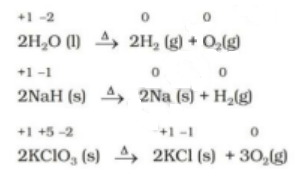 It may be emphasised that the assumption Of electron transfer is made for book-keeping Purpose only and it will become obvious at a Later stage in this unit that it leads to the simple Description of redox reactions. Oxidation number denotes the Oxidation state of an element in a Compound ascertained according to a set Of rules formulated on the basis that electron pair in a covalent bond belongs Entirely to more electronegative element. It is not always possible to remember or Make out easily in a compound/ ion, which Element is more electronegative than the other. Therefore, a set of rules has been formulated To determine the oxidation number of an Element in a compound/ ion. We may at this stage, state the rules for the Calculation of oxidation number. These rules are: 1.) In elements, in the free or the uncombined State, each atom bears an oxidation Number of zero. Evidently each atom in H2, O2, Cl2, O3, P4, S8, Na, Mg, Al has the Oxidation number zero. 2.) For ions composed of only one atom, the Oxidation number is equal to the charge On the ion. Thus Na+ Ion has an oxidation Number of +1, Mg2+ ion +2 , Fe3+ ion, +3, Cl – Ion, –1, O2 – ion, –2; and so on. In their Compounds all alkali metals have Oxidation number of +1, and all alkaline Earth metals have an oxidation number of +2. Aluminium is regarded to have an Oxidation number of +3 in all its Compounds. 3.) The oxidation number of oxygen in most Compounds is –2. However, we come across Two kinds of exceptions here. One arises In the case of peroxides and superoxides, The compounds of oxygen in which oxygen Atoms are directly linked to each other. While in peroxides (e.g., H2 O2, Na2 O2), each Oxygen atom is assigned an oxidation Number of –1, in superoxides (e.g., K O2, Rb O2) each oxygen atom is assigned an Oxidation number of –(½). The second Exception appears rarely, i.e. when oxygen Is bonded to fluorine. In such compounds e.g., oxygen difluoride (OF2) and dioxygen difluoride (O2F2), the oxygen is assigned an oxidation number of +2 and +1, respectively. The number assigned to oxygen will depend upon the bonding state of oxygen but this number would now be a positive figure only. 4.) The oxidation number of hydrogen is +1, Except when it is bonded to metals in binary Compounds (that is compounds containing Two elements). For example, in LiH, NaH, And Ca H2, its oxidation number is –1. 5.) In all its compounds, fluorine has an Oxidation number of –1. Other halogens (Cl, Br, and I) also have an oxidation number Of –1, when they occur as halide ions in Their compounds. Chlorine, bromine and Iodine when combined with oxygen, for Example in oxoacids and oxoanions, have Positive oxidation numbers. 6.) The algebraic sum of the oxidation number Of all the atoms in a compound must be Zero. In polyatomic ion, the algebraic sum Of all the oxidation numbers of atoms of The ion must equal the charge on the ion. Thus, the sum of oxidation number of three Oxygen atoms and one carbon atom in the Carbonate ion, (CO3) 2– must equal –2. A term that is often used interchangeably With the oxidation number is the oxidation State. Thus in CO2, the oxidation state of Carbon is +4, that is also its oxidation number And similarly the oxidation state as well as Oxidation number of oxygen is – 2. This implies That the oxidation number denotes the Oxidation state of an element in a compound. The oxidation number/state of a metal in a Compound is sometimes presented according To the notation given by German chemist, Alfred Stock. It is popularly known as Stock Notation. According to this, the oxidation Number is expressed by putting a Roman Numeral representing the oxidation number In parenthesis after the symbol of the metal in The molecular formula. Thus aurous chloride And auric chloride are written as Au(I)Cl and Au(III)Cl3. Similarly, stannous chloride and Stannic chloride are written as Sn(II) Cl2 and Sn(IV)Cl4. This change in oxidation number Implies change in oxidation state, which in Turn helps to identify whether the species is Present in oxidised form or reduced form. Thus, Hg2(I) Cl2 is the reduced form of Hg(II) Cl2.