Question
We must bear in mind that when Mendeleev developed his Periodic Table, chemists knew nothing about the internal structure of atom. However, the beginning of the 20th century witnessed profound developments in theories about sub-atomic particles. In 1913, the English physicist, Henry Moseley observed regularities in the characteristic X-ray spectra of the elements. A plot of ν (whereν is frequency of X-rays emitted) against atomic number (Z ) gave a straight line and not the plot of ν vs atomic mass. He thereby showed that the atomic number is a more fundamental property of an element than its atomic mass. Mendeleev’s Periodic Law was, therefore, accordingly modified. This is known as the Modern Periodic Law and can be stated as : The physical and chemical properties of the elements are periodic functions of their atomic numbers.Numerous forms of Periodic Table have been devised from time to time. Some forms emphasise chemical reactions and valence, whereas others stress the electronic configuration of elements. A modern version, the so-called “long form” of the Periodic Table of the elements , is the most convenient and widely used. The horizontal rows (which Mendeleev called series) are called periods and the vertical columns, groups. Elements having similar outer electronic configurations in their atoms are arranged in vertical columns, referred to as groups or families. According to the recommendation of International Union of Pure and Applied Chemistry (IUPAC), the groups are numbered from 1 to 18 replacing the older notation of groups IA … VIIA, VIII, IB … VIIB and 0. There are altogether seven periods. The period number corresponds to the highest principal quantum number (n) of the elements in the period. The first period contains 2 elements. The subsequent periods consists of 8, 8, 18, 18 and 32 elements, respectively. The seventh period is incomplete and like the sixth period would have a theoretical maximum (on the basis of quantum numbers) of 32 elements. In this form of the Periodic Table, 14 elements of both sixth and seventh periods (lanthanoids and actinoids, respectively) are placed in separate panels at the bottom. the IUPAC has made recommendation that until a new element’s discovery is proved, and its name is officially recognised, a systematic nomenclature be derived directly from the atomic number of the element using the numerical roots for 0 and numbers 1-9. The roots are put together in order of digits which make up the atomic number and “ium” is added at the end.Groupwise Electronic Configurations Elements in the same vertical column or group have similar valence shell electronic configurations, the same number of electrons in the outer orbitals, and similar properties. theoretical foundation for the periodic classification. The elements in a vertical column of the Periodic Table constitute a group or family and exhibit similar chemical behaviour. This similarity arises because these elements have the same number and same distribution of electrons in their outermost orbitals. We can classify the elements into four blocks viz., s-block, p-block, d-block and f-block depending on the type of atomic orbitals that are being filled with electrons. Two exceptions to this categorisation. Strictly, helium belongs to the s-block but its positioning in the p-block along with other group 18 elements is justified because it has a completely filled valence shell (1s) and as a result, exhibits properties characteristic of other noble gases. The other exception is hydrogen. It has only one s-electron and hence can be placed in group 1 (alkali metals). It can also gain an electron to achieve a noble gas arrangement and hence it can behave similar to a group 17 (halogen family) elements. Because it is a special case, we shall place hydrogen separately at the top of the Periodic Table.
  1. In 1913, the English physicist, ….observed regularities in the characteristic X-ray spectra of the elements.
  1. Johann Dobereiner
  2. John Alexander Newlands
  3. Demitri Mendeleev
  4. Henry Moseley
  1. Horizontal row in periodic table called:
  1. Group
  2. Period
  3. Triad
  4. Octave
  1. Vertical Column in periodic table called:
  1. Group
  2. Period
  3. Triad
  4. Octave
  1. According to Modern Periodic Law the physical and chemical properties of the elements are periodic functions of their ….
  1. Atomic mass
  2. Atomic numbers
  3. Atomic structure
  4. Atomic size
  1. What is IUPAC name of element having atomic number 107.
  1. Unnilpentium
  2. Unnilhexium
  3. Unnilseptium
  4. Unniloctium

Answer

  1. (d) Henry Moseley
  1. (b) Period
  1. (a) Group
  1. (b) Atomic numbers
  1. (c) Unnilseptium

Need a full question paper?

Generate a complete, print-ready paper with questions like this in minutes — across 16+ boards, with answer keys.

Start Generating Free

Similar questions

Lewis dot structures, in general, do notrepresent the actual shapes of the molecules.In case of polyatomic ions, the net charge ispossessed by the ion as a whole and not by aparticular atom. It is, however, feasible toassign a formal charge on each atom. Theformal charge of an atom in a polyatomicmolecule or ion may be defined as thedifference between the number of valenceelectrons of that atom in an isolated or freestate and the number of electrons assignedto that atom in the Lewis structure. It isexpressed as :Generally the lowest energystructure is the one with the smallestformal charges on the atoms. The formalcharge is a factor based on a pure covalentview of bonding in which electron pairsare shared equally by neighbouring atoms. The octet rule, though useful, is not universal.It is quite useful for understanding thestructures of most of the organic compoundsand it applies mainly to the second periodelements of the periodic table. There are threetypes of exceptions to the octet rule.
  • The incomplete octet of the central atom
  • Odd-electron molecules
  • The expanded octetFrom the Kössel and Lewis treatment of theformation of an ionic bond, it follows that theformation of ionic compounds wouldprimarily depend upon:
  • The ease of formation of the positive andnegative ions from the respective neutralatoms;
  • The arrangement of the positive andnegative ions in the solid, that is, thelattice of the crystalline compound.
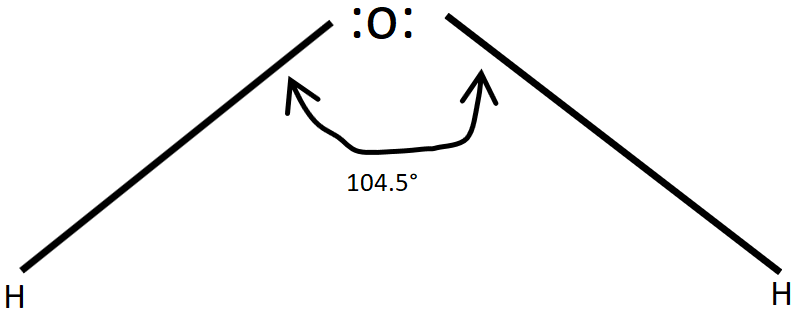
The Lattice Enthalpy of an ionic solid is defined as the energy required to completely separate one mole of a solid ionic compound into gaseous constituent ions. For example, the lattice enthalpy of NaCl is 788 kJ mol–1. This means that 788 kJ of energy is required to separate one mole of solid NaCl into one mole of Na+ (g) and one mole of Cl– (g) to an infinite distance.Bond length is defined as the equilibriumdistance between the nuclei of two bondedatoms in a molecule. Bond lengths aremeasured by spectroscopic, X-ray diffractionand electron-diffraction techniques . The covalent radius is measuredapproximately as the radius of an atom’score which is in contact with the core ofan adjacent atom in a bonded situation. The vander Waals radius represents the overall sizeof the atom which includes its valence shellin a nonbonded situation. Bond Angle is defined as the angle between the orbitalscontaining bonding electron pairs around thecentral atom in a molecule/complex ion. Bondangle is expressed in degree which can beexperimentally determined by spectroscopicmethods. It gives some idea regarding thedistribution of orbitals around the centralatom in a molecule/complex ion and hence ithelps us in determining its shape. Forexample H–O–H bond angle in water can berepresented as under:

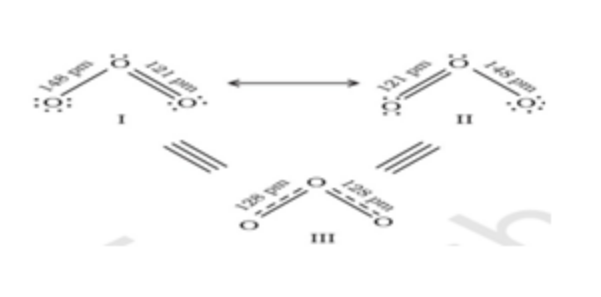
Bond Enthalpy It is defined as the amount of energy required to break one mole of bonds of a particular type between two atoms in a gaseous state. The unit of bond enthalpy is $kJ mol ^{-1}$. For example, the $H - H$ bond enthalpy in hydrogen molecule is $435.8 kJ mol ^{-1} \cdot H _2(g) \rightarrow H ( g )+ H ( g ) ; \Delta_{ a } H =435.8 kJ mol ^{-1}$. Bond Orderln the Lewis description of covalent bond, the Bond Order is given by the number ofbonds between the two atoms in amolecule. The bond order, for example in $H _2$ (with a single shared electron pair), in $O _2$ (with two shared electron pairs) and in $N _2$ (with three shared electron pairs) is 1,2,3respectively. A general correlation useful forunderstanding the stablities of moleculesis that: with increase in bond order, bondenthalpy increases and bond lengthdecreases. The concept of resonance was introducedto deal with the type of difficulty experiencedin the depiction of accurate structures ofmolecules like $O _3$. According to the conceptof resonance, whenever a single Lewis structure cannot describe a moleculeaccurately, a number of structures with similar energy, positions of nuclei, bonding and non-bonding pairs of electrons are taken as the canonical structures of the hybrid which describes the molecule accurately.

Thus for $O_3$, the two structures shown above constitute the canonical structures or resonance structures and their hybrid i.e., theIII structure represents the structure of $O_3$ more accurately. This is also called resonance hybrid. Resonance is represented by a double headed arrow. In general, it may be stated that
  • Resonance stabilizes the molecule as the energy of the resonance hybrid is lessthan the energy of any single cannonical structure; and,
  • Resonance averages the bond characteristics as a whole. Thus the energy of the$O_3$ . resonancehybrid is lower than either of the two cannonical froms I and II.
  1. Which of the following techniques used to measure bond length?
  1. Spectroscopic techniques
  2. X-ray diffraction
  3. Electron-diffraction techniques
  4. All the above
  1. The unit of bond enthalpy is …
  1. $kJ mol^{–1}$
  2. $Cal mol^{-1}$
  3. $Cal$ mol
  4. $kJ$ mol
  1. With increase in bond order, bond enthalpy… and bond length ….
  1. Decreases, decreases
  2. Increases, decreases
  3. Increases, increases
  4. Decreases, increases
  1. The …. is measured approximately as the radius of an atom’s core which is in contact with the core of an adjacent atom in a bonded situation.
  1. Ionic radius
  2. Metallic radius
  3. Covalent radius
  4. None of above
  1. … is given by the number of bonds between the two atoms in a molecule.
  1. Bond Order
  2. Bond size
  3. Bond enthalpy
  4. Bond angle
The idea of oxidation number has been invariably applied to define oxidation, reduction, oxidising agent (oxidant), reducing agent (reductant) and the redox reaction. To summarise, we may say that:
Oxidation: An increase in the oxidation number of the element in the given substance.
Reduction: A decrease in the oxidation number of the element in the given substance.
Oxidising agent: A reagent which can increase the oxidation number of an element in a given substance. These reagents are called as oxidants also.
Reducing agent: A reagent which lowers the oxidation number of an element in a given substance. These reagents are also called as reductants.
Redox reactions: Reactions which involve change in oxidation number of the interacting species.
Types of Redox Reactions
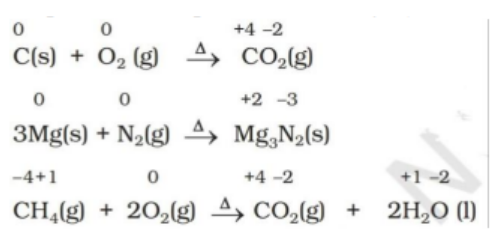
1.) Combination reactions -A combination reaction may be denoted in the manner:
$A + B → C$
Either A and B or both A and B must be in the elemental form for such a reaction to be a redox reaction. All combustion reactions, which make use of elemental dioxygen, as well as other reactions involving elements other than dioxygen, are redox reactions. Some important examples of this category are:

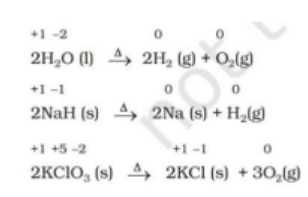
2.) Decomposition reactions- Decomposition reactions are the opposite of combination reactions. Precisely, a decomposition reaction leads to the breakdown of a compound into two or more components at least one of which must be in the elemental state.
Examples of this class of reactions are:

It may carefully be noted that there is no change in the oxidation number of hydrogen in methane under combination reactions and that of potassium in potassium chlorate in reaction. This may also be noted here that all decomposition reactions are not redox reactions. For example, decomposition of calcium carbonate is not a redox reaction.
3.) Displacement reactions- In a displacement reaction, an ion (or an atom) in a compound is replaced by an ion (or an atom) of another element. It may be denoted as:
$X + YZ → XZ + Y$
Displacement reactions fit into two categories: metal displacement and non-metal displacement.
(a) Metal displacement: A metal in a compound can be displaced by another metal in the uncombined state. Metal displacement reactions find many applications in metallurgical processes in which pure metals are obtained from their compounds in ores.
(b) Non-metal displacement: The non-metal displacement redox reactions include hydrogen displacement and a rarely occurring reaction involving oxygen displacement. All alkali metals and some alkaline earth metals (Ca, Sr, and Ba) which are very good reductants, will displace hydrogen from cold water. Many metals, including those which do not react with cold water, are capable of displacing hydrogen from acids. Dihydrogen from acids may even be produced by such metals which do not react with steam. Cadmium and tin are the examples of such metals.
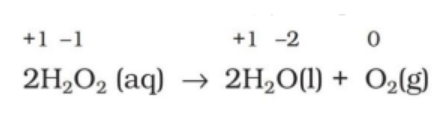
4.) Disproportionation reactions – Disproportionation reactions are a special type of redox reactions. In a disproportionation reaction an element in one oxidation state is simultaneously oxidised and reduced. One of the reacting substances in a disproportionation reaction always contains an element that can exist in at least three oxidation states. The element in the form of reacting substance is in the intermediate oxidation state; and both higher and lower oxidation states of that element are formed in the reaction. The decomposition of hydrogen peroxide is a familiar example of the reaction, where oxygen experiences disproportionation.

Here the oxygen of peroxide, which is present in –1 state, is converted to zero oxidation state in $O2$ and decreases to –2 oxidation state in $H_2O$.
  1. In … an ion (or an atom) in a compound is replaced by an ion (or an atom) of another element.
  1. displacement reaction
  2. decomposition reaction
  3. disproportionation reaction
  4. combination reaction
  1. leads to the breakdown of a compound into two or more components at least one of which must be in the elemental state.
  1. displacement reaction
  2. decomposition reaction
  3. disproportionation reaction
  4. combination reaction
  1. In …. an element in one oxidation state is simultaneously oxidised and reduced.
  1. displacement reaction
  2. decomposition reaction
  3. disproportionation reaction
  4. combination reaction
  1. Reactions which involve change in oxidation number of the interacting species…
  1. Exothermic reaction
  2. Endothermic reaction
  3. Neutralization reaction
  4. Redox reaction
  1. One of the reacting substances in a disproportionation reaction always contains an element that can exist in at least … oxidation states.
  1. 1
  2. 2
  3. 3
  4. 4
Read the passage given below and answer the following questions from (i) to (v).
Relation between Ka and Kb – Ka and Kb represent the strength of an acid and a base, respectively. In case of a conjugate acid-base pair, they are related in a simple manner so that if one is known, the other can be deduced. Considering the example of $NH_4^+$ and $NH_3$ we see,
${\text{NH}_4}^+{_{(\text{aq})}+\text{H}_2\text{O}_{(\text{l})}}\rightleftharpoons{\text{H}_3\text{O}}{^+}_{(\text{aq})}+\text{NH}_{3(\text{aq})}$
$\text{Ka}=\frac{[\text{H}_3\text{O}^+][\text{NH}_3]}{{[\text{NH}_4}^{+}]}=5.6\times10^{-10}$
$\text{NH}_{3(\text{aq})}+\text{H}_2\text{O}_{(\text{l})}\rightleftharpoons{{\text{NH}_4}^+}_{(\text{aq})}+{\text{OH}^-}_{(\text{aq})}$
$\text{Kb}=\frac{[{\text{NH}_4}^+][\text{OH}^-]}{[\text{NH}_3]}=1.8\times10^{-5}$
$\text{Net}:2{\text{H}_2\text{O}_{(\text{l})}}\rightleftharpoons{\text{H}_3\text{O}}{^+}_{(\text{aq})}+{\text{OH}^-}_{(\text{aq})}$
$\text{Kw}=[\text{H}_3\text{O}^+][\text{OH}^-]=1.0\times10^{-14}\text{M}$
Where, Ka represents the strength of $NH_4^+$ as an acid and Kb represents the strength of $NH_3$ as a base. It can be seen from the net reaction that the equilibrium constant is equal to the product of equilibrium constants Ka and Kb for the reactions added. Thus,
$\text{Ka}\times\text{Kb}=\Big\{\frac{[\text{H}_3\text{O}^+][\text{NH}_3]}{[{\text{NH}_4}^+]}\Big\}\times\Big\{\frac{[{\text{NH}_4}^+][\text{OH}^-]}{[\text{NH}_3]}\Big\}$
$= [H_3O^+ ][ OH^– ] = Kw = (5.6\times 10^{–10}) \times (1.8 \times 10^{–5}) = 1.0 \times 10^{–14} M$
This can be extended to make a generalisation. The equilibrium constant for a net reaction obtained after adding two (or more) reactions equals the product of the equilibrium constants for individual reactions:
$K_{NET} = K1 \times K2 \times$ ……
Similarly, in case of a conjugate acid-base pair,
Ka × Kb = Kw
Knowing one, the other can be obtained. It should be noted that a strong acid will have a weak conjugate base and vice-versa. Alternatively, the above expression
Kw = Ka × Kb, can also be obtained by considering the base-dissociation equilibrium reaction:
$\text{B}_{(\text{aq})}+\text{H}_2\text{O}_{(\text{l})}\rightleftharpoons{\text{BH}^+}_{(\text{aq})}+{\text{OH}^-}_{(\text{aq})}$
$\text{Kb}=\frac{[\text{BH}^+][\text{OH}^-]}{[\text{B}]}$
As the concentration of water remains constant it has been omitted from the denominator and incorporated within the dissociation constant. Then multiplying and dividing the above expression by $[H^+]$, we get:
$\text{Kb}=\frac{[\text{BH}^+][\text{OH}^-][\text{H}^+]}{[\text{B}][\text{H}^+]}$
$=\frac{[\text{OH}^-][\text{H}^+][\text{BH}^+]}{[\text{B}][\text{H}^+]}$
$=\frac{\text{Kw}}{\text{Ka}}$
or Ka × Kb = Kw
It may be noted that if we take negative logarithm of both sides of the equation, then pK values of the conjugate acid and base are related to each other by the equation:
pKa + pKb = pKw = 14 (at 298K)
Factors Affecting Acid Strength Having discussion on quantitatively the strengths of acids and bases, we come to a stage where we can calculate the pH of a given acid solution. But, the curiosity rises about why should some acids be stronger than others? What factors are responsible for making them stronger? The answer lies in its being a complex phenomenon. But, broadly speaking we can say that the extent of dissociation of an acid depends on the strength and polarity of the H-A bond. In general, when strength of H-A bond decreases, that is, the energy required to break the bond decreases, HA becomes a stronger acid. Also, when the H-A bond becomes more polar i.e., the electronegativity difference between the atoms H and A increases and there is marked charge separation, cleavage of the bond becomes easier thereby increasing the acidity. But it should be noted that while comparing elements in the same group of the periodic table, H-A bond strength is a more important factor in determining acidity than its polar nature. As the size of A increases down the group, H-A bond strength decreases and so the acid strength increases. For example,
Size increases
$HF << HCl << HBr << HI$
Acid strength increases
Similarly, $H_2S$ is stronger acid than $H_2O$. But, when we discuss elements in the same row of the periodic table, H-A bond polarity becomes the deciding factor for determining the acid strength. As the electronegativity of A increases, the strength of the acid also increases. For example,
Electronegativity of A increases
$CH4 < NH_3 < H_2O < HF$
Acid strength increases
Common Ion Effect in the Ionization of Acids and Bases Consider an example of acetic acid dissociation equilibrium represented as:
$CH3COOH_{(aq)} H^+_{(aq)} + CH3COO^–_{(aq)}$
or $HAc_{(aq)} H^+_{(aq)} + Ac^–_{(aq)}$
$\text{Ka}=\frac{[\text{H}^+][\text{Ac}^-]}{[\text{HAc}]}$
Addition of acetate ions to an acetic acid solution results in decreasing the concentration of hydrogen ions, $[H^+ ]$. Also, if $H^+$ ions are added from an external source then the equilibrium moves in the direction of undissociated acetic acid i.e., in a direction of reducing the concentration of hydrogen ions, $[H^+]$. This phenomenon is an example of common ion effect. It can be defined as a shift in equilibrium on adding a substance that provides more of an ionic species already present in the dissociation equilibrium. Thus, we can say that common ion effect is a phenomenon based on the Le Chatelier’s principle discussed earlier. In order to evaluate the pH of the solution resulting on addition of 0.05M acetate ion to 0.05M acetic acid solution, we shall consider the acetic acid dissociation equilibrium once again,
$\text{HAc}_{(\text{aq})}\rightleftharpoons{\text{H}^+}_{(\text{aq})}+{\text{Ac}^-}_{(\text{aq})}$
Initial concentration (M)
0.05 0 0.05
Let x be the extent of ionization of acetic acid.
Change in concentration (M)
-x +x +x
Equilibrium concentration (M)
0.05-x. x 0.05+x
Therefore, $\text{Ka}=\frac{[\text{H}^+][\text{Ac}^-]}{\text{HAc}}=\Big\{\frac{(0.05+\text{x})(\text{x})}{(0.05-\text{x})}\Big\}$
As Ka is small for a very weak acid, x<<0.05.
Hence, $(0.05+\text{x})\approx(0.05-\text{x})\approx0.05$
Thus, $=1.8\times10-5=\frac{(\text{x})(0.05+\text{x})}{(0.05-\text{x})}$
$=\frac{\text{x}(0.05)}{(0.05)}=\text{x}=[\text{H}^+]=1.8\times10^{-5}\text{M}$
$\text{pH}=-\log(1.8\times10^{-5})=4.74$
Buffer Solutions Many body fluids e.g., blood or urine have definite pH and any deviation in their pH indicates malfunctioning of the body. The control of pH is also very important in many chemical and biochemical processes. Many medical and cosmetic formulations require that these be kept and administered at a particular pH. The solutions which resist change in pH on dilution or with the addition of small amounts of acid or alkali are called Buffer Solutions. Buffer solutions.
Common Ion Effect on Solubility of Ionic Salts– It is expected from Le Chatelier’s principle that if we increase the concentration of any one of the ions, it should combine with the ion of its opposite charge and some of the salt will be precipitated till once again Ksp = Qsp . Similarly, if the concentration of one of the ions is decreased, more salt will dissolve to increase the concentration of both the ions till once again Ksp = Qsp . This is applicable even to soluble salts like sodium chloride except that due to higher concentrations of the ions, we use their activities instead of their molarities in the expression for Qsp . Thus if we take a saturated solution of sodium chloride and pass HCl gas through it, then sodium chloride is precipitated due to increased concentration (activity) of chloride ion available from the dissociation of HCl. Sodium chloride thus obtained is of very high purity and we can get rid of impurities like sodium and magnesium sulphates. The common ion effect is also used for almost complete precipitation of a particular ion as its sparingly soluble salt, with very low value of solubility product for gravimetric estimation. Thus we can precipitate silver ion as silver chloride, ferric ion as its hydroxide (or hydrated ferric oxide) and barium ion as its sulphate for quantitative estimations.
  1. H-A bond strength … and so the acid strength:
  1. Decreases, increases
  2. Increases, increases
  3. Increases, decreases
  4. Decreases, decreases
  1. As the electronegativity of A … the strength of the acid also:
  1. Decreases, increases
  2. Increases, increases
  3. Increases, decreases
  4. Decreases, decreases
  1. If the concentration of one of the ions is … more salt will dissolve to … the concentration of both the ions till once again Ksp = Qsp.
  1. Decreases, increases
  2. Increases, increases
  3. Increases, decreases
  4. Decreases, decreases
  1. The solutions which resist change in pH on dilution or with the addition of small amounts of acid or alkali are called:
  1. Neutral solution
  2. Basic solution
  3. Acidic solution
  4. Buffer solution
  1. When the H-A bond becomes more polar then the cleavage of the bond becomes easier thereby increasing the:
  1. Acidity
  2. Basicity
  3. Aromaticity
  4. Alkalinity

A process or change is said to be reversible, if a change is brought out in such a way that the process could, at any moment, be reversed by an infinitesimal change. A reversible process proceeds infinitely slowly by a series of equilibrium states such that system and the surroundings are always in near equilibrium with each other. Processes other than reversible processes are known as irreversible processes.
Isothermal and free expansion of an ideal gas For isothermal (T = constant) expansion of an ideal gas into vacuum; w = 0 since pex = 0. Also, Joule determined experimentally that q = 0; therefore, $\triangle\text{U}=0, \triangle =+\text{Uqw}$ can be expressed for isothermal irreversible and reversible changes as follows:
  1. For isothermal irreversible change
$\text{q}=-\text{w}=\text{nRTIn}\frac{\text{V}_\text{f}}{\text{V}_{\text{i}}}$
$=2.303\ \text{nRT}\log\frac{\text{V}_\text{f}}{\text{V}_{\text{i}}}$
  1. For isothermal reversible change
  2. For adiabatic change, q = 0
$\triangle\text{U}=\text{w}_{\text{ad}}$
In thermodynamics, a distinction is made between extensive properties and intensive properties. An extensive property is a property whose value depends on the quantity or size of matter present in the system. For example, mass, volume, internal energy, enthalpy, heat capacity, etc. are extensive properties. Those properties which do not depend on the quantity or size of matter present are known as intensive properties. For example temperature, density, pressure etc. are intensive properties. A molar property, χm, is the value of an extensive property χ of the system for 1 mol of the substance. If n is the amount of matter, χ χ m = n is independent of the amount of matter. Other examples are molar volume .
Measurement of $\triangle\text{U}$ and $\triangle{Η}$: Calorimetry We can measure energy changes associated with chemical or physical processes by an experimental technique called calorimetry. In calorimetry, the process is carried out in a vessel called calorimeter, which is immersed in a known volume of a liquid. Knowing the heat capacity of the liquid in which calorimeter is immersed and the heat capacity of calorimeter, it is possible to determine the heat evolved in the process by measuring temperature changes. Measurements are made under two different conditions: i) at constant volume, qV ii) at constant pressure, qP
Explain the determination of DeltaU of a reaction calorimetrically.
∆U Measurements For chemical reactions, heat absorbed at constant volume, is measured in a bomb calorimeter. Here, a steel vessel (the bomb) is immersed in a water bath. The whole device is called calorimeter. The steel vessel is immersed in water bath to ensure that no heat is lost to the surroundings. A combustible substance is burnt in pure dioxygen supplied in the steel bomb. Heat evolved during the reaction is transferred to the water around the bomb and its temperature is monitored. Since the bomb calorimeter is sealed, its volume does not change i.e., the energy changes associated with reactions are measured at constant volume. Under these conditions, no work is done as the reaction is carried out at constant volume in the bomb calorimeter. Even for reactions involving gases, there is no work done as $\triangle\text{v}=0$ Temperature change of the calorimeter produced by the completed reaction is then converted to qV, by using the known heat capacity of the calorimeter with the help of equation
b)$\triangle{Η}$ Measurements Measurement of heat change at constant pressure (generally under atmospheric pressure) can be done in a calorimeter shown in Figure. We know that $\triangle{Η}=\text{qp}$ (at constant p) and, therefore, heat absorbed or evolved, qP at constant pressure is also called the heat of reaction or enthalpy of reaction, $\triangle\text{rΗ}$ In an exothermic reaction, heat is evolved, and system loses heat to the surroundings. Therefore, qP will be negative and ∆rH will also be negative. Similarly in an endothermic reaction, heat is absorbed, qP is positive and $\triangle\text{rΗ}$ will be positive.
THERMODYNAMICS - NCERT Class 11 Chemistry
  1. For adiabatic change, q = 0 then …
  1. $\triangle\text{U}=\text{w}_{\text{ad}}$
  2. $\triangle\text{U}=\text{q}+\text{w}$
  3. $\triangle\text{U}=\text{w}-\text{q}$
  4. $\triangle\text{U}=\text{w}_{\text{rev}}$
  1. The technique for measure energy changes associated with chemical or physical processes by an experimental technique called …
  1. Colourimetry
  2. Calorimetry
  3. Titration
  4. Photometry
  1. A property whose value depends on the quantity or size of matter present in the system is known as …
  1. Extensive
  2. Intensive
  3. Reversible
  4. Irreversible
  1. If there is no work done …
  1. V = 0
  2. V = 1
  3. V = 2
  4. V = 3
  1. In an endothermic reaction, heat is absorbed, qP is … and $\triangle\text{rΗ}$ will be …
  1. Positive, Positive
  2. Negative, Negative
  3. Positive, Negative
  4. Negative, Positive
When anions and cations approach each other, the valence shell of anions are pulled towards the cation nucleus and thus, the shape of the anion is deformed. The phenomenon of deformation of anion by a cation is known as polarization and the ability of the cation to polarize the anion is called as polarizing power of cation. Due to polarization, sharing of electrons occurs between two ions to some extent and the bond shows some covalent character.
The magnitude of polarization depends upon a number of factors.

1. Out of $AlCl _3$ and $AlI _3$ which halides show maximum polarization? (1)
2. Out of $AlCl _3$ and $CaCl _2$ which one is more covalent in nature? (1)
3. The non-aqueous solvent like ether is added to the mixture of $LiCl , NaCl$ and KCl . Which will be extracted into the ether? (2)
OR
Out of $CaF _2$ and $CaI _2$ which one has a minimum melting point? (2)
IUPAC (International Union of Pure and Applied Chemistry) system of nomenclature. Common names are useful and in many cases indispensable, particularly when the alternative systematic names are lengthy and complicated. A systematic name of an organic compound is generally derived by identifying the parent hydrocarbon and the functional group(s) attached to it. By using prefixes and suffixes, the parent name can be modified to obtain the actual name. In a branched-chain compound, small chains of carbon atoms are attached at one or more carbon atoms of the parent chain. The small carbon chains (branches) are called alkyl groups. An alkyl group is derived from a saturated hydrocarbon by removing a hydrogen atom from carbon. Abbreviations are used for some alkyl groups. For example, methyl is abbreviated as Me, ethyl as Et, propyl as Pr and butyl as Bu.

1. Draw the structure of 3-Ethyl-4,4-dimethylheptane. (1)
2. How is the numbering in branched chain hydrocarbon done?
3. Derive the structure of 2-Chlorohexane. (2)
OR
Why $CH _4$ after becoming- $CH _3$ called a methyl group? (2)
The s-Block Elements The elements of Group 1 (alkali metals) and Group 2 (alkaline earth metals) which have ns1and ns2 outermost electronic configuration belong to the s-Block Elements. They are all reactive metals with low ionization enthalpies. They lose the outermost electron(s) readily to form 1+ ion (in the case of alkali metals) or 2+ ion (in the case of alkaline earth metals). The metallic character and the reactivity increase as we go down the group. Because of high reactivity they are never found pure in nature. The compounds of the s-block elements, with the exception of those of lithium and beryllium are predominantly ionic. The p-Block Elements comprise those belonging to Group 13 to 18 and these together with the s-Block Elements are called the Representative Elements or Main Group Elements. The outermost electronic configuration varies from ns2np1 to ns2np6 in each period. At the end of each period is a noble gas element with a closed valence shell ns2np6 configuration. All the orbitals in the valence shell of the noble gases are completely filled by electrons and it is very difficult to alter this stable arrangement by the addition or removal of electrons. The noble gases thus exhibit very low chemical reactivity. Preceding the noble gas family are two chemically important groups of non-metals. They are the halogens (Group 17) and the chalcogens (Group 16).The non-metallic character increases as we move from left to right across a period and metallic character increases as we go down the group. These are the elements of Group 3 to 12 in the centre of the Periodic Table. These are characterised by the filling of inner d orbitals by electrons and are therefore referred to as d-Block Elements. These elements have the general outer electronic configuration (n-1)d1-10ns0-2 . They are all metals. They mostly form coloured ions, exhibit variable valence (oxidation states), paramagnetism and oftenly used as catalysts. However, Zn, Cd and Hg which have the electronic configuration, (n-1) d10ns2 do not show most of the properties of transition elements. In a way, transition metals form a bridge between the chemically active metals of s-block elements and the less active elements of Groups 13 and 14 and thus take their familiar name “Transition Elements”.The two rows of elements at the bottom of the Periodic Table, called the Lanthanoids, Ce(Z = 58) – Lu(Z = 71) and Actinoids, Th(Z = 90) – Lr (Z = 103) are characterised by the outer electronic configuration (n-2)f 1-14 (n-1)d 0–1ns2 . The last electron added to each element is filled in f- orbital. These two series of elements are hence called the Inner- Transition Elements (f-Block Elements). They are all metals. Within each series, the properties of the elements are quite similar. The chemistry of the early actinoids is more complicated than the corresponding lanthanoids, due to the large number of oxidation states possible for these actinoid elements. Actinoid elements are radioactive. Many of the actinoid elements have been made only in nanogram quantities or even less by nuclear reactions and their chemistry is not fully studied. The elements after uranium are called Transuranium Elements. The elements can be divided into Metals and Non-Metals. In contrast, non-metals are located at the top right hand side of the Periodic Table. The elements become more metallic as we go down a group; the non- metallic character increases as one goes from left to right across the Periodic Table. Periodic Table show properties that are characteristic of both metals and non- metals. These elements are called Semi-metals or Metalloids.
  1. Alkali metal and alkaline earth metal belongs to ..
  1. S – block
  2. P – block
  3. D – block
  4. F – block
  1. The metallic character and the reactivity … as we go down the group.
  1. Decreases
  2. Increases
  3. Remains Constant
  4. None of Above
  1. Group … Elements known as chalcogens.
  1. 12
  2. 14
  3. 16
  4. 18
  1. Elements Ce(Z = 58) to Lu(Z = 71) are known as:
  1. Halogens
  2. Chalcogens
  3. Actinoids
  4. Lanthenoids
  1. The elements after uranium are called … Elements.
  1. Halogens
  2. Chalcogens
  3. Actinoids
  4. Transuranium
Read the passage given below and answer the following questions from 1 to 5.
Oxidation state and trends in chemical Reactivity Due to small size of boron, the sum of its first Three ionization enthalpies is very high. This Prevents it to form +3 ions and forces it to form Only covalent compounds. But as we move from B to Al, the sum of the first three ionisation Enthalpies of Al considerably decreases, and Is therefore able to form $Al^{3+}$ ions. In fact, Aluminium is a highly electropositive metal. However, down the group, due to poor Shielding effect of intervening d and f orbitals, The increased effective nuclear charge holds ns Electrons tightly (responsible for inert pair Effect) and thereby, restricting their Participation in bonding. As a result of this, Only p-orbital electron may be involved in Bonding. In fact in Ga, In and Tl, both +1 and +3 oxidation states are observed. The relative Stability of +1 oxidation state progressively Increases for heavier elements: A l< Ga < In< Tl. In Thallium +1 oxidation state is predominant whereas the +3 oxidation state is highly Oxidising in character. The compounds in +1 oxidation state, as expected from energy Considerations, are more ionic than those in +3 oxidation state.
Important trends and anomalous properties of boron – certain important trends can be observed in the chemical behaviour of group 13 elements. The tri-chlorides, bromides and iodides of all these elements being covalent in nature are hydrolysed in water. Species like tetrahedral $[M(OH)_4]^–$ and octahedral $[M(H_2O)6]^{3+}$, except in boron, exist in aqueous medium. The monomeric trihalides, being electron deficient, are strong Lewis acids. Boron trifluoride easily reacts with Lewis bases such as $NH_3$ to complete octet around boron. It is due to the absence of d orbitals that the maximum covalence of B is 4. Since the d orbitals are available with Al and other elements, the maximum covalence can be expected beyond 4. Most of the other metal halides (e.g., $AlCl_3$) are dimerised through halogen bridging (e.g., $Al2Cl_6$). The metal species completes its octet by accepting electrons from halogen in these halogen bridged molecules.
i) Reactivity towards air Boron is unreactive in crystalline form. Aluminium forms a very thin oxide layer on The surface which protects the metal from Further attack. Amorphous boron and Aluminium metal on heating in air form $B_2O_3$ And $Al_2O_3$ respectively. With dinitrogen at high Temperature they form nitrides. The nature of these oxides varies down the Group. Boron trioxide is acidic and reacts with Basic (metallic) oxides forming metal borates. Aluminium and gallium oxides are amphoteric And those of indium and thallium are basic in Their properties.
ii) Reactivity towards acids and alkalies Boron does not react with acids and alkalies Even at moderate temperature; but aluminium Dissolves in mineral acids and aqueous alkalies And thus shows amphoteric character. Aluminium dissolves in dilute HCl and Liberates dihydrogen.
$2Al(s) + 6HCl (aq) \rightarrow 2Al_3^+ (aq) + 6Cl^– (aq) + 3H_2 (g)$
However, concentrated nitric acid renders Aluminium passive by forming a protective Oxide layer on the surface. Aluminium also reacts with aqueous alkali And liberates dihydrogen.
$2Al (s) + 2NaOH(aq) + 6H_2O(l) \rightarrow 2 Na+ [Al(OH)_4]^– (aq) + 3H_2(g)$
Sodium Tetrahydroxoaluminate(III).
iii) Reactivity towards halogens These elements react with halogens to form Trihalides (except TlI3). $2E(s) + 3 X_2 (g) \rightarrow 2EX_3 (s) (X = F, Cl, Br, I)$
Borax- It is the most important compound of boron. It is a white crystalline solid of formula $Na_2B_4O_7⋅10H_2O$. In fact it contains the Tetranuclear units and correct Formula; therefore, is $Na2 [B4O5 (OH) 4].8H2O$. Borax dissolves in water to give an alkaline Solution.
$Na_2B_4O7 + 7H_2O \rightarrow 2NaOH + 4H_3BO_3$
On heating, borax first loses water Molecules and swells up. On further heating it Turns into a transparent liquid, which solidifies Into glass like material known as borax Bead. $Na_2B_4O_7.10H_2O \rightarrow Na^2B_4O_7\rightarrow 2NaBO_2+ B2O_3​​​​​​​$
Metaborate Boric Anhydride The metaborates of many transition metals Have characteristic colours and, therefore, Borax bead test can be used to identify them In the laboratory. For example, when borax is Heated in a Bunsen burner flame with CoO on A loop of platinum wire, a blue coloured Co(BO2) 2 bead is formed.
Orthoboric acid, $H_3BO_3$ is a white crystalline Solid, with soapy touch. It is sparingly soluble In water but highly soluble in hot water. It can Be prepared by acidifying an aqueous solution Of borax.
$Na_2B_4O_7 + 2HCl + 5H_2O \rightarrow 2NaCl + 4B(OH)_3​​​​​​​$
It is also formed by the hydrolysis (reaction With water or dilute acid) of most boron Compounds (halides, hydrides, etc.). It has a layer structure in which planar $BO_3$ units are Joined by hydrogen.
  1. Boron is … in crystalline form.
  1. unreactive
  2. highly reactive
  3. less reactive
  4. only (a) or (c)
  1. Orthoboric acid is …
  1. Amorphous
  2. Crystalline
  3. Polyamorphous
  4. None of above
  1. Aluminium and gallium oxides are … in their properties.
  1. acidic
  2. Basic
  3. amphoteric
  4. None of above
  1. Indium and thallium are … in their properties.
  1. acidic
  2. Alkali
  3. amphoteric
  4. basic
  1. Aluminium is a highly … metal.
  1. electronegative
  2. Neutral
  3. electropositive
  4. None of above
IUPAC (International Union of Pure and Applied Chemistry) system of nomenclature. Common names are useful and in many cases indispensable, particularly when the alternative systematic names are lengthy and complicated. A systematic name of an organic compound is generally derived by identifying the parent hydrocarbon and the functional group(s) attached to it. By using prefixes and suffixes, the parent name can be modified to obtain the actual name. In a branched-chain compound, small chains of carbon atoms are attached at one or more carbon atoms of the parent chain. The small carbon chains (branches) are called alkyl groups. An alkyl group is derived from a saturated hydrocarbon by removing a hydrogen atom from carbon. Abbreviations are used for some alkyl groups. For example, methyl is abbreviated as Me, ethyl as Et, propyl as Pr and butyl as Bu.

1. Draw the structure of 3-Ethyl-4,4-dimethylheptane. (1)
2. How is the numbering in branched chain hydrocarbon done? (1)
3. Derive the structure of 2-Chlorohexane. (2)
OR
Why $CH _4$ after becoming- $CH _3$ called a methyl group? (2)
There are many observable patterns in thephysical and chemical properties of elementsas we descend in a group or move across aperiod in the Periodic Table.Atomic Radius the determination of the atomic sizecannot be precise. In other words, there is no practical way by which the size of an individualatom can be measured. However, an estimateof the atomic size can be made by knowing thedistance between the atoms in the combinedstate. One practical approach to estimate thesize of an atom of a non-metallic element is tomeasure the distance between two atoms whenthey are bound together by a single bond in acovalent molecule and from this value, the“Covalent Radius” For metals, we define theterm “Metallic Radius” which is taken as halfthe internuclear distance separating the metalcores in the metallic crystal. Atomic Radius to refer to both covalent ormetallic radius depending on whether theelement is a non-metal or a metal. Atomic radiican be measured by X-ray or otherspectroscopic methods. The atomic size generallydecreases across a period. It is because within the period the outerelectrons are in the same valence shell and theeffective nuclear charge increases as the atomicnumber increases resulting in the increasedattraction of electrons to the nucleus.Note that the atomic radii of noble gasesAre not considered here. Being monoatomic,Their (non-bonded radii) values are very large.In fact radii of noble gases should be comparednot with the covalent radii but with the van derWaals radii of other elements. The removal of an electron from an atom resultsin the formation of a cation, whereas gain ofan electron leads to an anion. The ionic radiican be estimated by measuring the distancesbetween cations and anions in ionic crystals.In general, the ionic radii of elements exhibitthe same trend as the atomic radii. A cation issmaller than its parent atom because it hasfewer electrons while its nuclear charge remainsthe same. The size of an anion will be largerthan that of the parent atom because theaddition of one or more electrons would resultin increased repulsion among the electronsand a decrease in effective nuclear charge. When we find some atoms and ions whichcontain the same number of electrons, we callthem isoelectronic species. For example,$O2–, F–, Na+$ and $Mg2+$ have the same number ofelectrons (10). Their radii would be differentbecause of their different nuclear charges.A quantitative measure of the tendency of anelement to lose electron is given by itsIonization Enthalpy. It represents the energyrequired to remove an electron from an isolatedgaseous atom (X) in its ground state. The ionization enthalpy is expressed inunits of kJ mol–1. We can define the secondionization enthalpy as the energy required toremove the second most loosely boundelectron The first ionization enthalpies of elementshaving atomic numbers up to 60 are plotted then The periodicity of the graph is quitestriking. You will find maxima at the noble gaseswhich have closed electron shells and verystable electron configurations. On the otherhand, minima occur at the alkali metals andtheir low ionization enthalpies can be correlated with their high reactivity. In addition, you willnotice two trends the first ionization enthalpygenerally increases as we go across a periodand decreases as we descend in a group. Electron Gain Enthalpy. when an electron is added to a neutral gaseousatom (x) to convert it into a negative ion, theenthalpy change accompanying the process isdefined as the electron gain enthalpy (∆egh).Electron gain enthalpy provides a measure ofthe ease with which an atom adds an electronto form anion. electron gain enthalpies have largenegative values toward the upper right of theperiodic table preceding the noble gases.The variation in electron gain enthalpies ofelements is less systematic than for ionizationenthalpies. As a general rule, electron gainenthalpy becomes more negative with increasein the atomic number across a period. Theeffective nuclear charge increases from left toright across a period and consequently it willbe easier to add an electron to a smaller atomsince the added electron on an average wouldbe closer to the positively charged nucleus. ElectronegativityA qualitative measure of the ability of an atomin a chemical compound to attract sharedelectrons to itself is called electronegativity.Unlike ionization enthalpy and electron gainenthalpy, it is not a measureable quantity.However, a number of numerical scales ofelectronegativity of elements viz., Pauling scale,Mulliken-Jaffe scale, Allred-Rochow scale havebeen developed. The one which is the most widely used is the Pauling scale. Electronegativity generallyincreases across a period from leftto right (say from lithium tofluorine) and decrease down a group(say from fluorine to astatine) inthe periodic table. Non-metallic elements have strong tendencyto gain electrons. Therefore, electronegativityis directly related to that non-metallicproperties of elements. It can be furtherextended to say that the electronegativity isinversely related to the metallic properties of elements. Thus, the increase inelectronegativities across a period isaccompanied by an increase in non-metallicproperties (or decrease in metallic properties)of elements. Similarly, the decrease inelectronegativity down a group is accompanied by a decrease in non-metallic properties (orincrease in metallic properties) of elements.
  1. The atomic size generally … across a period.
  1. Increases
  2. Decreases
  3. Remains Constant
  4. None of above
  1. The ionization enthalpy is expressed in units of ….
  1. $kJ mol^{–1}$
  2. $mole kJ^{-1}$
  3. $mole kJ$
  4. $-kJ mol^{-1}$
  1. Which of the following is/are numerical scales of electronegativity of elements.
  1. Pauling scale
  2. Mulliken-Jaffe scale
  3. Allred-Rochow scale
  4. All the above
  1. The … in electronegativity down a group is accompanied by a … in non-metallic properties.
  1. Increase, Decrease
  2. Decrease, Increase
  3. Decrease, Decrease
  4. Increase , Increase
  1. Electronegativity generally … across a period from left to right and … down a group in the periodic table.
  1. Increase, Decrease
  2. Decrease, Increase
  3. Decrease, Decrease
  4. Increase, Increase