Question
Read the passage given below and answer the following questions:
Proteins are high molecular mass complex biomolecules of amino acids. The important proteins required for our body are enzymes, hormones, antibodies, transport proteins, structural proteins, contractile proteins etc. Except for glycine, all $\alpha$-amino acids have chiral carbon atom and most of them have L-configuration. The amino acids exists as dipolar ion called zwitter ion, in which a proton goes from the carboxyl group to the amino group. A large number of $\alpha$-amino acids are joined by peptide bonds forming polypeptides. The peptides having very large molecular mass (more than 10,000) are called proteins. The structure of proteins is described as primary structure giving sequence of linking of amino acids; secondary structure giving manner in which polypeptide chains are arranged and folded; tertiary structure giving folding, coiling or bonding polypeptide chains producing three dimensional structures and quaternary structure giving arrangement of sub-units in an aggregate protein molecule.
A statement of assertion followed by a statement of reason is given. Choose the correct answer out of the following choices.
  1. Assertion and reason both are correct statements and reason is correct explanation for assertion.
  2. Assertion and reason both are correct statements but reason is not correct explanation for assertion.
  3. Assertion is correct statement but reason is wrong statement.
  4. Assertion is wrong statement but reason is correct statement.
  1. Assertion: Except glycine, all naturally occurring CL-amino acids are optically active.
Reason: All naturally occurring CL-amino acids, except glycine, has at least one asymmetric carbon.
  1. Assertion: All amino acids are optically active.
Reason: Amino acids contain asymmetric carbon atoms.
  1. Assertion: In $\alpha$-helix structure, intramolecular H-bonding takes place whereas in $\beta$-pleated structure, intermolecular H-bonding takes place.
Reason: An egg contains a soluble globular protein called albumin which is present in the white part.
  1. Assertion: Secondary structure of protein refers to regular folding patterns of continuos portions of the polypeptide chain.
Reason: Out of 20 amino acids, only 12 amino acids can be synthesised by human body.
  1. Assertion: The helical structure of protein is stabilised by intramolecular hydrogen bond between -NH and carbonyl oxygen.
Reason: Sanger's reagent is used for the identification of N-tenninal amino acid of peptide chain.

Answer

  1. (a) Assertion and reason both are correct statements and reason is correct explanation for assertion.
  1. (d) Assertion is wrong statement but reason is correct statement.
Explanation:

All amino acids except glycine are optically active because they contain, asymmetric carbon atom. They exist in both D and L-forms. Most naturally occurring amino acids have L-configuration.
  1. (b) Assertion and reason both are correct statements but reason is not correct explanation for assertion.
Explanation:

In $\alpha$-helix structure, the formation of hydrogen bonds takes place between -CO- and -NH groups, whereas in $\beta$-pleated structure, hydrogen bonds are formed between amide groups of two different chains.
  1. (c) Assertion is correct statement but reason is wrong statement.
Explanation:

Out of 20 amino acids, only 10 amino acids can be synthesised by human body.
  1. (b) Assertion and reason both are correct statements but reason is not correct explanation for assertion.

Need a full question paper?

Generate a complete, print-ready paper with questions like this in minutes — across 16+ boards, with answer keys.

Start Generating Free

Similar questions

Read the passage given below and answer the following questions:
The halogen elements show great resemblances to one another in their chemical behaviour and properties of their compounds with other elements. There is, however, a progressive change in properties from F through $Cl, Br,$ and I to At. F is most reactive among the halogens and in fact, from all other elements and it has certain other properties that set it apart from the other halogens.
In these questions (Q.No. i - iv), a statement of assertion followed by a statement of reason is given. Choose the correct answer out of the following choices.
  1. Assertion and reason both are correct statements and reason is correct explanation for assertion.
  2. Assertion and reason both are correct statements but reason is not correct explanation for assertion.
  3. Assertion is correct statement but reason is wrong statement.
  4. Assertion is wrong statement but reason is correct statement.
  1. Assertion: $F_2 $ has high reactivity.
Reason: $F_2$ has low bond dissociation enthalpy.
  1. Assertion: The bond between $F - F$ is weaker than between $Cl - Cl.$
Reason: Atomic size of $F$ is smaller than that of $Cl.$
  1. Assertion: Fluoride does not show oxidation number greater than zero.
Reason: The halogens chlorine, bromine and iodine can show positive oxidation state of $+1, +3$ and $+7.$
  1. Assertion: F atom has less negative electron affinity than Cl atom.
Reason: Additional electrons are repelled more effectively by $3p-$electrons in $Cl$ than by $2p-$electrons in Fatom.
  1. Assertion: Fluorine is strongest oxidising agent in halogens.
Reason: It displaces other halogens from its aqueous solution.
Decrease in concentration of reactant or increase in concentration of product per unit time is called rate of reaction. lt is of two types:
  1. Instantaneous rate of reaction: Rate of change of concentration of reactant or product at a particular time is called instantaneous rate of reaction.
$\text{r}_\text{inst.}=\frac{\text{dC}}{\text{dt}}$
where, dC = infinitely small change in concentration
dt = infinitely small change in time.
  1. Average rate of reaction: Ratio of change in concentration and time required for the change is average rate of reaction.
$\text{r}_\text{av}=\frac{\triangle\text{x}}{\triangle\text{t}}=\frac{\text{Change in concentration}}{\text{Time required for the change}}$
For a reaction of the type, $m_1A + m_2B → n_1C + n_2D$
Rate of reaction is given as
$\frac{1}{\text{m}_1}\frac{\text{d[A]}}{\text{dt}}=-\frac{1}{\text{m}_2}\frac{\text{d[B]}}{\text{dt}}=+\frac{1}{\text{n}_1}\frac{\text{d[C]}}{\text{dt}}=+\frac{1}{\text{n}_2}\frac{\text{d[D]}}{\text{dt}}$
In these questions (Q. No. i-iv), a statement of assertion followed by a statement ofreason is given. Choose the correct answer out of the following choices.
  1. Assertion and reason both are correct statements and reason is correct explanation for assertion.
  2. Assertion and reason both are correct statements but reason is not correct explanation for assertion.
  3. Assertion is correct statement but reason is wrong statement.
  4. Assertion is wrong statement but reason is correct statement.
  1. Assertion: The kinetics of the reaction, $\text{mA}+\text{nB}+\text{pC}\rightarrow\text{m}'\text{ X}+\text{n}'\text{ Y}+\text{p}'\text{ Z}$ obey the rate expression as $\frac{\text{dx}}{\text{dt}}=\text{k}[\text{A}]^\text{m}[\text{B}]^\text{n}.$
Reason: The rate of the reaction does not depend upon the concentration of C.
  1. Assertion: Instantaneous rate of reaction is equal to $\frac{\text{dx}}{\text{dt}}.$
Reason: lt is the rate of reaction at any particular instant of time.
  1. Assertion: For the reaction, $\text{RCl}+\text{NaOH}\rightarrow\text{ROH}+\text{NaCl},$ the rate of reaction is reduced to half on reducing the concentration of RCl to half.
Reason: The rate of reaction is represented by k[RCl].
  1. Assertion: ln rate law, unlike in the expression for equilibrium constants, the exponents for concentrations do not necessarily match the stoichiometric coefficients.
Reason: It is the mechanism and not the balanced chemical equation for the overall change that governs the reaction rate.
  1. Assertion: ln a reaction, $2A + B → A_2B$, the reactant B will disappear at twice the rate as A will decrease.
Reason: The rate of disappearance of reactant will be $-\frac{1}{2}\frac{\text{d[A]}}{\text{dt}}=-\frac{\text{d[B]}}{\text{dt}}$
Read the passage given below and answer the following questions:
Amines are produced when an alcoholic solution of ammonia and an alkyl or a benzyl halide is heated in a sealed tube at 373K. This reaction is called ammonolysis and usually gives a mixture of primary, secondary and tertiary amines along with some quarternary ammonium salts. This reaction is an example of nucleophilic substitution reaction in which ammonia acts as a nucleophile due to the presence of a lone pair of electrons on the nitrogen atom. However this method cannot be used for the preparation of aryl amines. One of the most convenient methods for the preparation of aryl amines is reduction of nitro compounds. Aryl amines can also be prepared by reduction of nitrites or Gabriel phthalimide synthesis.
A statement of assertion followed by a statement of reason is given. Choose the correct answer out of the following choices.
  1. Assertion and reason both are correct statements and reason is correct explanation for assertion.
  2. Assertion and reason both are correct statements but reason is not correct explanation for assertion.
  3. Assertion is correct statement but reason is wrong statement.
  4. Assertion is wrong statement but reason is correct statement.
  1. Assertion: Ammonolysis of alkyl halides only produces 2° amines.
Reason: Ammonolysis of alkyl halides involves the reaction between alkyl halides and alcoholic ammonia.
  1. Assertion: Gabriel-phthalimide reaction can be used to prepare both aryl and alkyl primary amines.
Reason: Aryl halides are more reactive alkyl halides towards nucleophilic substitution reactions.
  1. Assertion: Anunonolysis method cannot be used for the preparation of aryl amines.
Reason: Aryl halides are much less reactive than alkyl halides towards nucleophilic substitution reaction.
  1. Assertion: Ammonolysis can be used to prepare pure primary amines.
Reason: Ammonolysis of haloalkanes lead to multiple ammonium salts.
  1. Assertion: Aromatic 1º amines can not be prepared by Gabriel phthalimide synthesis.
Reason: Aryl halides do not undergo nucleophilic substitution with anion formed by phthalimide.
Read the passage given below and answer the following questions:
Under the normal conditions, noble gases are monoatomic and have closed shell electronic configuration. Lighter noble gases have low boiling points due to weak dispersion forces between the atoms and the absence of other interatomic interactions. Xenon, one of the important noble gas, forms a series of compounds with fluorine with oxidation number $+2, +4$ and $+6.$ All xenon fluorides are strong oxidising agents. $XeF_4$ reacts violently with water to give $XeO_3.$ The geometry of xenon compounds can be deduced by considering the total number of electron pairs in their valence shell.
The following questions are multiple choice questions. Choose the most appropriate answer:
  1. Among noble gases (from He to Xe) only xenon reacts with fluorine to form stable xenon fluorides because xenon.
  1. Has the largest size.
  2. Has the lowest ionisation enthalpy.
  3. Has the highest heat ofvapourisation.
  4. Is the most readily available noble gas.
  1. The structure of $XeO_3$ is:
  1. Square planar.
  2. Pyramidal.
  3. Linear.
  4. T-shaped.
  1. $XeF_6$ is expected to be.
  1. Oxidising agent.
  2. Reducing agent.
  3. Unreactive.
  4. Strongly basic.
  1. In the preparation of compound of xenon, Bartlett had taken $\text{O}_2^+\text{PtF}_6^-$ as a base compound. This is because,
  1. Both $O_2$ and $Xe$ have same size.
  2. Both $Xe$ and $O_2$ have same electron gain enthalpy.
  3. Both have almost same ionisation enthalpy.
  4. Both $Xe$ and $O_2$ are gases.
  1. The oxidation state of xenon in $XeO_3$ is:
  1. $+4$
  2. $+2$
  3. $+8$
  4. $+6$
Read the passage given below and answer the following questions: Aniline activates the benzene ring by increasing electron density at ortho- and para-positions. Hence, it is o-, p-directing. -NH2 group strongly activates the ring therefore it is difficult to stop the reaction at monosubstitution stage. Among electrophilic substitution reaction, direct nitration of aniline is not done to get o- and p-nitroaniline because lone pair of electrons present at nitrogen atom will accept proton from nitrating mixture to give anilinium ion which is meta-directing. Aniline with $NaNO_2$ and HCI forms benzene diazonium chloride at very low temperature. Aromatic amines react with nitrous acid to form a yellow oily liquid known as N-nitrosoamines. A statement of assertion followed by a statement of reason is given. Choose the correct answer out of the following choices.
  1. Assertion and reason both are correct statements and reason is correct explanation for assertion.
  2. Assertion and reason both are correct statements but reason is not correct explanation for assertion.
  3. Assertion is correct statement but reason is wrong statement.
  4. Assertion is wrong statement but reason is correct statement.
  1. Assertion: Nitrating mixture used for carrying out nitration of benzene consists of cone. $HNO_3$ + cone. $H_2SO_4$.
Reason: In presence of $H_2SO_4, HNO_3$ acts as a base and produces $\text{NO}^+_2$ ions.
  1. Assertion: Anilinium chloride is more acidic than ammonium chloride.
Reason: Anilinium ion is not resonance-stabilised.
  1. Assertion: Nitrobenzene can be prepared from benzene by using mixture of cone. $HNO_3$ and cone. $H_2SO_4$.
Reason: In the mixture, $H_2SO_4$ act as a acid.
  1. Assertion: In strongly acidic solution, aniline becomes less reactive towards electrophilic reagents.
Reason: The amino group being completely protonated in strongly acidic solution, the lone pair of electrons on the nitrogen is no longer available for resonance.
  1. Assertion: Nitration of aniline can be done conveniently by protecting $-NH_2$ group through acetylation.
Reason: Acetylation of aniline results in the increase of electron density in the benzene ring.
Read the passage given below and answer the following questions:
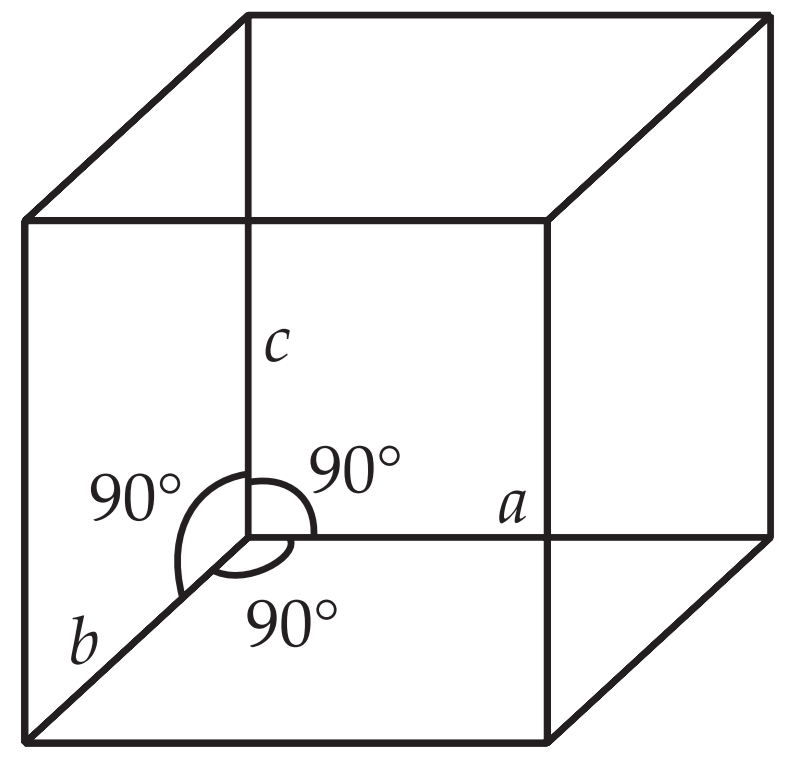
The adjective 'crystalline' when applied to solids, implies an ideal crystal in which the structural units, termed as unit cells, are repeated regularly and indefinitely in three dimensions in space. The unit cell, containing at least one molecule, has a definite orientation and shape defined by the translational vectors, a, b and c. The unit cell therefore has a definite volume, V that contains the atoms and molecules necessary for generating the crystal. Every crystal can be classified as a member of one of the seven possible crystal systems or crystal classes that are defined by the relationships between the individual dimensions, a, b and c of the unit cell and between the individual angles, ⁣$\alpha,\beta$ and $\gamma$ of the unit cell. The structure of the given crystal may be assigned to one of the $7$ crystal systems, to one of the $14$ Bravais lattices, and to one of the 230 space groups. These uniquely define the possible ways of arranging atoms in a three-dimensional solid. Based on these observations, seven crystal systems were identified: triclinic, monoclinic, trigonal or rhombohedral, tetragonal, hexagonal, rhombic or orthorhombic and cubic.
The following questions are multiple choice questions. Choose the most appropriate answer:
  1. The crystal system of a compound with unit cell dimensions, $a = 0.38$7nm, $b = 0.387$nm and $c = 0.504$nm $\alpha=\beta=90^\circ$ and $\gamma=120^\circ$ is.
  1. Cubic
  2. Hexagonal
  3. Orthorhombic
  4. Rhombohedral.
  1. The unit cell with the structure given below represents________________crystal system.
  1. Cubic
  2. Orthorhombic
  3. tetragonal
  4. trigonal
  1. In a triclinic crystal.
  1. $\text{a}=\text{b}=\text{c},\ \alpha=\beta=\gamma\neq90^\circ$
  2. $\text{a}\neq\text{b}=\text{c},\ \alpha=\beta=\gamma=90^\circ$
  3. $\text{a}\neq\text{b}\neq\text{c},\ \alpha\neq\beta\neq\gamma\neq90^\circ$
  4. $\text{a}\neq\text{b}\neq\text{c},\ \alpha=\gamma=90^\circ\beta\neq90^\circ$
  1. The unit cell with dimensions $\alpha=\beta=\gamma=90^\circ,\ \text{a}=\text{b}\neq\text{c}$ is.
  1. Cubic
  2. Triclinic
  3. Hexagonal
  4. Tetragonal.
  1. An example of orthorhombic crystal system is.
  1. $SnO_2$
  2. $KN0_3$
  3. $ZnO$
  4. $K_2Cr_2O_7$
In these questions, a statement of assertion followed by a statement of reason is given. Choose the correct answer out of the following choices.
Assertion: Colloidal particles show Brownian movement.
Reason: Brownian movement arises because of the impact of the molecules of the dispersion medium with the colloidal particles.

Read the passage given below and answer the following questions:
When a solution of an et-amino acid is placed in an electric field depending on the pH of the medium, following three cases may happen.
  1. In alkaline solution, CL-amino acids exist as anion II, and there is a net migration of amino acid towards the anode.
  2. In acidic solution, a-amino acids exist as cation III, and there is a net migration of amino acid towards the cathode.
  3. If II and III are exactly balanced there is no net migration; under such conditions any one molecule exists as a positive ion and as a negative ion for exactly the same amount of time, and any small movement in the direction of one electrode is subsequently cancelled by an equal movement back toward the other electrode. The pH of the solution in which a particular amino acid does not migrate under the influence of an electric field is called the is oelectric point of that amino acid.
The following questions are multiple choice questions. Choose the most appropriate answer:
  1.  

Arrange in order of increasing acid strengths.
  1. X > Z > Y
  2. Z < X < Y
  3. X > Y > Z
  4. Z > X > Y
  1. In aqueous solutions, amino acids mostly exist as:
  1. $NH_2 - CHR - COOH$
  2. $NH_2 - CHR - COO^-$
  3. $\stackrel{+}{\hbox{ N}}\text{H}_3\text{CHRCOOH}$
  4. $\text{H}_3\stackrel{{+}}{\hbox{N}}\text{CHRCOO}^-$
  1. Amino acids are least soluble:
  1. at pH 1
  2. at pH 7
  3. At their isoelectric points.
  4. None of these.
  1. The $\text{pK}_{\text{a}_1}$ and $\text{pK}_{\text{a}_2}$ of an amino acid are 2.3 and 9.7 respectively. The is oelectric point of the amino acid is:
  1. 12.0
  2. 7.4
  3. 6.0
  4. 3.7
  1. A tripeptide (X) on partial hydrolysis gave two dipeptides Cys-Gly and Glu-Cys. Identify the tripeptide.
  1. Glu-Cys-Gly
  2. Gly-Glu-Cys
  3. Cys-Gly-Glu
  4. Cys-Glu-Gly
Two types of conductors are generally used, metallic and electrolytic. Free electrons are the current carrier in metallic and in electrolytic conductors, free ions. Specific conductance or conductivity of an electrolytic solution is given by
$\text{K}=\text{C}\times\frac{\text{l}}{\text{A}}$
where, $\text{C}\times\frac{1}{\text{R}}$ and $\frac{\text{l}}{\text{A}}=\text{G}^\star$ (cell constant)
Molar conductance $(\wedge_\text{m})$ and equivalent conductance $(\wedge_\text{e})$ of an electrolyte solution are calculated as
$\wedge_\text{m}=\frac{\text{K}\times1000}{\text{M}}$ or $\wedge_\text{e}=\frac{\text{K}\times1000}{\text{N}}$
where, M = molarity of solution and N is normality of solution. Molar conductance of strong electrolyte depends on the concentration.
$\wedge_\text{m}=\wedge^\circ_{\text{m}^-}\text{b}\sqrt{\text{C}}$
$\wedge^\circ_\text{m}=$ molar conductance at infinite dilution, b = constant, C = cone.of solution
In these questions (Q. No. i-iv), a statement of assertion followed by a statement of reason is given. Choose the correct answer out of the following choices.
  1. Assertion and reason both are correct statements and reason is correct explanation for assertion.
  2. Assertion and reason both are correct statements but reason is not correct explanation for assertion.
  3. Assertion is correct statement but reason is wrong statement.
  4. Assertion is wrong statement but reason is correct statement.
  1. Assertion: The molar conductivity of strong electrolyte decreases with increase in concentration.
Reason: At high concentration, migration ofions is slow.
  1. Assertion: The molar conductance of weak electrolyte at infinite dilution is equal to the sum of molar conductance of cations and anions.
Reason: Kohlrausch's law is applicable for strong electrolytes.
  1. Assertion: Equivalent conductance of all electrolytes increases with increasing concentration.
Reason: More number ofions are available per gram equivalent at higher concentration.
  1. Assertion: Specific conductance decreases with dilution whereas equivalent conductance increases.
Reason: On dilution, number of ions per millilitre decreases but total number ofions increases considerably.
  1. Assertion: The ratio of specific conductivity to the observed conductance does not depend upon the concentration of the solution taken in the conductivity cell.
Reason: Specific conductivity decreases with dilution whereas observed conductance increases with dilution.
Read the passage given below and answer the following questions:
Nitric acid reacts with most of the metals (except noble metals like gold and platinum) and non-metals. Towards its reaction with metals. $HNO_3$ acts as an acid as well as an oxidising agent. Like other acids, $HNO_3$ liberate nascent hydrogen from metals which further reduces the nitric acid into number of products like $NO, NO_2, N_{2O}$ or $NH_3.$ The different stages of reduction of nitric acid are:
$\ \ _{+5}\ \ \ \ \ \ \ \ \ \ \ \ \ \ \ \ \ \ _{+4}\ \ \ \ \ \ \ \ \ \ \ \ \ \ \ \ \ \ _{+2}\ \ \ \ \ \ \ \ \ \ \ \ \ \ \ _{+1}\ \ \ \ \ \ \ \ \ \ \ \ \ \ \ \ \ _{-3}\\\text{HNO}_3\xrightarrow{\ \ \ \ +\text{e}\ \ \ \ }\text{NO}_2\xrightarrow{\ \ \ \ +2\text{e}^-}\text{NO}\xrightarrow[\text{NaOH}]{\ \ \ \ +\text{e}^-}\text{N}_2\text{O}\xrightarrow{\ \ \ \ +4\text{e}^-}\text{NH}_3$
The product of the reduction of $HNO_3$ depends upon the nature of the metal, concentration of nitric acid and temperature.
The following questions are multiple choice questions. Choose the most appropriate answer:
  1. Which of the following reactions is used to prepare laughing gas?
  1. $Pb +$ dil. $HNO_3 \rightarrow$
  2. $Hg +$ dil. $HNO_3 \rightarrow$
  3. $Zn +$ dil. $HNO_3 \rightarrow$
  4. $Cu +$ dil. $HNO_3 \rightarrow$
  1. Gold and platinum does not dissolve in $HNO_3$ but soluble in $1 : 3$ mixture of $HNO_3$ and $HCl$ due to the formation of respectively.
  1. $Au(NO_3)_2, [Pt(NO_3)_2]$
  2. $H[AuCl_4J, H_2[PtCl_6]$
  3. $[AuCl_6]^{2-}, [PtCl_2)^{2-}$
  4. $[Au(NO_3)_4], [Pt(NO_3)_6]^{2-}$
  1. Identify B in the following reaction.
$\text{Cu}+\text{HNO}_{3{\text{(conc.)}}}\xrightarrow{\ \ \ \ }\ \ \ \ \ \ (\text{A})\ \ \ \ \ \ \ +\ \ \ \ \ \ \ (\text{B})+\text{H}_2\text{O}\\\ \ \ \ \ \ \ \ \ \ \ \ \ \ \ \ \ \ \ \ \ \ \ \ \ \ \ \ \ \ \ \ {\text{Deep blue colour}}\ \ \ \ \ \ \ \text{Gas}$
  1. $NO_2$
  2. $N_2$
  3. $NO$
  4. $N_2O$
  1. In which of the following reactions $HNO_3$ will not act as an oxidising agent?
  1. $HNO_3 + H_2SO_4 \rightarrow$
  2. $HNO_3 + FeS0_4 + H_2S0_4 \rightarrow$
  3. $KI + HNO_3 \rightarrow$
  4. $Au + HNO_3\rightarrow$
  1. When dil. $HNO_3$ reacts with Hg, which gas will liberate?
  1. $N_2$
  2. $O_2$
  3. $NO$
  4. $NO_2$
