Question
Read the passage given below and answer the following questions:
Werner, a Swiss chemist in $1892$ prepared and characterised a large number of coordination compounds and studied their physical and chemical behaviour. He proposed that, in coordination compounds, metals possess two types of valencies, viz. primary valencies, which are normally ionisable and secondary valencies which are non-ionisable. ln a series of compounds of cobalt (III) chloride with ammonia, it was found that some of the chloride ions could be precipitated as $AgCl$ on adding excess of $AgNO_3$ solution in cold, but some remained in solution. The number ofions furnished by a complex in a solution can be determined by precipitation reactions. The measurement of molar conductance of solutions of coordination compounds helps to estimate the number of ions furnished by the compound in solution.
In these questions (Q. No. i-iv), a statement of assertion followed by a statement ofreason is given. Choose the correct answer out of the following choices.
  1. Assertion and reason both are correct statements and reason is correct explanation for assertion.
  2. Assertion and reason both are correct statements but reason is not correct explanation for assertion.
  3. Assertion is correct statement but reason is wrong statement.
  4. Assertion is wrong statement but reason is correct statement.
The following questions are multiple choice questions. Choose the most appropriate answer:
  1. Assertion: The complex $[Co(NH_3)_3Cl_3]$ does not give precipitate with silver nitrate solution.
Reason: The given complex is non-ionisable.
  1. Assertion: The complex $[Co(NH_3)_4Cl_2]Cl$ gives precipitate corresponding to 2 mol of AgCl with $AgNO_3$ solution.
Reason: It ionises as $[Co(NH_3)_4Cl_2]^+ + Cl^-.$
  1. Assertion: $CoCl_3. 4NH_3$ gives 1 mol of AgCl on reacting with $AgNO_3$​​​​​​​, its secondary valency is 6.
Reason: Secondary valency corresponds to coordination number.
  1. Assertion: 1 mol of $[CrCl_2(H_2O)_4]Cl· 2H_2O$ will give 1 mol of AgCl on treating with $AgNO_3$​​​​​​​.
Reason: $Cl^-$ ions satisfying secondary valanceis will not be precipitated.
  1. Assertion: $CoCl_3. 3NH_3$ is not conducting while $CoCl_3. 5NH_3$​​​​​​​ is conducting.
Reason: The complex of $CoCl_3. 3NH_3$ is $[CoCl_3(NH_3)_3]$ while that of $CoCl_3· 5NH_3$ is $[CoCl(NH_3)_5]Cl_3$.

Answer

  1. (a) Assertion and reason both are correct statements and reason is correct explanation for assertion.
  2. (d) Assertion is wrong statement but reason is correct statement.
Explanation:

$[\text{Co(NH}_3)_4\text{Cl}_2]\text{Cl}+\text{AgNO}_3\rightarrow[\text{Co(NH}_3)_4\text{Cl}_2]^++\text{AgCl}\downarrow$

Thus it gives precipitate of 1 mol of AgCI.
  1. (b) Assertion and reason both are correct statements but reason is not correct explanation for assertion.
Explanation:

$CoCl_3$. $4NH_3$ gives 1 mol AgCl on reaction with $AgNO_3$, hence the complex can be represented as $[CoCl_2(NH_3)_4]CI$.
  1. (a) Assertion and reason both are correct statements and reason is correct explanation for assertion.
Explanation:

The $Cl^-$ ions outside the coordination sphere can only be precipitated.
  1. (a) Assertion and reason both are correct statements and reason is correct explanation for assertion.

Need a full question paper?

Generate a complete, print-ready paper with questions like this in minutes — across 16+ boards, with answer keys.

Start Generating Free

Similar questions

Read the passage given below and answer the following questions:
Nucleophilic substitution reactions are of two types; substitution nucleophilic bimolecular $(S_N2)$ and substitution nucleophilic unimolecular $(S_N1)$ depending on molecules taking part in determining the rate of reaction. Reactivity of alkyl halide towards $S_N1$ and $S_N2$ reactions depends on various factors such as steric hindrance, stability of intermediate or transition state, and polarity of solvent. $S_N2$ reaction mechanism is favoured mostly by primary alkyl halide then secondary and then tertiary. This order is reversed in case of $S_N1$ reactions.
The following questions are multiple choice questions. Choose the most appropriate answer:
  1. Which of the following is most reactive towards nucleophilic substitution reaction?
  1. $C_6H_5Cl$
  2. $CH_2 = CHCl$
  3. $ClCH_2CH = CH_2$
  4. $CH_3CH = CHCl$
  1. Isopropyl chloride undergoes hydrolysis by:
  1. $S_N1$ mechanism.
  2. $S_N2$ mechanism.
  3. $S_N1$ and $S_N2$ mechanism.
  4. Neither $S_N1$ nor $S_N2$ mechanism.
  1. The most reactive nucleophile among the following is:
  1. $CH_3O^-$
  2. $C_6H_5O^-$
  3. $(CH_3)_2CHO^-$
  4. $(CH_3)_3CO^-$
  1. Tertiary alkyl halides are practically inert to substitution by $S_N2$ mechanism because of:
  1. Insolubility.
  2. Instability.
  3. Inductive effect.
  4. Stearic hindrance.
  1. Which of the following is the correct order of decreasing $S_N2$ reactivity?
  1. $RCH_2X > R_2CHX > R_3CX$
  2. $R_3CX > R_2CHX > RCH_2X$
  3. $R_2CHX > R_3CX > RCH_2X$
  4. $RCH_2X > R_3CX > R_2CHX$
Read the passage given below and answer the following questions :
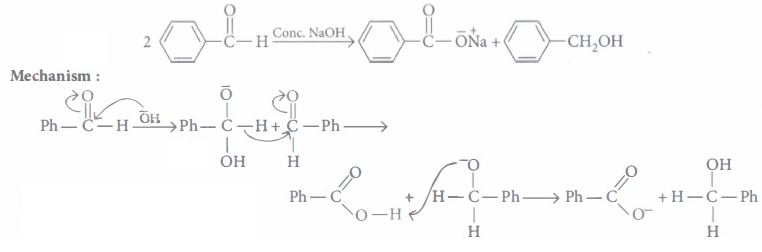
When an aldehyde with no a-hydrogen reacts with concentrated aqueous $NaOH$, half the aldehyde is converted to carboxylic acid salt and other half is converted to an alcohol. In other words, half of the reactant is oxidized
and other half is reduced. This reaction is known as Cannizzaro reaction

The following questions are multiple choice questions. Choose the most appropriate answer:
  1. A mixture of benzaldehyde and formaldehyde on heating with aqueous $NaOH$ solution gives:
  1. Benzyl alcohol and sodium formate.
  2. Sodium benzoate and methyl alcohol.
  3. Sodium benzoate and sodium formate.
  4. Benzyl alcohol and methyl alcohol.
  1. Which of the following compounds will undergo Cannizzaro reaction?
  1. $CH_3CHO$
  2. $CH_3COCH_3$
  3. $C_6H_5CHO$
  4. $C_6H_5CH_2CHO$
  1. Trichloroacetaldehyde is subjected to Cannizzaro's reaction by using $NaOH$. The mixture of the products contains sodium trichloroacetate ion and another compound. The other compounds is:
  1. 2, 2, 2-trichloroethanol
  2. Trichloromethanol
  3. 2, 2, 2-trichloropropanol
  4. Chloroform
  1. Which of the following reaction will not result in the formation of carbon-carbon bonds?
  1. Cannizzaro reaction
  2. Wurtz reaction
  3. Reimer- Tiemann reaction
  4. Friedel - Crafts acylation
A reaction in which rate ofreaction is independent of concentration of the reactants is called zero order reaction. Photochemical combination of hydrogen and chlorine to give hydrogen chloride is an example of zero order reaction. The rate constant of a zero order reaction is equal to the rate of reaction. The half life period of a zero order reaction is directly proportional to initial concentration of the reactant. For a zero order reaction,
$\text{k}=\frac{1}{\text{t}}\left\{[\text{A}]-[\text{A}]\right\}$
In these questions (Q. No. i-iv), a statement of assertion followed by a statement of reason is given. Choose the correct answer out of the following choices.
  1. Assertion and reason both are correct statements and reason is correct explanation for assertion.
  2. Assertion and reason both are correct statements but reason is not correct explanation for assertion.
  3. Assertion is correct statement but reason is wrong statement.
  4. Assertion is wrong statement but reason is correct statement.
  1. Assertion: For a zero order reaction, plot of rate vs concentration will be a straight line parallel to concentration axis.
Reason: For a zero order reaction, rate is independent of concentration.
  1. Assertion: Photochemical combination of hydrogen and chlorine to give hydrogen chloride is an example of zero order reaction.
Reason: The rate of reaction depends on the concentration of hydrogen and independent of concentration of chlorine.
  1. Assertion: If in a zero order reaction, the concentration of the reactant is doubled, the half-life period is also doubled.
Reason: For a zero order reaction, the rate of reaction is independent of initial concentration.
  1. Assertion: ln a reaction A → products, the concentration of the reactant is reduced to zero after a finite time.
Reason: The order of reaction is zero.
  1. Assertion: Rate constant of a zero order reaction has same units as the rate of reaction.
Reason: Rate constant of a zero order reaction does not depend on the unit of concentration.
Read the passage given below and answer the following questions:
Under the normal conditions, noble gases are monoatomic and have closed shell electronic configuration. Lighter noble gases have low boiling points due to weak dispersion forces between the atoms and the absence of other interatomic interactions. Xenon, one of the important noble gas, forms a series of compounds with fluorine with oxidation number $+2, +4$ and $+6.$ All xenon fluorides are strong oxidising agents. $XeF_4$ reacts violently with water to give $XeO_3.$ The geometry of xenon compounds can be deduced by considering the total number of electron pairs in their valence shell.
The following questions are multiple choice questions. Choose the most appropriate answer:
  1. Among noble gases (from He to Xe) only xenon reacts with fluorine to form stable xenon fluorides because xenon.
  1. Has the largest size.
  2. Has the lowest ionisation enthalpy.
  3. Has the highest heat ofvapourisation.
  4. Is the most readily available noble gas.
  1. The structure of $XeO_3$ is:
  1. Square planar.
  2. Pyramidal.
  3. Linear.
  4. T-shaped.
  1. $XeF_6$ is expected to be.
  1. Oxidising agent.
  2. Reducing agent.
  3. Unreactive.
  4. Strongly basic.
  1. In the preparation of compound of xenon, Bartlett had taken $\text{O}_2^+\text{PtF}_6^-$ as a base compound. This is because,
  1. Both $O_2$ and $Xe$ have same size.
  2. Both $Xe$ and $O_2$ have same electron gain enthalpy.
  3. Both have almost same ionisation enthalpy.
  4. Both $Xe$ and $O_2$ are gases.
  1. The oxidation state of xenon in $XeO_3$ is:
  1. $+4$
  2. $+2$
  3. $+8$
  4. $+6$
Read the passage given below and answer the following questions:
Most important crystal lattices are the simple cubic, body centred cubic and face centred cubic. In simple cubic lattice, all the atoms are present at all the corners of the cube. In body-centred cubic lattice, atoms are present at all the corners and at the body-centre. In face-centred cubic lattice, atoms are present at the corners and at the centers of all six faces. In the formation of crystals, the constituent particles get closely packed together. The closely packed arrangement is that in which maximum available space is occupied, leaving minimum vacant space. The most efficient close packing, can be achieved in two ways, one which is called hexagonal close packing.(hcp) and the other, cubic close packing (ccp or fcc)
In these questions (Q. No. i-iv) a statement of assertion followed by a statement of reason is given. Choose the correct answer out of the following choices.
  1. Assertion and reason both are correct statements, and reason is correct explanation for assertion.
  2. Assertion and reason both are correct statements, but reason is not correct explanation for assertion.
  3. Assertion is correct statement, but reason is wrong statement.
  4. Assertion is wrong statement, but reason is correct statement.
  1. Assertion: Face centred cubic cell has $4$ atoms per unit cell.
Reason: ln fee unit cell, there are $8$ atoms at the corners and $ 6$ atoms at face centres
  1. Assertion: CsCl has body-centred cubic arrangement.
Reason: CsCl has one $Cs^+$ ion and $8$ $CI^-$ ions in its unit cell.
  1. Assertion: fcc and hcp have same packing efficiency.
Reason: bcc and fcc both have same number of atoms per unit cell and same arrangement.
  1. Assertion: The total number of atoms present in a simple cubic unit cell is one.
Reason: Simple cubic unit cell has atoms at its corners, each of which is shared between eight adjacent unit cells.
  1. Assertion: The packing efficiency is maximum for the fee structure.
Reason: The coordination number is $12$ in fcc structures.
Read the passage given below and answer the following questions: Lucas test is a test to differentiate between primary, secondary and tertiary alcohols. This test consists of treating an alcohol with Lucas' reagent, and turbidity, due to the formation of insoluble alkyl chloride, is observed. Lucas test is based on the difference in reacting of three classes of alcohols with hydrogen chloride via $S_N1$ reaction. The different reactivity reflects the differing ease of formation of the corresponding carbocations. In these questions $(Q.$ No. $i-iv),$ a statement of assertion followed by a statement ofreason is given. Choose the correct answer out of the following choices.
  1. Assertion and reason both are correct statements and reason is correct explanation for assertion.
  2. Assertion and reason both are correct statements but reason is not correct explanation for assertion.
  3. Assertion is correct statement but reason is wrong statement.
  4. Assertion is wrong statement but reason is correct statement.
  1. Assertion: Equimolar mixture of cone. $HCI$ and anhydrous $ZnCl_2$ is called Lucas' reagent.
Reason: Lucas' reagent can be used to distinguish between methanol and ethanol.
  1. Assertion: $2-$Methyl$-2-$butanol gives no turbidity with Lucas' reagent at room temperature.
Reason: It is a $3^\circ$ alcohol.
  1. Assertion: Tertiary alcohols react fastest with Lucas' reagent by $S_N1$ mechanism.
Reason: $3^\circ$ carbocation is most stable.
  1. Assertion: Amongst the compounds, $H2C = CHCH_2OH (I), C_6H_5OH (II), CH_3CH_2CH_2OH (III)$ and $(CH_3)_3COH (IV),$ only $(IV)$ reacts with Lucas' reagent at room temperature.
Reason: Tertiary alcohol gives turbidity immediately with Lucas' reagent.
  1. Assertion: Lucas test can be used to distinguish between $1-$propanol and $2-$propanol.
Reason: Lucas test is based upon the difference in reactivity of primary, secondary and tertiary alcohols with cone. HCI and anhyd. $ZnCl_2.$
Read the passage given below and answer the following questions:In contrast to the disorders of gases and liquids, there is translational order in crystals. However, disordered or amorphous solids also exist which lack such order, they are really highly viscous liquids. In translational order entire structure or lattice, can be generated by repeated replication of a small regular figure, termed as unit cell. The planes of any crystalline structure can be specified using Miller indices, which is also serve to identify single crystal faces.The ordered structure, or lattice, of a solid can be determined by X-ray or neutron diffraction studies, in which a beam of X-rays of neutrons is scattered from the sample to produce a diffraction pattern which can be analyzed to reveal the crystal structure of the sample. All crystal lattices can be classified into 14 Bravais lattices belonging to 7 systems. For example, the simple cubic, face-centred cubic and body-centred cubic lattices are the 3 lattices of the cubic system. Cubic and hexagonal close-packed structures have the structure of tightly packed spheres, where each sphere touches 12 neighbours, 6 in the same plane and 3 above and 3 below. These two dose-packed structures differ in the placement of successive planes or layers. For the hexagonal close packing, a third layer is laid down to reproduce the first layer, so that the structure could be represented by ABABAB …. For cubic close packing, third layer is again displaced, corresponding to ABCABC.
The following questions are multiple choice questions. Choose the most appropriate answer:
  1. In hexagonal close packing, a sphere has coordination number of.
  1. 4
  2. 6
  3. 8
  4. 12
  1. Which of the following arrangements correctly represents hexagonal and cubic close packed structure respectively?
  1. ABCABC...and ABAB...
  2. ABAB...and ABCABC...
  3. Both have ABAB ... arrangement.
  4. Both have ABCABC... Arrangement.
  1. The arrangement of the first two layers, one above the other, in hep and ccp arrangements is.
  1. Exactly same in both cases
  2. Partly same and partly different
  3. Different from each other
  4. Nothing definite.
  1. Which of the following statements is not correct?
  1. The amorphous solids have a random, disordered arrangement of constituents.
  2. The simple cubic, face-centred and body-centred are the three lattices of the cubic system.
  3. The number of Bravais lattice in which a crystal can be categorized is 7.
  4. A metal that crystallizes in hep structure has coordination number 12.
  1. Which of the following statements about amorphous solids is incorrect?
  1. They melt over a range of temperature.
  2. There is no orderly arrangement of particles.
  3. They are anisotropic.
  4. They are rigid and incompressible.
In these questions, a statement of assertion followed by a statement of reason is given. Choose the correct answer out of the following choices.
Assertion: In chemisorption, adsorption keeps on increasing with temperature.
Reason: Chemisorption increases with increase of pressure.
For a reaction, A + B → Products, the rate law is – Rate = $k[A][B]^{3/2}$ Can the reaction be an elementary reaction? Explain.
Read the passage given below and answer the following questions:
In ideally ionic structures, the coordination numbers of the ions are determined by electrostatic considerations. Cations surround themselves with as many anions as possible, and vice versa. This maximizes the attractions between neighbouring ions of opposite charge and hence maximizes the lattice energy of the crystal. This requirement led to the formulation of the radius ratio rule for ionic structures, in which the ions and the structure adopted for a particular compound depend on the relative sizes of the ions. Thus, for the stable ionic crystalline structures, there is definite radius ratio limit for a cation to fit perfectly in the lattice of anions, called radius ratio rule. This depends upon the ratio of radii of two types of ions $\frac{\text{r}_+}{r}$This ratio for coordination numbers $3, 4, 6$ and $8$ are respectively $0.155 - 0.225, 0.225 - 0.414, 0.414 - 0.732$ and $0.732 - 1.000$. The coordination number of ionic solids also depends upon temperature and pressure. On applying high pressure, coordination number increases. On the other hand, on applying high temperature, it decreases.
The following questions are multiple choice questions. Choose the most appropriate answer:
  1. The ionic radii of $K^+,Rb^+$ and $Br-$ are $137, 148$ and $195$pm. The coordination number of cation in RbBr and KBr structures are respectively.
  1. $8, 6$
  2. $6, 4$
  3. $6, 8$
  4. $4, 6$
  1. For a coordination number $4,$ the maximum limiting radius ratio is.
  1. $0.414$
  2. $0.732$
  3. $0.225$
  4. $0.155$
  1. If the radius of $Na^+$ ion is 95 pm and that of $Cl^-$ ion is $181$  pm, the coordination number of $Na^+$ ion is.
  1. $6$
  2. $4$
  3. $8$
  4. $12$
  1. Which is not the correct statement for ionic solids, in which positive and negative ions are held by strong electrostatic attractive forces?
  1. The radius ratio $\frac{\text{r}_+}{r}$ increases as coordination number increases.
  2. As the difference in size of ions increases, coordination number increases.
  3. When coordination number is eight, $\frac{\text{r}_+}{r}$ ratio lies between $0.225$ to $0.414.$
  4. In ionic solid of the type AX (ZnS, wurtzite), the coordination number of $Zn^2$ and $S^2$- respectively are $4 $and $4.$
  1. If the pressure of CsCl is increased, then its coordination number will.
  1. Increase
  2. Remain the same
  3. Decrease
  4. None of these.