Question
Need a full question paper?
Generate a complete, print-ready paper with questions like this in minutes — across 16+ boards, with answer keys.
Explore more
Similar questions
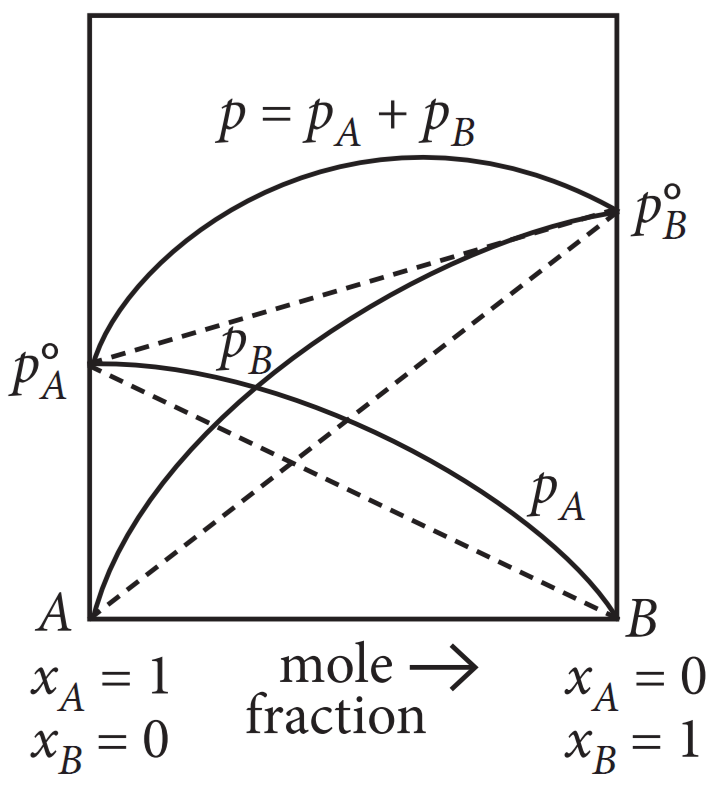
Read the passage given below and answer the following questions: An ideal solution may be defined as the solution which obeys Raoult's law exactly over the entire range of concentration. The solutions for which vapour pressure is either higher or lower than that predicted by Raoult's law are called non-ideal solutions.Non-ideal solutions can show either positive or negative deviations from Raoult's law depending on whether the A-B interactions in solution are stronger or weaker than A - A and B - B interactions. The following questions are multiple choice questions. Choose the most appropriate answer:
→- Which of the following solutions is/are ideal solution(s)?
- Bromoethane and iodoethane.
- Acetone and chloroform
- Benzene and acetone
- n-heptane and n-hexane
- Only I
- I and II
- II and III
- I and Iv
- For which of the following solutions $\Delta\text{H}_{\text{mix}}$ and $\Delta\text{V}_{\text{mix}}$ is negative?
- Acetone and aniline
- Ethyl alcohol and cyclohexane
- Acetone and CS2
- Benzene and toluene
- Which of the following is not true for positive deviations?
- The A-B interactions in solution are weaker than the A - A and B - B interactions.
- $\text{P}_\text{A}<\text{P}\mathring{\text{A}}\ \text{x}_\text{A}$ and $\text{P}_\text{B}<\text{P}\mathring{\text{B}}\ \text{x}_\text{B}$
- Carbon tetrachloride and chloroform mixture is an example of positive deviations.
- All of these.
- For water and nitric acid mixture, which of the given graph is correct?
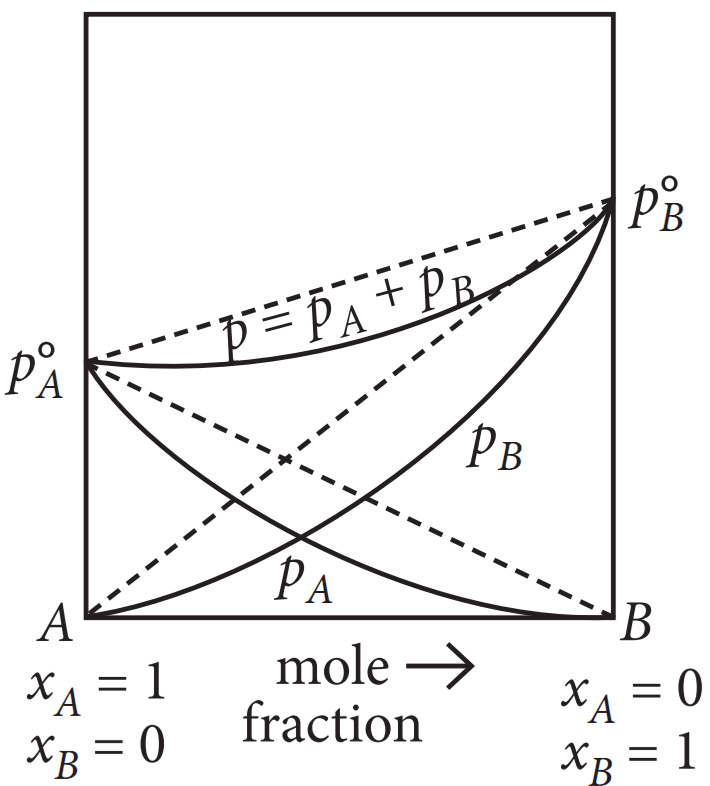
- Both of these
- None of these
- Water-HCI mixture.
- Shows positive deviations.
- Forms minimum boiling azeotrope.
- Shows negative deviations.
- Forms maximum boiling azeotrope.
- I and II
- I and III
- I and IV
- III and IV
A reaction is said to be of the first order if the rate of the reaction depends upon one concentration term only. For a first order reaction of the type A → Products, the rate of the reaction is given as: rate = k[A]. The differential rate law is given as: $\frac{\text{dA}}{\text{dt}}=-\text{k}[\text{A}].$ The integrated rate law is: In $\frac{[\text{A}]}{[\text{A}]_0}=-\text{kt},$ [A] is the concentration of reactant left at time t and [A]0 is the initial concentration of the reactant, k is the rate constant.
The following questions are multiple choice questions. Choose the most appropriate answer:
→The following questions are multiple choice questions. Choose the most appropriate answer:
- The unit of rate constant for a first order reaction is:
- S-1
- mol L-1 s-1
- L mol-1 s-1
- L2 mol-2 s-1
- Half-life period of a first order reaction is 10min. Starting with initial concentration 12M, the rate after 20min is:
- 0.693 × 3M min-1
- 0.0693 × 4M min-1
- 0.0693 × M min-1
- 0.0693 × 3M min-1
- 50% of a first order reaction is complete in 23 minutes. Calculate the ti me required to complete 90% of the reaction.
- 70.4 minutes.
- 76.4 minutes.
- 38.7 minutes.
- 35.2 minutes.
- For a first order reaction, (A) → products, the concentration of A changes from 0.1M to 0.025M in 40 minutes. The rate of reaction when the concentration of A is 0.01M, is:
- 3.47 × 10⁻⁴ M/ min
- 3.47 × 10⁻⁵ M/ min
- 1.73 × 10⁻⁴ M/ min
- 1.73 × 10⁻⁵ M/ min
- The half-life period ofa 1st order reaction is 60 minutes. What percentage will be left over after 240 minutes?
- 6.25%
- 4.25%
- 5%
- 6%
Read the passage given below and answer the following questions:
To explain bonding in coordination compounds various theories were proposed. One of the important theory was valence bond theory. According to that, the central metal ion in the complex makes available a number of empty orbitals for the formation of coordination bonds with suitable ligands. The appropriate atomic orbitals of the metal hybridise to give a set of equivalent orbitals of definite geometry.
The d-orbitals involved in the hybridisation may be either inner d-orbitals i.e., (n - 1)d or outer d-orbitals i.e., nd. For example, Co3+ forms both inner orbital and outer orbital complexes, with ammonia it forms [Co(NH3)6]3+ and with fluorine it forms [CoF6]3- complex ion.
The following questions are multiple choice questions. Choose the most appropriate answer:
→→To explain bonding in coordination compounds various theories were proposed. One of the important theory was valence bond theory. According to that, the central metal ion in the complex makes available a number of empty orbitals for the formation of coordination bonds with suitable ligands. The appropriate atomic orbitals of the metal hybridise to give a set of equivalent orbitals of definite geometry.
The d-orbitals involved in the hybridisation may be either inner d-orbitals i.e., (n - 1)d or outer d-orbitals i.e., nd. For example, Co3+ forms both inner orbital and outer orbital complexes, with ammonia it forms [Co(NH3)6]3+ and with fluorine it forms [CoF6]3- complex ion.
The following questions are multiple choice questions. Choose the most appropriate answer:
- Which of the following is not true for [CoF6]3-?
- It is paramagnetic.
- It has coordination number of 6.
- It is outer orbital complex.
- It involves d2sp3 hybridisation.
- [Cr(H2O)6]Cl3 (at. no. of Cr = 24) has a magnetic moment of 3.83B.M. The correct distribution of 3d-electrons in the central metal of the complex is:
- $3\text{d}^1_\text{xy},3\text{d}^1_{\text{x}^2-\text{y}^2},3\text{d}^1_\text{yz}$
- $3\text{d}^1_\text{xy},3\text{d}^1_{\text{yz}},3\text{d}^1_\text{zx}$
- $3\text{d}^1_\text{xy},3\text{d}^1_{\text{zy}},3\text{d}^1_{\text{z}^2}$
- $3\text{d}^1_{\text{x}^2-\text{y}^2},3\text{d}^1_{\text{z}^2},3\text{d}^1_\text{xz}$
- Which of the following is true for [Co(NH3)6]3+?
- It is an octahedral, di magnetic and outer orbital complex.
- It is an octahedral, paramagnetic and outer orbital complex.
- It is an octahedral, paramagnetic and inner orbital complex.
- It is an octahedral, di magnetic and inner orbital complex.
- The paramagnetism of [CoF6]3- is due to.
- 3 electrons.
- 4 electrons.
- 2 electrons.
- 1 electron.
- Which of the following is an inner orbital or low spin complex?
- [Ni(H2O)6]3+
- [FeF6]3-
- [Co(CN)6]3-
- [NiCl4]2-
Read the passage given below and answer the following questions:
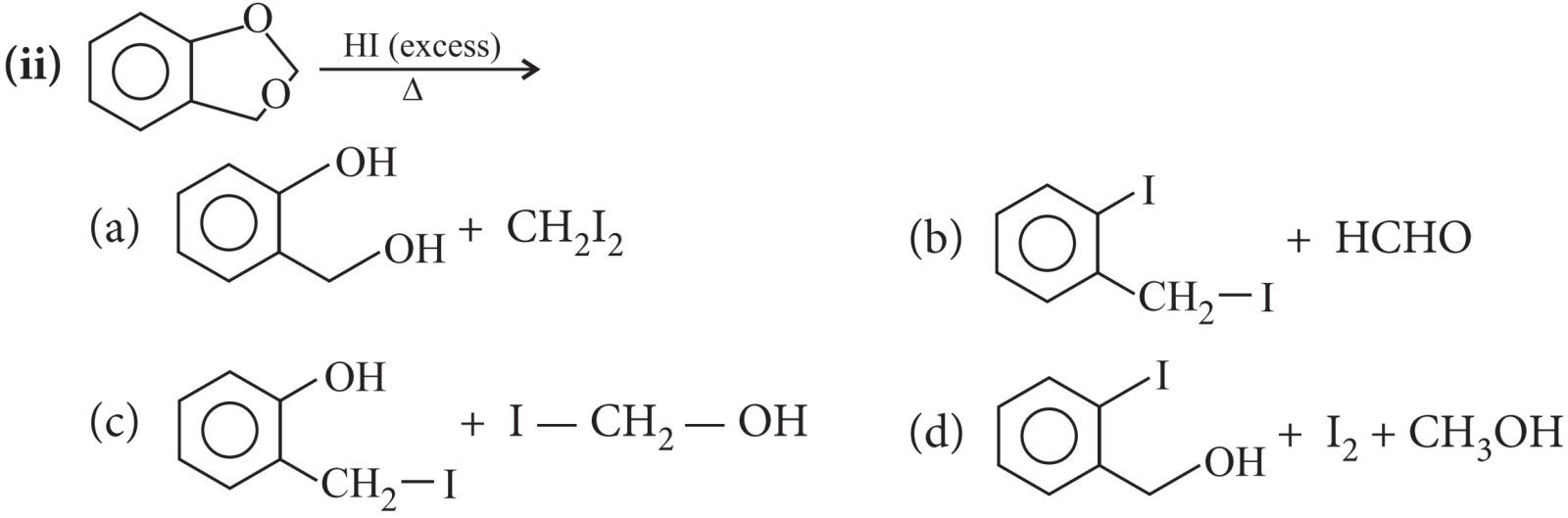
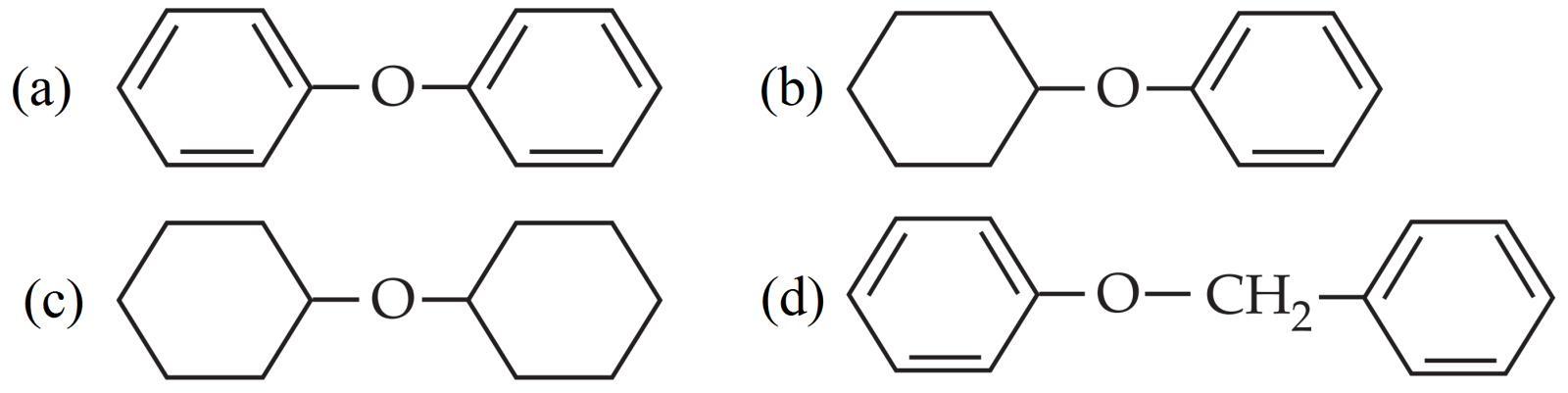
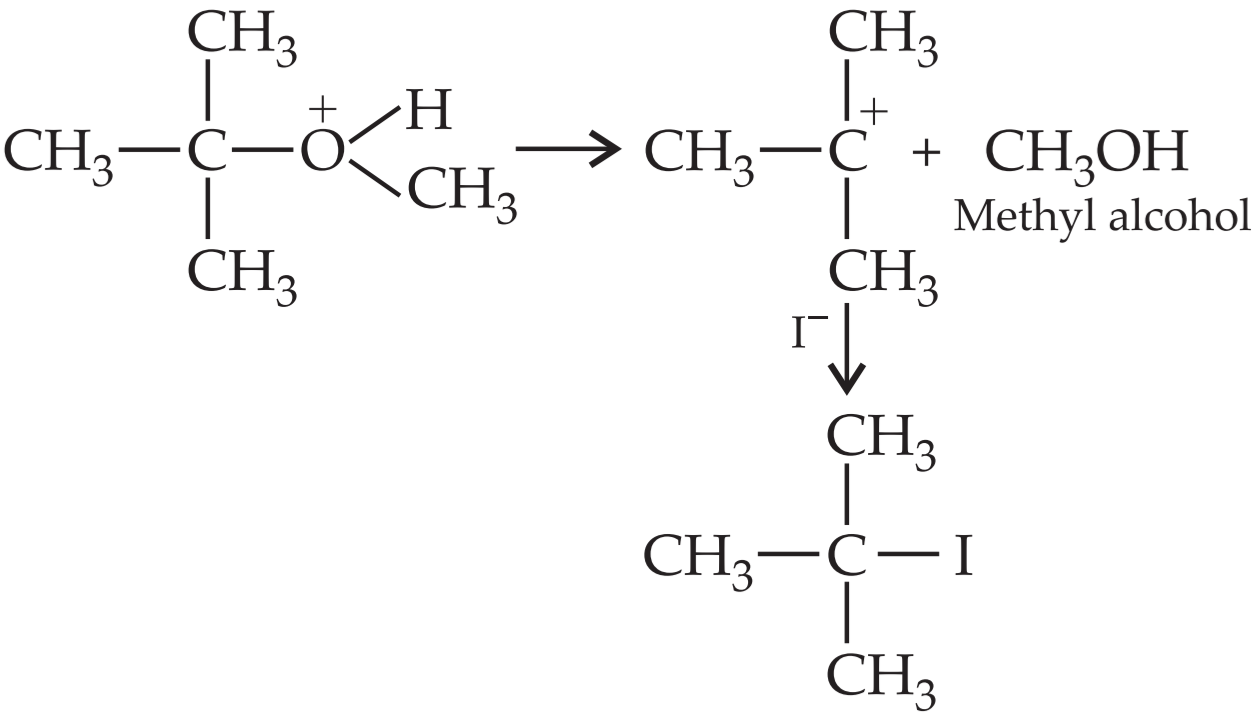
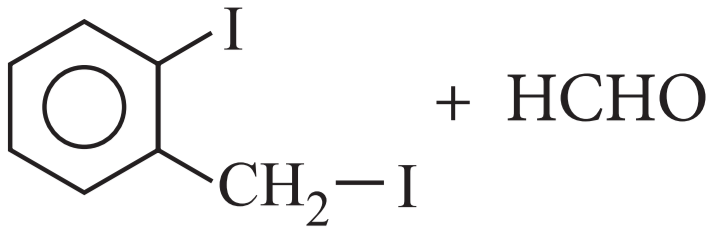
A compound (X) containing C, H and O is unreactive towards sodium. It also does not react with Schiff s reagent. On refluxing with an excess of hydroiodic acid, (X) yields only one organic product ( Y). On hydrolysis, (Y) yields a new compound (Z) which can be converted into (Y) by reaction with red phosphorus and iodine. The compound (Z) on oxidation with potassium permanganate gives a carboxylic acid. The equivalent weight of this acid is 60.
The following questions are multiple choice questions. Choose the most appropriate answer:
→A compound (X) containing C, H and O is unreactive towards sodium. It also does not react with Schiff s reagent. On refluxing with an excess of hydroiodic acid, (X) yields only one organic product ( Y). On hydrolysis, (Y) yields a new compound (Z) which can be converted into (Y) by reaction with red phosphorus and iodine. The compound (Z) on oxidation with potassium permanganate gives a carboxylic acid. The equivalent weight of this acid is 60.
The following questions are multiple choice questions. Choose the most appropriate answer:
- The compound (X) is an:
- Acid.
- Aldehyde.
- Alcohol.
- Ether.
- The IUPAC name of the acid formed is:
- Methanoic acid.
- Ethanoic acid.
- Propanoic acid.
- Butanoic acid.
- Compound (Y) is:
- Ethyl iodide.
- Methyl iodide.
- Propyl iodide.
- Mixture of (a) and (b).
- Compound (Z) is:
- Methanol.
- Ethanol.
- Propanol.
- Butanol.
- Compound (X) on treatment with excess of Cl2 in presence of tight gives:
- $\propto-$ Chlorodiethyl ether.
- $\propto,\propto'-$ Dichlorodiethyl ether.
- Perchlorodiethyl ether.
- None of these.
Read the passage given below and answer the following questions:
The solubility of gases increases with increase of pressure. William Henry made a systematic investigation of the solubility of a gas in a liquid. According to Henry's law "the mass of a gas dissolved per unit volume of the solvent at constant temperature is directly proportional to the pressure of the gas in equilibrium with the solution". Dalton during the same period also concluded independently that the solubility of a gas in a ti quid solution depends upon the partial pressure of the gas. If we use the mole fraction of gas in the solution as a measure of its solubility, then Henry's law can be modified as "the partial pressure of the gas in the vapour phase is directly proportional to the mole fraction of the gas in the solution"
The following questions are multiple choice questions. Choose the most appropriate answer:
The solubility of gases increases with increase of pressure. William Henry made a systematic investigation of the solubility of a gas in a liquid. According to Henry's law "the mass of a gas dissolved per unit volume of the solvent at constant temperature is directly proportional to the pressure of the gas in equilibrium with the solution". Dalton during the same period also concluded independently that the solubility of a gas in a ti quid solution depends upon the partial pressure of the gas. If we use the mole fraction of gas in the solution as a measure of its solubility, then Henry's law can be modified as "the partial pressure of the gas in the vapour phase is directly proportional to the mole fraction of the gas in the solution"
The following questions are multiple choice questions. Choose the most appropriate answer:
- Henry's law constant for the solubility of methane in benzene at 298K is 4.27 x 105mm Hg. The solubility of methane in benzene at 298K under 760mm Hg is:
- 4.27 × 10⁻⁵
- 1.78 × 10⁻³
- 4.27 × 10⁻³
- 1.78 × 10⁻⁵
- The partial pressure of ethane over a saturated solution containing 6.56 × 10⁻²g of ethane is I bar. If the solution contains 5.00 × 10⁻²g of ethane then what will be the partial pressure (in bar) of the gas?
- 0.762
- 1.312
- 3.81
- 5.0
- KH (K bar) values for Ar(g), CO2(g), HCHO(g) and CH4(g) are 40.39, 1.67, 1.83 × 10⁻⁵ and 0.413 respectively. Arrange these gases in the order of their increasing solubility. Arrange these gases in the order of their increasing solubility.
- HCHO < CH4 < CO2 < Ar
- HCHO < CO2 < CH4 < Ar
- Ar < CO2 < CH4 < HCHO
- Ar < CH4 < CO2 < HCHO
- When a gas is bubbled through water at 298K, a very dilute solution of the gas is obtained. Henry's law constant for the gas at 298K is 150 kbar. If the gas exerts a partial pressure of 2 bar, the number of millimoles of the gas dissolved in IL of water is:
- 0.55
- 0.87
- 0.37
- 0.66
- Which of the following statements is correct?
- KH increases with increase of temperature.
- KH decreases with increase of temperature.
- KH remains constant with increase of temperature.
- KH first increases then decreases, with increase of temperature.
Read the passage given below and answer the following questions: The order of reactivity towards SN1 reaction depends upon the stability of carbocation in the first step. Greater the stability of the carbocation, greater will be its ease of formation from alkyl halide and hence faster will be the rate of the reaction. As we know, 3º carbocation is most stable, therefore, the tert-alkyl that halides will undergo SN1 reaction very fast. For example, it has been observed that the reaction (CH3)3CBr with OH- ion to give 2-methyl-2-propanol is about I million times as fast as the corresponding reaction of the methyl bromide to give methanol. The primary alkyl halides always react predominantly by SN2 mechanism. On the other hand, the tertiary alkyl halides react predominantly by SN1 mechanism. Secondary alkyl halides may react by either mechanism or by both the mechanisms without much preference depending upon the nature of the nucleophile and solvent. In these questions (Q. No. i-tv), a statement of assertion followed by a statement of reason is given. Choose tile correct answer out of tile following choices.
- Assertion and reason both are correct statements and reason is correct explanation for assertion.
- Assertion and reason both are correct statements but reason is not correct explanation for assertion.
- Assertion is correct statement but reason is wrong statement.
- Assertion is wrong statement but reason is correct statement.
- Assertion: Low concentration of nudeophile favours SN1 mechanism.
Reason: 2º alkyl halides are less reactive than 1º towards SN1 reactions.
- Assertion: Polar solvent slows down SN2 reactions.
Reason: CH3-Br is less reactive than CH3Cl.
- Assertion: Benzyl bromide when kept in acetone- water it produces benzyl alcohol.
Reason: The reaction follows SN2 mechanism.
- Assertion: Rate of hydrolysis of methyl chloride to methanol is higher in DMF than in water.
Reason: Hydrolysis of methyl chloride follows second order kinetics.
- Assertion: SN1 reaction is carried out in the presence of a polar protic solvent.
Reason: A polar protic solvent increases the stability of carbocation due to solvation.
The potential of each electrode is known as electrode potential. Standard electrode potential is the potential when concentration of each species taking part in electrode reaction is unity and the reaction is taking place at 298K. By convention, the standard electrode potential of hydrogen (SHE) is 0.0V. The electrode potential value for each electrode process is a measure of relative tendency of the active species in the process to remain in the oxidised/ reduced form. The negative electrode potential means that the redox couple is stronger reducing agent than $\frac{\text{H}^+}{\text{H}_2}$ couple. A positive electrode potential means that the redox couple is a weaker reducing agent than the $\frac{\text{H}^+}{\text{H}_2}$ couple. Metals which have higher positive value of standard reduction potential form the oxides of greater thermal stability. In these questions (Q. No. i-iv), a statement of assertion followed by a statement ofreason is given. Choose the correct answer out of the following choices.
→- Assertion and reason both are correct statements and reason is correct explanation for assertion.
- Assertion and reason both are correct statements but reason is not correct explanation for assertion.
- Assertion is correct statement but reason is wrong statement.
- Assertion is wrong statement but reason is correct statement.
- Assertion: An electrochemical cell can be set-up only if the redox reaction is spontaneous.
Reason: A reaction is spontaneous if the free energy change is negative.
- Assertion: The standard electrode potential of hydrogen is 0.0V.
Reason: It is by convention.
- Assertion: The more negative is the standard reduction potential, greater is its ability to displace H2 from acid.
Reason: Strength of reducing agent increases with the increase in negative value of the standard reduction potential.
- Assertion: The negative value of standard reduction potential means that reduction takes place on this electrode with reference to hydrogen electrode.
Reason: The standard electrode potential of a half cell has a fixed value.
- Assertion: The absolute value of electrode potential cannot be determined experimentally.
Reason: The electrode potential values are generally determined with respect to SHE.
The electrochemical cell shown below is concentration cell. M|M2+ (saturated solution of a sparingly soluble salt, MX2) || M2+ (0.001 mol dm-3) |M The emfof the cell depends on the difference in concentrations of M2+ ions at the two electrodes. The emf of the cell at 298 K is 0.059V. The following questions are multiple choice questions. Choose the most appropriate answer:
→- The solubility product (Ksp' mol3 dm-9) of MX2 at 298 K based on the information available for the given concentration cell is $(\text{take }2.303 \times \text{R}\times \frac{298}{\text{F}} = 0.059)$
- 2 × 10-15
- 4 × 10-15
- 3 × 10-12
- 1 × 10-12
- The value of $\triangle\text{G}$ (in kJ mol-1) for the given cell is (take 1 F = 96500 C mol-1)
- 3.7
- -3.7
- 10.5
- -11.4
- The equilibrium constant for the foUowing reaction is:
$\text{Fe}^{2+}+\text{Ce}^{4+}\rightleftharpoons\text{Ce}^{3+}+\text{Fe}^{3+}$
(Given, $\text{E}^\circ_\frac{\text{Ce}^{4+}}{\text{Ce}^{3+}}=1.44\text{V}$ and $\text{E}^\circ_\frac{\text{Fe}^{3+}}{\text{Fe}^{2+}}=0.68\text{V}$)
- 7.6 × 10¹²
- 6.5 × 10¹⁰
- 5.2 × 10⁹
- 3.4 × 10¹²
- The solubility product of a saturated solution of Ag2CrO4 in water at 298 K if the emf of the cell
Ag|Ag+ (satd. Ag2CrO4 soln) || Ag+ (0.1 M) | Ag
is 0.164V at 298 K, is:
- 3.359 × 10⁻¹² mol3 L-3
- 2.287 × 10⁻¹² mol3 L-3
- 1.158 × 10⁻¹² mol3 L-3
- 4.135 × 10⁻¹² mol3 L-3
- To calculate the emf of the cell, which of the foUowing options is correct?
- emf = Ecathode - Eanode
- emf = Eanode - Ecathode
- emf = Eanode + Ecathode
- None of these.
Read the passage given below and answer the following questions: Due to intermolecular hydrogen bonding, the boiling points of alcohols and phenols are much higher than those of corresponding haloalkanes, haloarenes, aliphatic and aromatic hydrocarbons. Among isomeric alcohols, the boiling points follow the order: primary > secondary > tertiary. Boiling points of ethers are much lower than those of isomeric alcohols. The solubility of alcohols in water decreases as the molecular mass of alcohols increases. Amongst isomeric alcohols solubility increases with branching. The solubility of phenols in water is much lower than that of alcohols. Lower ethers such as dimethyl ether and ethyl methyl ether are soluble in water, but the solubility decreases as the molecular mass increases. In these questions (Q. No. i-iv), a statement of assertion followed by a statement of reason is given. Choose the correct answer out of the following choices.
- Assertion and reason both are correct statements and reason is correct explanation for assertion.
- Assertion and reason both are correct statements but reason is not correct explanation for assertion.
- Assertion is correct statement but reason is wrong statement.
- Assertion is wrong statement but reason is correct statement.
- Assertion: Alcohols have higher boiling points than ethers of comparable molecular masses.
Reason: Alcohols and ethers are isomeric in nature.
- Assertion: The solubility of phenols in water is much lower than that of alcohols.
Reason: Phenols do not form H-bonds with water.
- Assertion: Among n-butane, ethoxyethane, 1-propanol and 2-propanol, the increasing order of boiling points is, 1-butanol < 1-propanol < ethoxyethane < n-butane.
Reason: Boiling point increases with increase in molecular mass.
- Assertion: Dimethyl ether and diethylether are soluble in water.
Reason: As the molecular mass increases, solubility of ethers in water decreases.
- Assertion: Butan-2-ol has higher boiling point than 2-methylpropan-2-ol.
Reason: Amongst isomeric alcohols, the boiling points decreases with branching.