Question
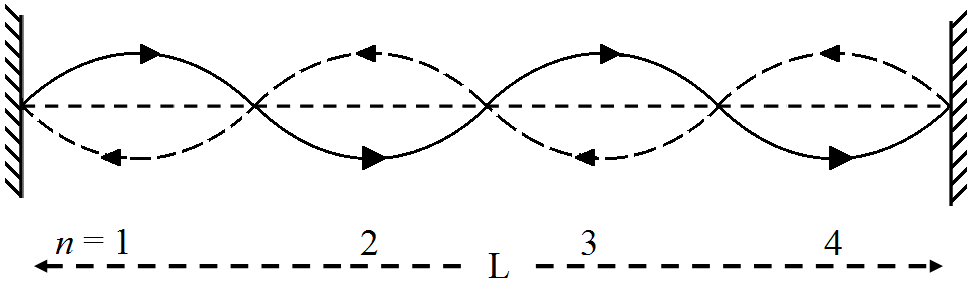
Show that when a string fixed at its two ends vibrates in 1 loop, 2 loops, 3 loops and 4 loops, the frequencies are in the ratio 1 : 2 : 3 : 4.
Answer

​​​​Let n be the number of loop in the string.The length of each loop is $\frac{\lambda}{2}$
$\therefore\text{L}=\frac{\text{n}\lambda}{2}$ or $\lambda=\frac{2\text{L}}{\text{n}}$

$\text{v}=\text{v}\lambda$ and $\lambda=\frac{\upsilon}{\text{v}}.$
so $\frac{\upsilon}{\text{v}}=\frac{2\text{L}}{\text{n}}$
$\text{v}=\frac{\text{n}}{2\text{L}}.\text{v}$ v is stretch string $=\sqrt{\frac{\text{T}}{\text{m}}}$
$\therefore\text{v}=\frac{\text{n}}{2\text{L}}\sqrt{\frac{\text{T}}{\text{m}}}$
For n =1, $\text{v}_1=\frac{1}{2\text{L}}\sqrt{\frac{\text{T}}{\text{m}}}=\text{v}_0$
If n = 2 then $\text{v}_2=\frac{2}{2\text{L}}\sqrt{\frac{\text{T}}{\text{m}}}=2\text{v}_0$
n = 3 then $\text{v}_3=\frac{3}{2\text{L}}\sqrt{\frac{\text{T}}{\text{m}}}=3\text{v}_0$
$\therefore\text{v}_1:\text{v}_2:\text{v}_3:\text{v}_4:=\text{n}_1:\text{n}_2:\text{n}_3:\text{n}_4:=1:2:3:4$

Need a full question paper?

Generate a complete, print-ready paper with questions like this in minutes — across 16+ boards, with answer keys.
Start Generating Free

Similar questions

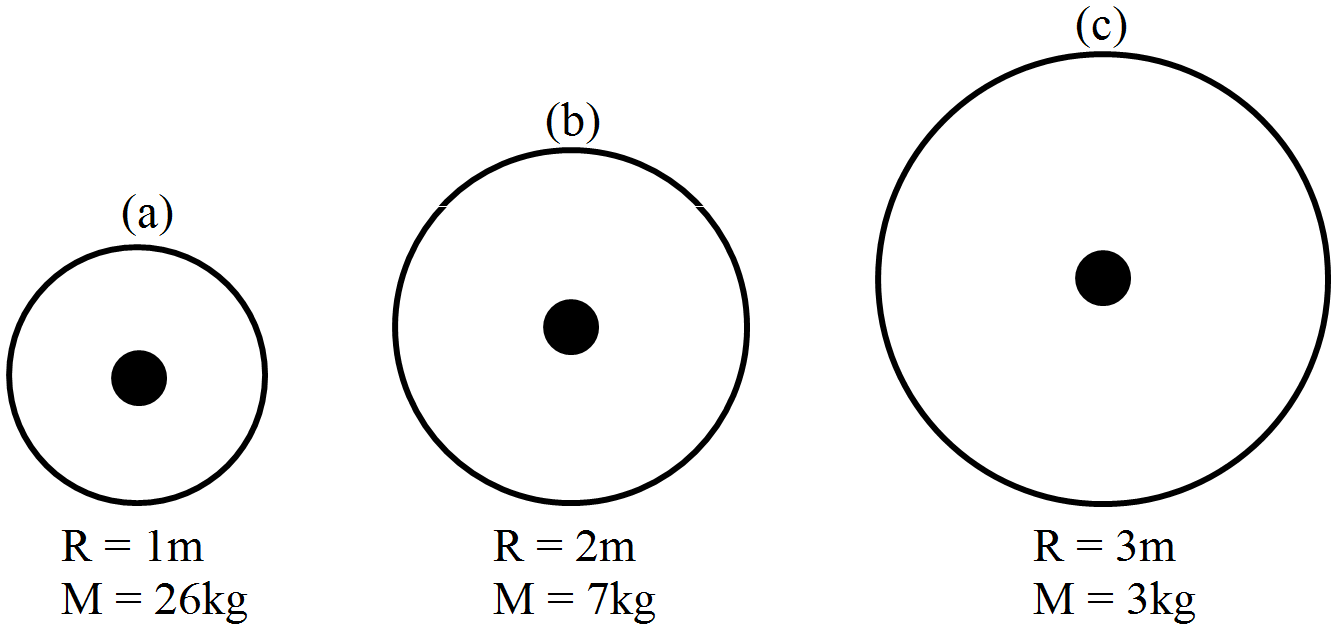
Figure shows three uniform discs, along with their radii R and masses M. Rank the discs according to their rotational inertia about their central axes, greatest first.
Two trains A and B of length $400m$ each are moving on two parallel tracks with a uniform speed of $72km h^{–1}$ in the same direction, with A ahead of B. The driver of B decides to overtake A and accelerates by $1m s^{–2}$. If after $50s$, the guard of B just brushes past the driver of A, what was the original distance between them?
What do you mean by orbital velocity? Find the expression for orbital velocity.
A converging lens of focal length 15cm and a converging mirror of focal length 10cm are placed 50cm apart with common principal axis. A point source is placed in between the lens and the mirror at a distance of 40cm from the lens. Find the locations of the two images formed.
State the law of conservation of angular momentum and illustrate it with the example of planetary motion.
The magnetic field existing in a region is given by $\overrightarrow{\text{B}}=\text{B}_0\Big(1+\frac{\text{x}}{\text{l}}\Big)\overrightarrow{\text{k}}.$ A square loop of edge land carrying a current i, is placed with its edges parallel to the x - y axes. Find the magnitude of the net magnetic force experienced by the loop.
Prove the result that the velocity v of translation of a rolling body (like a ring, disc, cylinder or sphere) at the bottom of an inclined plane of a height h is given by $\text{v}^2=\frac{2\text{gh}}{\Big(\frac{1+\text{k}^2}{\text{R}^2}\Big)}$ using dynamical consideration (i.e. by consideration of forces and torques).
Note: k is the radius of gyration of the body about its symmetry axis, and R is the radius of the body. The body starts from rest at the top of the plane.
Define the term orbital speed. Establish a relation for orbital speed of a satellite orbiting very close to the surface of the earth. Find the ratio of this orbital speed and escape speed.
A metre stick is balanced on a knife edge at its centre. When two coins, each of mass 5g are put one on top of the other at the 12.0cm mark, the stick is found to be balanced at 45.0cm. What is the mass of the metre stick?
A conducting loop of area $5.0cm^2$ is placed in a magnetic field which varies sinusoidally with time as $\text{B}=\text{B}_0\sin\omega\text{t}$ wherer $\text{B}_0=0.20\text{T}$ and $\omega=300\text{s}^{-1}.$ The normal to the coil makes an angle of 60° with the field. Find
  1. The maximum emf induced in the coil.
  2. The emf induced at $\text{t}=\Big(\frac{\pi}{900}\Big)\text{s}$
  3. $\text{t}=\Big(\frac{\pi}{600}\Big)\text{s}.$
  4. The emf induced at $\text{t}=\Big(\frac{\pi}{600}\Big)\text{s}.$