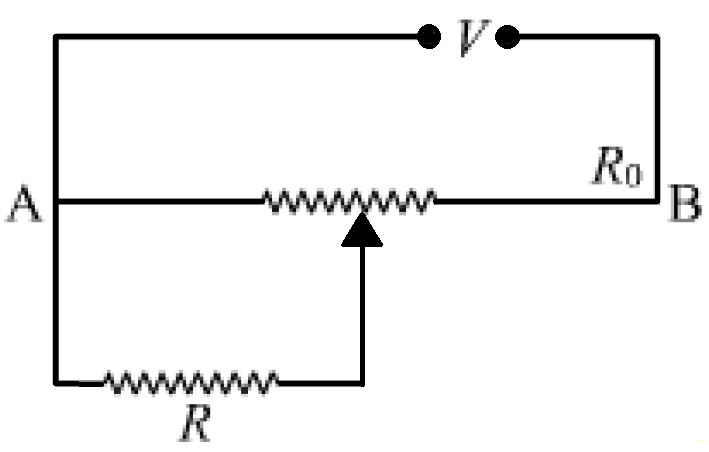
A resistance of R draws current from a potentiometer. The potentiometer wire $, AB, $ has a total resistance of $R_o. A$ voltage $V$ is supplied to the potentiometer. Derive an expression for the voltage across $R$ when the sliding contact is in the middle of potentiometer wire.
CBSE DELHI - SET 2 2017
Download our app for free and get started
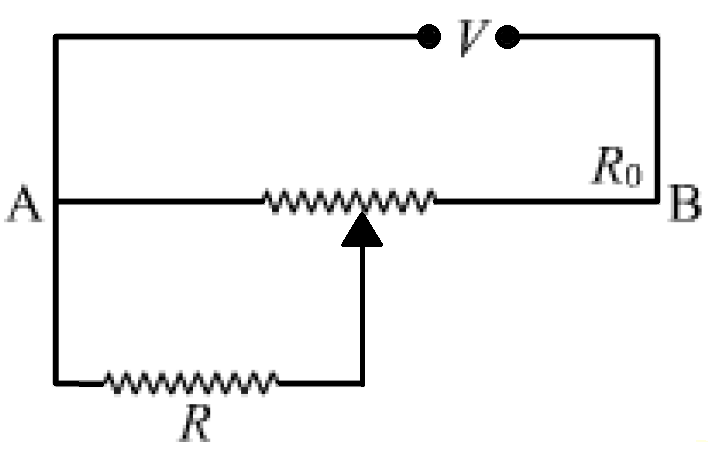
When the slide is in the middle of the potentiometer, only half of its total resistance.
i.e. $R_02 \ ($since resistance is directly proportional to length$)$ will be between $A$ and point of contact $(C),$ say $R_1,$ will be given by the following expression $\ce{1R_1 = 1R + 1R_02 R1 = RR_02R + R_0}$
The total resistance between $A$ and $B$ will be sum of the resistance between $A C$ and $C B$ ie $R_1 + R_02$ Current flowing through the potentiometer will be $\ce{I = VR_{1 }+ R_02= 2V2R_{1 }+ R_0}$
The voltage $V_1$ taken from the potentiometer will be the product of current $I$ and the resistance $\ce{R_1V_1 = IR_1 = 2V2R_1+ R_0 X R_1 = 2V_2RR_02R + R_{0 }+ R_0 X RR_02R + R_0 = 2VRR_0 + 4R}$

Download our appand get started for free
Experience the future of education. Simply download our apps or reach out to us for more information. Let's shape the future of learning together!No signup needed.*
Similar Questions
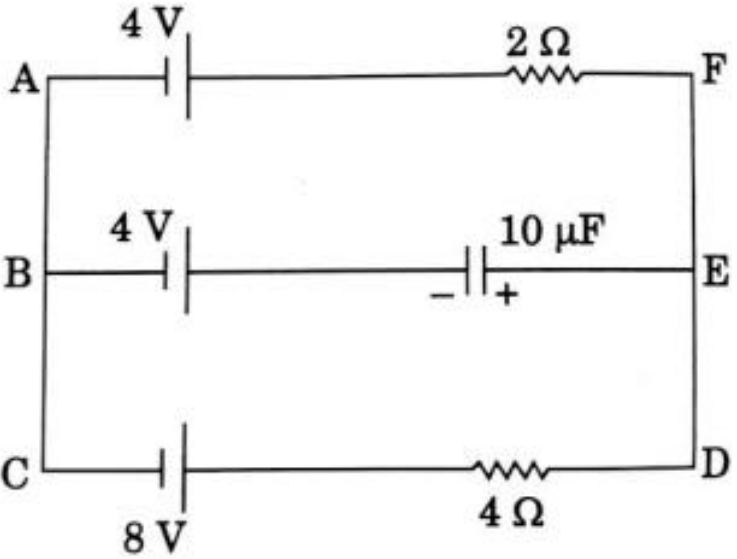
- 1View SolutionIn the given circuit, with steady current, calculate the potential drop across the capacitor and the charge stored in it.
- 2(a) In Example 3.1, the electron drift speed is estimated to be only a few $mm s ^{-1}$ for currents in the range of a few amperes? How then is current established almost the instant a circuit is closed?View Solution
(b) The electron drift arises due to the force experienced by electrons in the electric field inside the conductor. But force should cause acceleration. Why then do the electrons acquire a steady average drift speed?
(c) If the electron drift speed is so small, and the electron's charge is small, how can we still obtain large amounts of current in a conductor?
(d) When electrons drift in a metal from lower to higher potential, does it mean that all the 'free' electrons of the metal are moving in the same direction?
(e) Are the paths of electrons straight lines between successive collisions (with the positive ions of the metal) in the (i) absence of electric field, (ii) presence of electric field? - 3View SolutionDefine the terms (i) drift velocity, (ii) relaxation time.
A conductor of length L is connected to a dc source of emf ε. If this conductor is replaced by another conductor of same material and same area of cross-section but of length 3L, how will the drift velocity change? - 4View SolutionThe specification on a heater coil is 250V, 500W. Calculate the resistance of the coil. What will be the resistance of a coil of 1000W to operate at the same voltage?
- 5A potentiometer wire of length 1.0 m has a resistance of l5 $\Omega$. It is connected to a 5 V battery in series with a resistance of 5 $\Omega$ Determine the emf of the primary cell which gives a balance point at 60 cm.View Solution
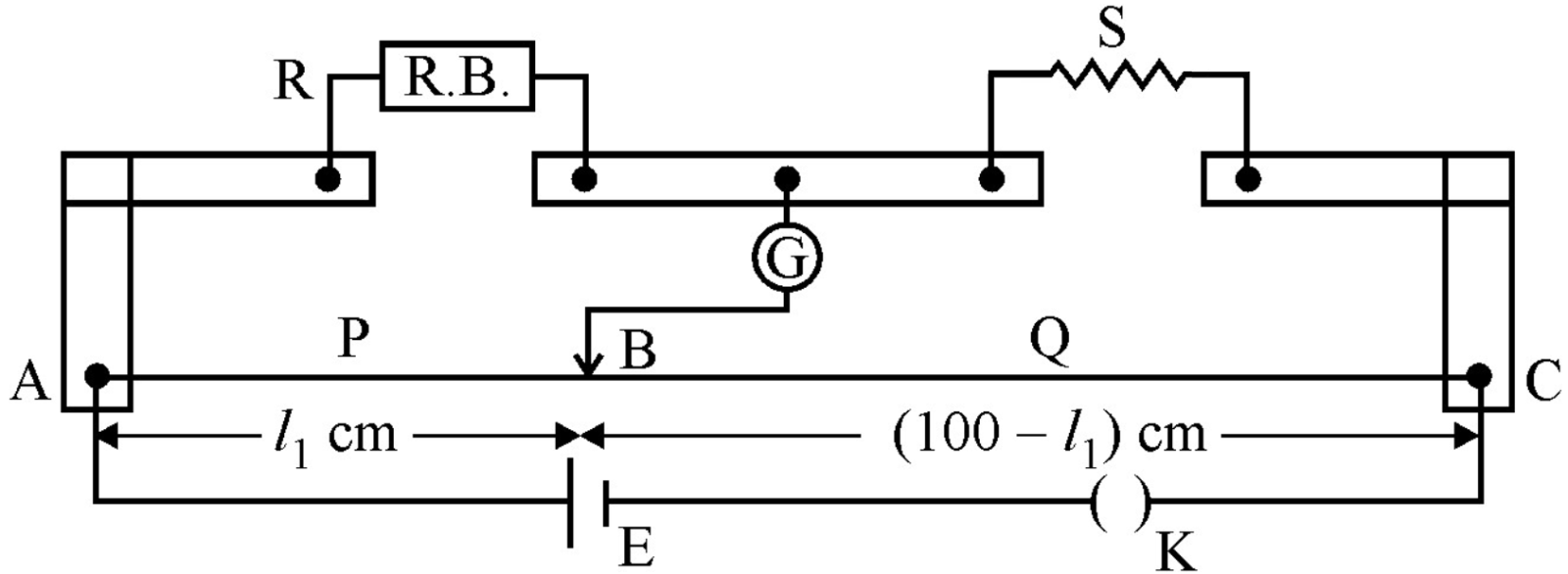
- 6What is end error in a metre bridge? How is it overcome? The resistances in the two arms of the metre bridge are $\text{R}=5\Omega$ and $S$ respectively. When the resistance $S$ is shunted with an equal resistance, the new balance length found to be $1.5 l_1 ,$ where $l_1$ is the initial balancing length. Calculate the value of $S.$View Solution
- 7View SolutionFind the equivalent resistances of the networks shown in the figure. between the points a and b.
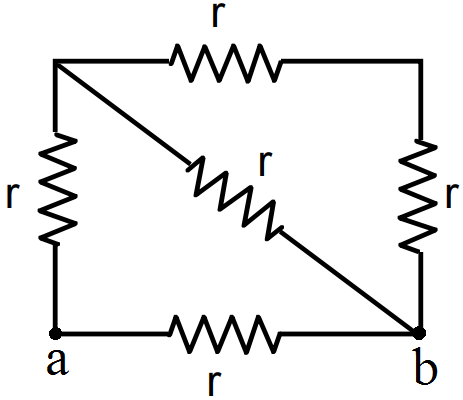
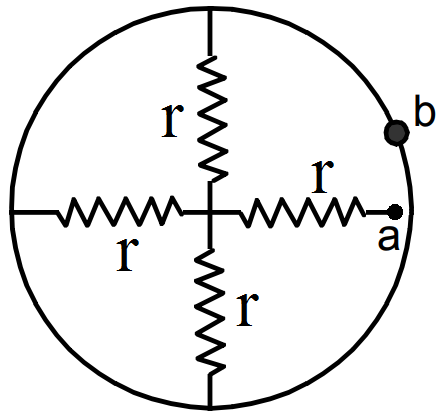
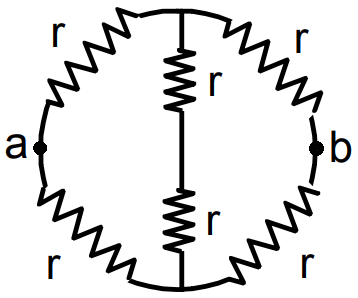
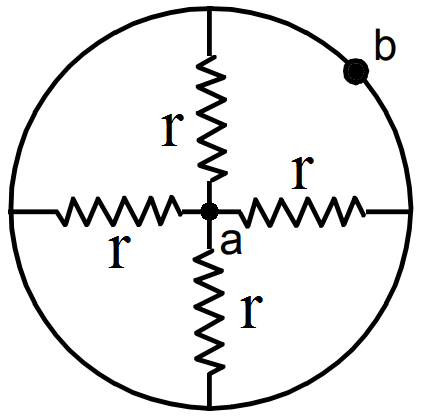
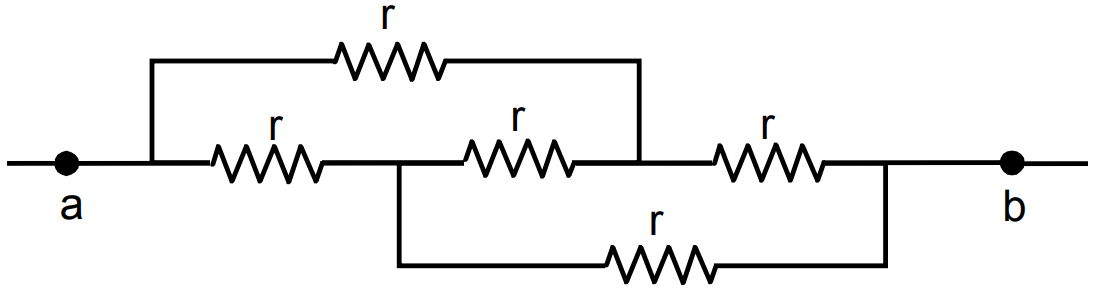
- 8View SolutionWrite any two factors on which internal resistance of a cell depends. The reading on a high resistance voltmeter, when a cell is connected across it, is 2.2 V. When the terminals of the cell are also connected to a resistance of 5 Ω as shown in the circuit, the voltmeter reading drops to 1.8 V. Find the internal resistance of the cell.
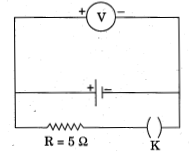
- 9The potential difference across a resistor $‘r\ ’$ carrying current $‘I\ ’$ is $Ir.$View Solution
- Now if the potential difference across $‘r\ ’$ is measured using a voltmeter of resistance $‘RV\ ’,$ show that the reading of voltmeter is less than the true value
- Find the percentage error in measuring the potential difference by a voltmeter.
- At what value of $RV,$ does the voltmeter measures the true potential difference?
- 10View SolutionElectrons are continuously in motion within a conductor but there is no current in it unless some source of potential is applied across its ends. Give reason.