Maharashtra BoardEnglish MediumSTD 11 SciencePhysicsElectrostatics4 Marks
Question
State and prove Gauss’ law of electrostatics.
✓
Answer
Statement:
The flux of the net electric field through a closed surface equals the net charge enclosed by the surface divided by $E$.
$\int \vec{E} \cdot \overrightarrow{ dS }=\frac{ Q }{\varepsilon_0}$
where $Q$ is the total charge within the surface.
Proof:
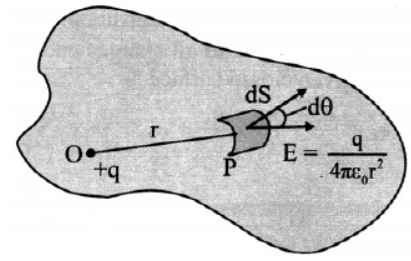
$i$. Consider a closed surface of any shape which encloses number of positive electric charges.
$ii$. Imagine a small charge $+q$ present at a point $O$ inside closed surface. Imagine an infinitesimal area $dS$ of the given irregular closed surface.
$iii.$ The magnitude of electric field intensity at point $P$ on $dS$ due to charge $+q$ at point $O$ is, $E =\frac{1}{4 \pi \varepsilon_0}\left(\frac{ q }{ r ^2}\right) ..............(1)$
$iv$. The direction of $E$ is away from point $O$.
Let $\theta$ be the angle subtended by normal drawn to area $dS$ and the direction of $E$
$v$. Electric flux passing through area $(d$ varnothing $)$
$= E \cos\theta \ dS$
$=\frac{ q }{4 \pi \varepsilon_0 r ^2} \cos \theta dS ..............($from $1)$
$=\left(\frac{ q }{4 \pi \varepsilon_0}\right)\left(\frac{ dS \cos \theta}{ r ^2}\right)$
$\text { But, } d \omega=\frac{d S \cos \theta}{r^2}$
where, $dc$ is the solid angle subtended by area $dS$ at a point $O$.
$\therefore d \varnothing=\left(\frac{ q }{4 \pi \varepsilon_0}\right) d \omega .............(2)$
$vi$. Total electric flux crossing the given closed surface can be obtained by integrating equation $(2)$ over the total area.
$\phi_{ E }=\int_{ s } d \phi=\int_{ s } \overrightarrow{ E } \cdot \overrightarrow{ dS }$
$=\int \frac{ q }{4 \pi \varepsilon_0} d \omega=\frac{ q }{4 \pi \varepsilon_0} \int d \omega$
$vii$. But $\int d \omega=4 \pi=$ solid angle subtended by entire closed surface at point $O$.
Total Flux $=\frac{q}{4 \pi \varepsilon_0}(4 \pi)$
$\therefore \varnothing_{ E }=\int_{ s } \overrightarrow{ E } \cdot \overrightarrow{ dS }=\frac{+ q }{\varepsilon_0}$
$viii$. This is true for every electric charge enclosed by a given closed surface.
Total flux due to charge $q _1$, over the given closed surface $=+\frac{q_1}{\varepsilon_0}$
Total flux due to charge $q _2$, over the given closed surface $=+\frac{q_2}{\varepsilon_0}$
Total flux due to charge $q _n$, over the given closed surface $=+\frac{q_n}{\varepsilon_0}$
$ix$. According to the superposition principle, the total flux $c|>$ due to all charges enclosed within the given closed surface is
$\phi_{ E }=\frac{ q _1}{\varepsilon_0}+\frac{ q _2}{\varepsilon_0}+\frac{ q _3}{\varepsilon_0}+\ldots+\frac{ q _{ n }}{\varepsilon_0}=\sum_{ i =1}^{ i = n } \frac{ q _{ i }}{\varepsilon_0}=\frac{ Q }{\varepsilon_0}$
Need a full question paper?
Generate a complete, print-ready paper with questions like this in minutes — across 16+ boards, with answer keys.