Question
State the formula for calculating work done by a force. Are there any conditions or limitations in using it directly? If so, state those clearly. Is there any mathematical way out for it? Explain.
Answer

1. Suppose a constant force $\vec{F}$ acting on a body produces a displacement $\vec{S}$ in the body along the positive X-direction. Then the work done by the force is given as, $W =$ F.s $\cos \theta$
Where $\theta$ is the angle between the applied force and displacement.
2. If displacement is in the direction of the force applied, $\theta=0^{\circ}$
$W =\overrightarrow{ F } \cdot \overrightarrow{ s }$
Conditions/limitations for application of work formula:
1. The formula for work done is applicable only if both force $\vec{F}$ and displacement $\vec{s}$ are constant and finite i.e., it cannot be applied when the force is variable.
2. The formula is not applicable in several real- life situations like lifting an object through several thousand kilometres since the gravitational force is not constant. It is not applicable to viscous forces like fluid resistance as they depend upon speed and thus are often not constant with time.
3. The method of integration has to be applied to find the work done by a variable force.
Integral method to find work done by a variable force:

Image
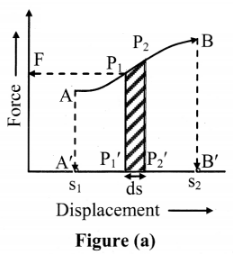
  1. Let the force vary non-linearly in magnitude between the points A and B as shown in figure (a).
  2. In order to calculate the total work done during the displacement from $s_1$ to $s_2,$ we need to use integration. For integration, we need to divide the displacement into large numbers of infinitesimal (infinitely small) displacements.
  3. Let at $P_1$, the magnitude of force be $F = P_1P_1‘$. Due to this force, the body displaces through infinitesimally small displacement ds, in the direction of force.
    It moves from $P_1$ to $P_2.$
    $\therefore d \overrightarrow{ s }=\overrightarrow{ P _1 P _2}$
    4. But direction of force and displacement are same, we have
    $d \overrightarrow{ s }= P _1^{\prime} P _2^{\prime}$
    5. $d \overrightarrow{ s }$ is so small that the force $F$ is practically constant for the displacement. As the force is constant, the area of the strip $\vec{F} \cdot d \vec{s}$ is the work done dW for this displacement.
    6. Hence, small work done between $P_1$ to $P_2$ is $d W$ and is given by
    $dW =\overrightarrow{ F } \cdot d \overrightarrow{ s }= P _1 P _1^{\prime} \times P _1^{\prime} P _2^{\prime}$
    $\text { = Area of the strip } P _1 P _2 P _2^{\prime} P _1^{\prime} \text {. }$
    The total work done can be found out by dividing the portion AB into small strips like $P_1P_2P_2‘P_1‘$ and taking sum of all the areas of the strips.
    $∴ W = \int_{s_{1}}^{s 2} \vec{F} \cdot d \vec{s}=\text { Area } A B B^{\prime} A^{\prime}$
    8. Method of integration is applicable if the exact way of variation in $\overrightarrow{ F }$ and $\overrightarrow{ s }$ is known and that function is integrable.
    9. The work done by the non-linear variable force is represented by the area under the portion of force-displacement graph.
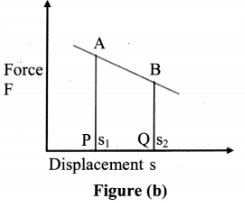
    10. Similarly, in case of a linear variable force, the area under the curve from $s_1$ to $s_2$ (trapezium APQB) gives total work done W [figure (b)].
Image

Need a full question paper?

Generate a complete, print-ready paper with questions like this in minutes — across 16+ boards, with answer keys.
Start Generating Free

Similar questions

That are rectangular components of vectors? Explain their uses.
A metal sphere cools at the rate of $0.05^{\circ} C / s$ when its temperature is $70^{\circ} C$ and at the rate of $0.025^{\circ} C / s$ when its temperature is $50^{\circ} C$. Determine the temperature of the surroundings and find the rate of cooling when the temperature of the metal sphere is $40^{\circ} C$.
Explain the different types of modulation.
QUESTION A glass flask has volume $1 \times 10^{-4} m^3$. It is filled with a liquid at $30^{\circ} C$. If the temperature of the system is raised to $100{ }^{\circ} C$, how much of the liquid will overflow. (Coefficient of volume expansion of glass is $1.2 \times 10^{-5}\left({ }^{\circ} C \right)^{-1}$ while that of the liquid is $75 \times 10^{-5}{ }^{\circ} C ^{-1}$ )
State the formula for acceleration due to gravity at depth ' $d$ ' and altitude ' $h$ ' Hence show that their ratio is equal to $\left(\frac{R-d}{R-2 h}\right)$ by assuming that the altitude is very small as compared to the radius of the Earth.
State and prove parallelogram law of vector addition and determine magnitude and direction of resultant vector.
Derive expression for couple acting on an electric dipole in a uniform electric field.
Variation of a force in a certain region is given by $F = 6x^2 – 4x – 8$. It displaces an object from $x = 1\ m$ to $x = 2\ m$ in this region. Calculate the amount of work
done. [Ans: Zero]
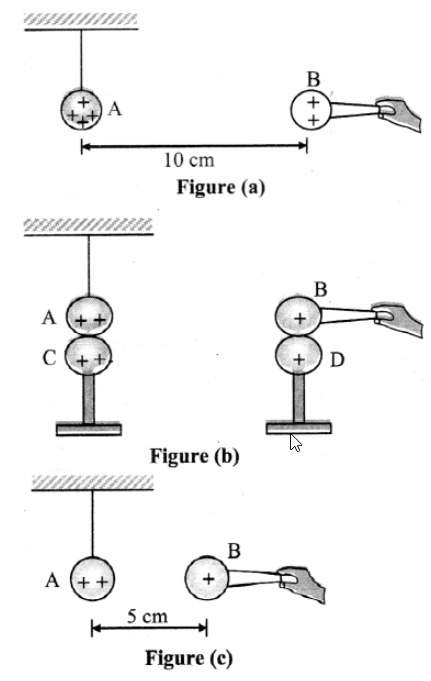
A charged metallic sphere A is suspended by a nylon thread. Another charged metallic sphere B held by an insulating handle is brought close to A such that the distance between their centres is 10 cm, as shown in figure (a). The resulting repulsion of A is noted (for example, by shining a beam of light and measuring the deflection of its shadow on a screen.) Spheres A and B are touched by uncharged spheres C and D respectively, as shown in figure (b). C and D are then removed and B is brought closer to A to a distance of 5.0 cm between their centres, as shown in figure (c). What is the expected repulsion of A on the basis of Coulomb’s law? Spheres A and C and spheres B and D have identical sizes. Ignore the sizes of A and B comparison to the separation between their centres.
Image
State and prove Gauss’ law of electrostatics.