Question
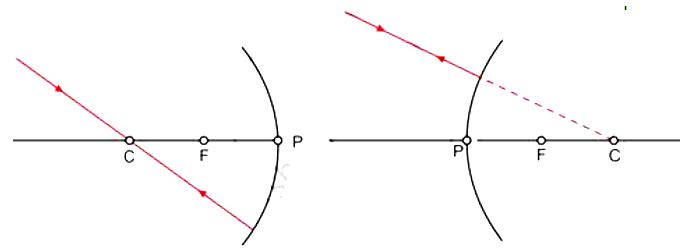
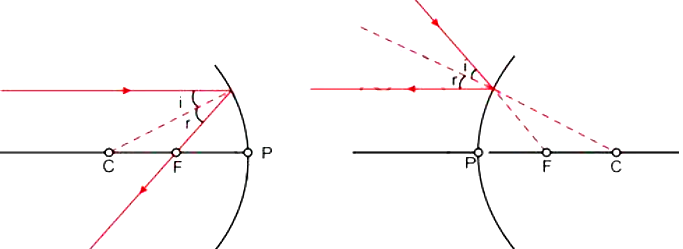
State the two convenient rays that are chosen to construct the image by a spherical mirror for a given object? Explain your answer with the help of suitable ray diagrams.
Answer

Two convenient rays that are chosen to construct the image by a spherical mirror for a given object:
  1. A ray passing through the centre of curvature:A ray of light passing through the centre of curvature of a concave mirror or a ray directed in the direction of centre of curvature of a convex mirror is reflected back along the same path after reflection.

2. A ray parallel to the principal axis: A ray of light parallel to the principal axis, after reflection pass through the principal focus in case of a concave mirror or appears to diverge from it in case of convex mirror.

Need a full question paper?

Generate a complete, print-ready paper with questions like this in minutes — across 16+ boards, with answer keys.
Start Generating Free

Similar questions

A body moves from rest with uniform acceleration and travels $270 m$ in $3$ s. Find the velocity of the body at $10$ s after the start.
QUESTION The density of ice is $0.92 g cm ^{-3}$ and that of sea water is $1.025 g cm ^{-3}$. Find the total volume of an iceberg which floats with its volume $800 cm^3$ above water.
How do you account for (a) positive zero error (b) negative zero error, for calculating correct diameter of wires?
State and explain the law of action and reaction. by giving two examples.
Below Figure shows the velocity-time graph of a particle of mass 200 g moving in a stra ight line. Calculate the force acting on the particle.
A motor bike running at $90 kmh ^{-1}$ is slowed down to $18 kmh ^{-1}$ in 2.5 s . Calculate
1. acceleration
2. distance covered during slow down.
A hollow metal cylinder of length 10 cm floats in alcohol of density $0.80 g cm ^{-3}$, with 1 cm of its length above it. What length of cylinder will be above copper sulphate solution of density $1.25 g cm ^{-3}$ ?
 A ball moves on a smooth floor in a straight line with uniform velocity $10 m s ^{-1}$ for 6 s . At $t =6 s$, the ball hits a wall and comes back along the same line to the starting point with the same speed. Draw the velocity-time graph and use it to find the total distance travelled by the ball and its displacement.
Define
1. Scalar quantities.
2. Vector quantities. Give two differences between scalar and vector quantities.
A balloon of volume $800 cm^2$ is filled with hydrogen gas of density $9 \times 10:$ gemr2. If the empty balloon weighs 0.3 gf and density of air is $1.3 \times 10^2 g gem ^2$, calculate the lifting power of balloon.