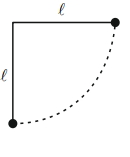
The bob of a pendulum was released from a horizontal position. The length of the pendulum is $10 \mathrm{~m}$. If it dissipates $10 \%$ of its initial energy against air resistance, the speed with which the bob arrives at the lowest point is : [Use, $\mathrm{g}: 10 \mathrm{~ms}^{-2}$ ]
JEE MAIN 2024, Diffcult


Download our appand get started for free
Experience the future of education. Simply download our apps or reach out to us for more information. Let's shape the future of learning together!No signup needed.*
Similar Questions
- 1$Assertion :$ For a particle performing $SHM$, its speed decreases as it goes away from the mean position.View Solution
$Reason :$ In $SHM$, the acceleration is always opposite to the velocity of the particle. - 2A particle of unit mass is moving along the $x$-axis under the influence of a force and its total energy is conserved. Four possible forms of the potential energy of the particle are given in column $I$ (a and $U _0$ are constants). Match the potential energies in column $I$ to the corresponding statement$(s)$ in column $II.$View Solution
column $I$ column $II$ $(A)$ $U _1( x )=\frac{ U _0}{2}\left[1-\left(\frac{ x }{ a }\right)^2\right]^2$ $(P)$ The force acting on the particle is zero at $x = a$. $(B)$ $U _2( x )=\frac{ U _0}{2}\left(\frac{ x }{ a }\right)^2$ $(Q)$ The force acting on the particle is zero at $x=0$. $(C)$ $U _3( x )=\frac{ U _0}{2}\left(\frac{ x }{ a }\right)^2 \exp \left[-\left(\frac{ x }{ a }\right)^2\right]$ $(R)$ The force acting on the particle is zero at $x =- a$. $(D)$ $U _4( x )=\frac{ U _0}{2}\left[\frac{ x }{ a }-\frac{1}{3}\left(\frac{ x }{ a }\right)^3\right]$ $(S)$ The particle experiences an attractive force towards $x =0$ in the region $| x |< a$. $(T)$ The particle with total energy $\frac{ U _0}{4}$ can oscillate about the point $x=-a$. - 3View SolutionThe equation of simple harmonic motion may not be expressed as (each term has its usual meaning)
- 4The potential energy of a particle of mass $4\,kg$ in motion along the $x$-axis is given by $U =4(1-\cos 4 x )\,J$. The time period of the particle for small oscillation $(\sin \theta \simeq \theta)$ is $\left(\frac{\pi}{ K }\right)\,s$. The value of $K$ is .......View Solution
- 5A pendulum suspended from the ceiling of a train has a period $T$ when the train is at rest. When the train travels same distance per unit time, the period of oscillation isView Solution
- 6The displacement of a particle executing $S.H.M.$ is given by $x=0.01 \sin 100 \pi(t+0.05)$. The time period is ........ $s$View Solution
- 7A particle is performing simple harmonic motion with amplitude A and angular velocity ${\omega }$. The ratio of maximum velocity to maximum acceleration isView Solution
- 8The resultant of two rectangular simple harmonic motions of the same frequency and unequal amplitudes but differing in phase by $\frac{\pi }{2}$ isView Solution
- 9If the mass of the bob in a simple pendulum is increased to thrice its original mass and its length is made half its original length, then the new time period of oscillation is $\frac{x}{2}$ times its original time period. Then the value of $x$ is:View Solution
- 10A simple harmonic oscillator of angular frequency $2\,rad\,s^{-1}$ is acted upon by an external force $F = sin\,t\,N .$ If the oscillator is at rest in its equilibrium position at $t = 0,$ its position at later times is proportional toView Solution