The angle between the electric lines of force and the equipotential surface is
NEET 2022, Easy
Download our app for free and get started
Electric field is always perpendicular to $EPS$.

Download our appand get started for free
Experience the future of education. Simply download our apps or reach out to us for more information. Let's shape the future of learning together!No signup needed.*
Similar Questions
- 1The plates of a capacitor are charged to a potential difference of $320 \, volts$ and are then connected across a resistor. The potential difference across the capacitor decays exponentially with time. After $1 $ second the potential difference between the plates of the capacitor is $240 \, volts$, then after $2$ and $3$ seconds the potential difference between the plates will beView Solution
- 2A uniformly charged ring of radius $3a$ and total charge $q$ is placed in $xy-$ plane centered at origin. A point charge $q$ is moving towards the ring along the $z-$ axis and has speed $v$ at $z = 4a$. The minimum value of $v$ such that it crosses the origin isView Solution
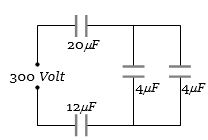
- 3In the adjoining figure, four capacitors are shown with their respective capacities and the $P.D.$ applied. The charge and the $P.D.$ across the $4\,\mu F$ capacitor will beView Solution
- 4A capacitor $4\,\mu F$ charged to $50\, V$ is connected to another capacitor of $2\,\mu F$ charged to $100 \,V$ with plates of like charges connected together. The total energy before and after connection in multiples of $({10^{ - 2}}\,J)$ isView Solution
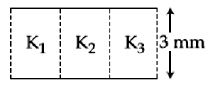
- 5A parallel plate capacitor is of area $6\, cm^2$ and a separation $3\, mm$. The gap is filled with three dielectric materials of equal thickness (see figure) with dielectric constants $K_1 = 10, K_2 = 12$ and $K_3 = 14$. The dielectric constant of a material which when fully inserted in above capacitor, gives same capacitance would beView Solution
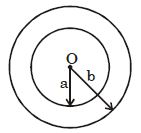
- 6If electric potential of the inner sphere is $10\, volt$ and that of the outer shell is $50\, volt$ then potential at common centre is :-......$V$View Solution
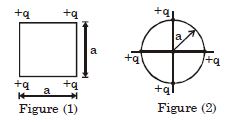
- 7Consider the configuration of a system of four charges each of value $+q$ . The work done by external agent in changing the configuration of the system from figure $(1)$ to figure $(2)$ isView Solution
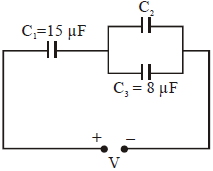
- 8In the circuit shown in the figure, the total charge in $750\, \mu C$ and the voltage across capacitor $C _{2}$ is $20\, V$. Then the charge on capacitor $C _{2}$ is$....\mu C$View Solution
- 9Charges of $ + \frac{{10}}{3} \times {10^{ - 9}}C$ are placed at each of the four corners of a square of side $8\,cm$. The potential at the intersection of the diagonals isView Solution
- 10View SolutionIf two conducting spheres are separately charged and then brought in contact