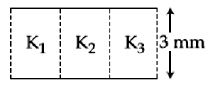
A parallel plate capacitor is of area $6\, cm^2$ and a separation $3\, mm$. The gap is filled with three dielectric materials of equal thickness (see figure) with dielectric constants $K_1 = 10, K_2 = 12$ and $K_3 = 14$. The dielectric constant of a material which when fully inserted in above capacitor, gives same capacitance would be
JEE MAIN 2019, Diffcult
Download our app for free and get started
$\mathrm{C}_{\mathrm{net}}=\mathrm{C}_{1}+\mathrm{C}_{2}+\mathrm{C}_{3}$
$\frac{\mathrm{k} \mathrm{AE}_{\mathrm{o}}}{\mathrm{d}}=\mathrm{k}_{1}\left(\frac{\mathrm{A}}{3}\right) \frac{\mathrm{E}_{\mathrm{o}}}{\mathrm{d}}+\mathrm{k}_{2}\left(\frac{\mathrm{A}}{3}\right) \frac{\mathrm{E}_{\mathrm{o}}}{\mathrm{d}}+\mathrm{k}_{3}\left(\frac{\mathrm{A}}{3}\right) \frac{\mathrm{E}_{\mathrm{o}}}{\mathrm{d}}$
$\mathrm{k}=\frac{\mathrm{k}_{1}+\mathrm{k}_{2}+\mathrm{k}_{3}}{3}=12$

Download our appand get started for free
Experience the future of education. Simply download our apps or reach out to us for more information. Let's shape the future of learning together!No signup needed.*
Similar Questions
- 1An electric charge $10^{-3}\ \mu C$ is placed at the origin $(0, 0)$ of $X-Y$ coordinate system. Two points $A$ and $B$ are situated at $(\sqrt 2 ,\sqrt 2 )$ and $(2, 0)$ respectively. The potential difference between the points $A$ and $B$ will be......$V$View Solution
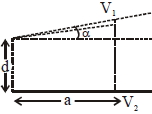
- 2A capacitor is made of two square plates each of side $a$ making a very small angle $\alpha$ between them, as shown in figure. The capacitance will be close toView Solution
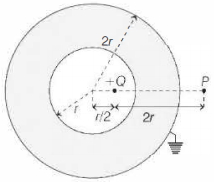
- 3Consider an initially neutral hollow conducting spherical shell with inner radius $r$ and outer radius $2 r$. A point charge $+Q$ is now placed inside the shell at a distance $r / 2$ from the centre. The shell is then grounded by connecting the outer surface to the earth. $P$ is an external point at a distance $2 r$ from the point charge $+Q$ on the line passing through the centre and the point charge $+Q$ as shown in the figure. The magnitude of the force on a test charge $+q$ placed at $P$ will beView Solution
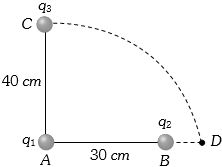
- 4Two charges ${q_1}$ and ${q_2}$ are placed $30\,\,cm$ apart, shown in the figure. A third charge ${q_3}$ is moved along the arc of a circle of radius $40\,cm$ from $C$ to $D$. The change in the potential energy of the system is $\frac{{{q_3}}}{{4\pi {\varepsilon _0}}}k$, where $k$ isView Solution
- 5The potential $V$ is varying with $x$ and $y$ as $V\, = \,\frac{1}{2}\,\left( {{y^2} - 4x} \right)\,volt.$ The field at ($1\,m, 1\,m$ ) isView Solution
- 6A spherical condenser has inner and outer spheres of radii $a$ and $b$ respectively. The space between the two is filled with air. The difference between the capacities of two condensers formed when outer sphere is earthed and when inner sphere is earthed will beView Solution
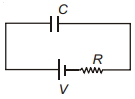
- 7As in the figure, if a capacitor of capacitance $C$ is charged by connecting it with resistance $R$, then energy given by the battery will beView Solution
- 8Two large vertical and parallel metal plates having a separation of $1 \ cm$ are connected to a $DC$ voltage source of potential difference $X$. A proton is released at rest midway between the two plates. It is found to move at $45^{\circ}$ to the vertical $JUST$ after release. Then $X$ is nearlyView Solution
- 9View SolutionIf a charge is shifted from a low potential region to high potential region, the electric potential energy
- 10This questions has statement$-1$ and statement$-2$. Of the four choices given after the statements, choose the one that best describe the two statements.View Solution
An insulating solid sphere of radius $R$ has a uniformly
positive charge density $\rho$. As a result of this uniform charge distribution there is a finite value of electric potential at the centre of the sphere, at the surface of the sphere and also at a point out side the sphere. The electric potential at infinite is zero.Statement$ -1$ : When a charge $q$ is take from the centre of the surface of the sphere its potential energy changes by $\frac{{q\rho }}{{3{\varepsilon _0}}}$
Statement$ -2$ : The electric field at a distance $r(r < R)$ from centre of the sphere is $\frac{{\rho r}}{{3{\varepsilon _0}}}$