Question
The compound $\mathrm{AgF}_2$ is unstable compound. However, if formed, the compound acts as a very strong oxidising agent. Why?

Answer

The oxidation state of $\mathrm{Ag}$ in $\mathrm{AgF}_2$ is +2 . But, +2 is an unstable oxidation state of Ag . Therefore, whenever $\mathrm{AgF}_2$ is formed, silver readily accepts an electron to form $\mathrm{Ag}^{+}$. This helps to bring the oxidation state of Ag down from +2 to a more stable state of +1 . As a result, $\mathrm{AgF}_2$ acts as a very strong oxidizing agent.

Need a full question paper?

Generate a complete, print-ready paper with questions like this in minutes — across 16+ boards, with answer keys.
Start Generating Free

Similar questions

Calculate the oxidation states of Carbon, Bromine and Manganese in $C _3 O _2$ (Carbon suboxide), $Br _3 O _8$ (Tribromo octaoxide) and $Mn _3 O _4$ respectively.
Use the following thermodynamic data to calculate the enthalpy change for the formation of solid lithium fluoride, LiF(s) from Li(s) and $\text{F}_2$(g):$\text{Li(s)}+\frac{1}{2}\text{F}_2(\text{g})\overrightarrow{\ \ \ \ \ \ \ }\ \text{LiF(s)}$
$\text{Li(s)}\overrightarrow{\ \ \ \ \ \ \ \ }\ \text{Li(g)};$ $\Delta_\text{s}\text{H}^\circ=155\text{kJ mol}^{-1}$
$\frac{1}{2}\text{F}_2(\text{g})\overrightarrow{\ \ \ \ \ \ \ }\ \text{F(g)};$ $\Delta\text{H}^\circ=75\text{kJ}$
$\text{Li(g)}\overrightarrow{\ \ \ \ \ } \ \text{Li}^{+}(\text{g})+\text{e}^-;$ $\Delta\text{H}^\circ=520\text{kJ mol}^{-1}$
$\text{F(g)}+\text{e}^-\overrightarrow{\ \ \ \ \ \ } \ \text{F}^-(\text{g});$ $\Delta\text{H}^\circ=-333\text{kJ mol}^{-1}$
$\text{Li}^+\text{(g)}+\text{F}^-(\text{g})\overrightarrow{\ \ \ \ \ \ \ \ }\ \text{LiF(s)};$ $\Delta\text{H}^\circ=-1012\text{kJ mol}^{-1}$
Balance $\text{P}+\text{HNO}_3\xrightarrow{ \ \ \ \ \ \ \ \ }\text{H}_3\text{PO}_4+\text{NO}_2+\text{H}_2\text{O}$ by oxidation number method.
A metal is higher than a particular metal in electrochemical series. Will the metal be stronger reducing agent or weaker reducing agent?
A liquid is in equilibrium with its vapour in a sealed container at a fixed temperature. The volume of the container is suddenly increased.
What happens when equilibrium is restored finally and what will be the final vapour pressure?
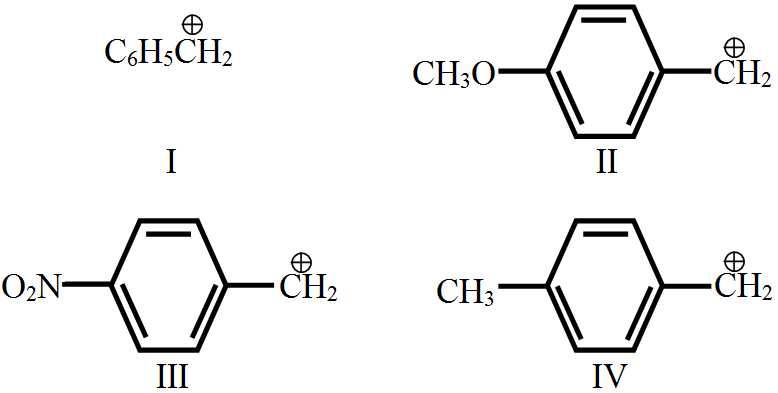
Arrange the following in decreasing order of stability:
Explain the following:
Gallium has higher ionisation enthalpy than aluminium.
Taking a specific example, show that $\Delta\text{S}_\text{total }$ is a criterion for the spontaneity of a change.
$\text{N}_2(\text{g})+3\text{H}_2(\text{g})\rightleftharpoons2\text{NH}_3(\text{g});$
$\text{K}=0.50\text{ at }673\text{K.}$
Write the equilibrium expression and equilibrium constant for reverse reaction.
What will be the pH of a mixture of $\frac{ N }{10} HCl$
$
(100 ml)+\frac{N}{2} 20 HNO_3(200 ml)+\frac{M}{60} H_2 SO_4(300 ml) ?
$