The cyclotron frequency of an electron grating in a magnetic field of $1\, T$ is approximately
AIIMS 2004, Medium


Download our appand get started for free
Experience the future of education. Simply download our apps or reach out to us for more information. Let's shape the future of learning together!No signup needed.*
Similar Questions
- 1The expression for the torque acting on a coil having area of cross-section $A$, number of turns $n$, placed in a magnetic field of strength $B$, making an angle $\theta $ with the normal to the plane of the coil, when a current $i$ is flowing in it, will beView Solution
- 2A solenoid of $1.5$ $metre$ length and $4.0\, cm$ diameter posses $10$ $turn$ per $cm$. A current of $5$ $ampere$ is flowing through it. The magnetic induction at axis inside the solenoid isView Solution
- 3View SolutionA proton and an alpha particle of the same enter in a uniform magnetic field which is acting perpendicular to their direction of motion. The ratio of the circular paths described by the alpha particle and proton is ....
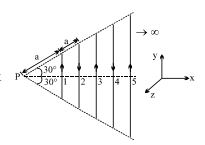
- 4Infinite number of straight wires each carrying current $I$ are equally placed as shown in the figure. Adjacent wires have current in opposite direction. Net magnetic field at point $P$ isView Solution
- 5A horizontal rod of mass $10\, gm$ and length $10\, cm$ is placed on a smooth plane inclined at an angle of $60^\circ $ with the horizontal, with the length of the rod parallel to the edge of the inclined plane. A uniform magnetic field of induction $B$ is applied vertically downwards. If the current through the rod is $1.73$ $ampere$, then the value of $B$ for which the rod remains stationary on the inclined plane is......$Tesla$View Solution
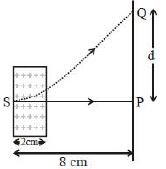
- 6An electron, moving along the $x-$ axis with an initial energy of $100\, eV$, enters a region of magnetic field $\vec B = (1.5\times10^{-3}T)\hat k$ at $S$ (See figure). The field extends between $x = 0$ and $x = 2\, cm$. The electron is detected at the point $Q$ on a screen placed $8\, cm$ away from the point $S$. The distance $d$ between $P$ and $Q$ (on the screen) is :......$cm$ (electron's charge $= 1.6\times10^{-19}\, C$, mass of electron $= 9.1\times10^{-31}\, kg$)View Solution
- 7In bio savart law direction of magnetic field is shown by $d\vec B = \frac{{{\mu _0}}}{{4\pi }}\frac{{I\overrightarrow {dl} \times \vec r}}{{{r^3}}}$View Solution
- 8Consider the two idealised systems $(i)$ a parallel plate capacitor with large plates and small separation and $(ii)$ a long solenoid of length $L >> R$, radius of cross-section. In $(i)\, E$ ideally treated as a constant between plates and zero outside. In $(ii)$ magnetic field is constant inside the solenoid and zero outside. These idealised assumptions, however, contradict fundamental laws as belowView Solution
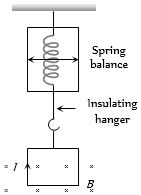
- 9A square loop of side $a$ hangs from an insulating hanger of spring balance. The magnetic field of strength $B$ occurs only at the lower edge. It carries a current $I$. Find the change in the reading of the spring balance if the direction of current is reversedView Solution
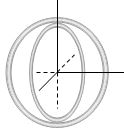
- 10View SolutionTwo insulated rings, one of slightly smaller diameter than the other are suspended along their common diameter as shown. Initially the planes of the rings are mutually perpendicular. When a steady current is set up in each of them