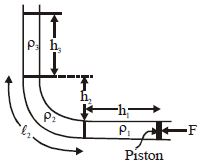
The diameter of two pistons of a hydraulic press are $0.1\,\, m$ and $0.6\,\, m$ respectively. Advantage of the hydraulic press assuming effort is applied directly on pump plunger
Medium


Download our appand get started for free
Experience the future of education. Simply download our apps or reach out to us for more information. Let's shape the future of learning together!No signup needed.*
Similar Questions
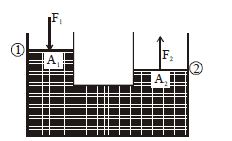
- 1The diagram below shows a hydraulic lift.A force is applied at $side\ 1$ and an output force is generated at $side\ 2$. Which of the following is true?View Solution
- 2A uniform rod of density $\rho $ is placed in a wide tank containing a liquid of density ${\rho _0}({\rho _0} > \rho )$. The depth of liquid in the tank is half the length of the rod. The rod is in equilibrium, with its lower end resting on the bottom of the tank. In this position the rod makes an angle $\theta $ with the horizontalView Solution
- 3A metallic sphere weighing $3 \,kg$ in air is held by a string so as to be completely immersed in a liquid of relative density $0.8$. The relative density of metallic is $10$. The tension in the string is ........ $N$View Solution
- 4View SolutionA good lubricant should have
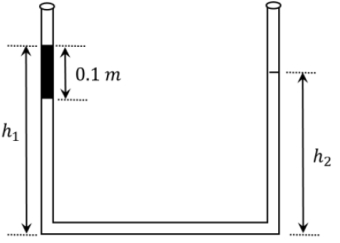
- 5An open-ended U-tube of uniform cross-sectional area contains water (density $10^3 kg m ^{-3}$ ). Initially the water level stands at $0.29 m$ from the bottom in each arm. Kerosene oil (a water-immiscible liquid) of density $800 kg m ^{-3}$ is added to the left arm until its length is $0.1 m$, as shown in the schematic figure below. The ratio $\left(\frac{h_1}{h_2}\right)$ of the heights of the liquid in the two arms is-View Solution
- 6Water flows in a streamlined manner through a capillary tube of radius $a$, the pressure difference being $P$ and the rate of flow $Q$. If the radius is reduced to $a/2$ and the pressure increased to $ 2P, $ the rate of flow becomesView Solution
- 7A uniform rod of density $\rho $ is placed in a wide tank containing a liquid of density ${\rho _0}({\rho _0} > \rho )$. The depth of liquid in the tank is half the length of the rod. The rod is in equilibrium, with its lower end resting on the bottom of the tank. In this position the rod makes an angle $\theta $ with the horizontalView Solution
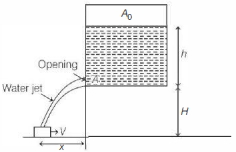
- 8Consider the configuration of a stationary water tank of cross-section area $A_{0}$ and a small bucket as shown in figure below; the speed $v$ is .......... $m/s$ of the bucket, so that the water leaking out of a hole of cross-section area $A$ (as shown) from the water tank does not fall outside the bucket? (Take, $h=5 \,m , H=5 \,m , g=10 \,m / s ^{2}, A=5 \,cm ^{2}$ and $\left.A_{0}=500 \,cm ^{2}\right)$.View Solution
- 9A hole is made at the bottom of the tank filled with water (density $1000\, kg/m^3$). If the total pressure at the bottom of the tank is $3$ atmosphere ($1$ atmosphere $= 10^5\, N/m^2$), then the velocity of efflux isView Solution
- 10A tube is bent into $L$ shape and kept in a vertical plane. If these three liquids are kept in equilibrium by the piston of area $A$ , the value of $\frac {F}{A}$ isView Solution