Question
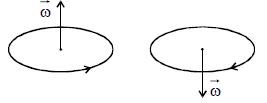
The direction of the angular velocity vector along
Answer

Angular velocity is a vector whose direction is perpendicular to the plane of circular path or axis of rotation. Its direction has been shown in the figure

Need a full question paper?

Generate a complete, print-ready paper with questions like this in minutes — across 16+ boards, with answer keys.
Start Generating Free

Similar questions

In a $p-n$ junction diode the direction of diffusion current is from
If the diameter of a capillary tube is doubled, then the height of the liquid that will rise is
Two very long straight parallel wires, parallel to $y-$ axis,carrycurrents $4I$ and $I,$ along $+y$ directionand$-y$ direction, respectively. The wires are passes through the $x-$axis at the points $(d, 0, 0)$ and $(- d, 0, 0)$ respectively.The graph of magnetic field $z-$component as one moves along the $x-$axis from $x=- d$ to $x= +d,$ is best given by
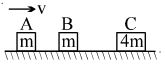
Three blocks are initially placed as shown in the figure. Block $A$ has mass $m$ and initial velocity $v$ to the right. Block $B$ with mass $m$ and block $C$ with mass $4m$ are both initially at rest. Neglect friction. All collisions are elastic. The final velocity of block $A$ is
This question has Statement $1$ and Statement $2$ . Of the four choices given after the Statements, choose the one that best describes the two Statements.

Statement $1$: A charged particle is moving at right angle to a static magnetic field . During the motion the kinetic energy of the charge remains unchanged.

Statement $2$: Static magnetic field exert force on a moving charge in the direction perpendicular to the magnetic field.
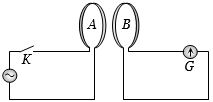
The diagram below shows two coils $A$ and $B$ placed parallel to each other at a very small distance. Coil $A$ is connected to an ac supply. $G$ is a very sensitive galvanometer. When the key is closed
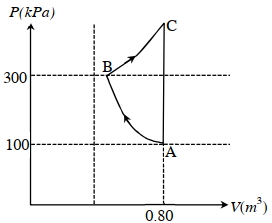
In the given $P$-V diagram, a monoatomic gas $\left(\gamma=\frac{5}{3}\right)$ is first compressed adiabatically from state $A$ to state $B$. Then it expands isothermally from state $B$ to state $C$. [Given: $\left(\frac{1}{3}\right)^{0.6} \simeq 0.5, \ln 2 \simeq 0.7$ ].

Which of the following statement($s$) is(are) correct?

$(A)$ The magnitude of the total work done in the process $A \rightarrow B \rightarrow C$ is $144 kJ$.

$(B)$ The magnitude of the work done in the process $B \rightarrow C$ is $84 kJ$.

$(C)$ The magnitude of the work done in the process $A \rightarrow B$ is $60 kJ$.

$(D)$ The magnitude of the work done in the process $C \rightarrow A$ is zero.
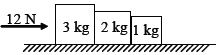
Three blocks of masses $3\, kg, 2\, kg$ and $1\, kg$ are placed side by side on a smooth  surface as shown in figure. A horizontal force of $12\,N$ is applied to $3\, kg$ block. The  net force on $2\, kg$ block is ............ $N$
Which of the following is coldest planet
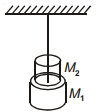
The length of wire, when $M_1$ is hung from it, is $I_1$ and is $I_2$ with both $M_1$ and $M_2$ hanging. The natural length of wire is ........