MCQ
The electric field near a conducting surface having a uniform surface charge density σ is given by
  • A
    $\frac{\sigma}{\varepsilon_0}$ and is parallel to the surface
  • B
    $\frac{2\sigma}{\varepsilon_0}$ and is parallel to the surface
  • $\frac{\sigma}{\varepsilon_0}$ and is normal to the surface
  • D
    $\frac{2\sigma}{\varepsilon_0}$ and is normal to the surface
Answer

Correct option: C.
$\frac{\sigma}{\varepsilon_0}$ and is normal to the surface
(c) $\frac{\sigma}{\varepsilon_0}$ and is normal to the surface

Need a full question paper?

Generate a complete, print-ready paper with questions like this in minutes — across 16+ boards, with answer keys.

Start Generating Free

Similar questions

The value of internal resistance of an ideal cell is $\Omega$
The number of revolutions per second made by an electron in the first Bohr orbit of hydrogen atom is of the order of 3
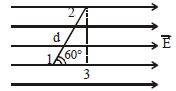
The electric field $\vec E$ between two points is constant in both magnitude and direction. Consider a path of length d at an angle $\theta = 60^o$ with respect to field lines shown in figure. The potential difference between points $1$ and $2$ is
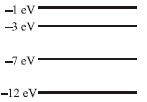
The diagram to the right shows the lowest four energy levels for an electron in $a$ hypothetical atom. The electron is excited to the $-1\, eV$ level of the atom and transitions to the lowest energy state by emitting only two photons. Which of the following energies could not belong to either of the photons? ......... $eV$
The state of the energy gained by valance electrons when the temperature is raised or when electric field is applied is called as
Human eye:
When a hydrogen atom is raised from the ground state to an excited state
A very long solenoid of radius $R$ is carrying current $I\left( t \right) = kt{e^{ - \alpha t}}\,\left( {k > 0} \right)$ , as a function of time $(t  \geq  0)$. counter clockwise current is taken to be positive. A circular conducting coil of radius $2R$ is placed in the equatorial plane of the solenoid and concentric with the solenoid. The current induced in the outer coil is correctly depicted, as a function of time, by
A car of mass $1000\,kg$ negotiates a banked curve of radius $90\,m$ on a fictionless road. If the banking angle is $45^o$, the speed of the car is ......... $ms^{-1}$
With increase in temperature the conductivity of: