The electric potential at a point $(x, y, z)$ is given by $V=-x^2y-xz^3 +4 $. The electric field at that point is
AIPMT 2009, Easy


Download our appand get started for free
Experience the future of education. Simply download our apps or reach out to us for more information. Let's shape the future of learning together!No signup needed.*
Similar Questions
- 1An elementary particle of mass $m$ and charge $ + e$ is projected with velocity $v$ at a much more massive particle of charge $Ze,$ where $Z > 0.$What is the closest possible approach of the incident particleView Solution
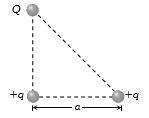
- 2Three charges $Q,\, + q$ and $ + q$ are placed at the vertices of a right-angled isosceles triangle as shown. The net electrostatic energy of the configuration is zero if $Q$ is equal toView Solution
- 3View SolutionThe potential gradient is a
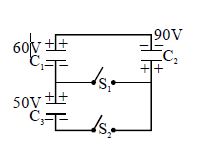
- 4Three charged capacitors, $C_1$ = $17\ μF$, $C_2$ = $34\ μF$, $C_3$ = $41\ μF$and two open switches, $S_1$ and $S_2$ are assembled into a network with initial voltages and polarities, as shown. Final status of the network is attained when the two switches, $S_1$ and $S_2$ are closed. In the figure, the final charge on capacitor $C_3$ in $mC$, is closet to:View Solution
- 5Two capacitors of capacitances $C$ and $2\, C$ are charged to potential differences $V$ and $2\, V$, respectively. These are then connected in parallel in such a manner that the positive terminal of one is connected to the negative terminal of the other. The final energy of this configuration is$.....CV^2$View Solution
- 6View SolutionThe energy stored in the condenser is
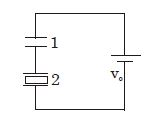
- 7Two identical capacitors $1$ and $2$ are connected in series. The capacitor $2$ contains a dielectric slab of constant $K$ as shown. They are connected to a battery of emf $V_0\ volts$ . The dielectric slab is then removed. Let $Q_1$ and $Q_2$ be the charge stored in the capacitors before removing the slab and $Q'_1$ , and $Q'_2$ be the values after removing the slab. ThenView Solution
- 8Three capacitances of capacity$10\,\mu F,\;5\,\mu F$ and $5\,\mu F$ are connected in parallel. The total capacity will be........$\mu F$View Solution
- 9A parallel plate capacitor has capacitance $C$. If it is equally filled with parallel layers of materials of dielectric constants $K_1$ and $K_2$ its capacity becomes $C_1$. The ratio of $C_1$ to $C$ isView Solution
- 10Concentric metallic hollow spheres of radii $R$ and $4 R$ hold charges $Q _{1}$ and $Q _{2}$ respectively. Given that surface charge densities of the concentric spheres are equal, the potential difference $V ( R )- V (4 R )$ isView Solution