The equation of motion of a particle of mass $1\,g$ is $\frac{{{d^2}x}}{{d{t^2}}} + {\pi ^2}x = 0$ where $x$ is displacement (in $m$ ) from mean position. The frequency of oscillation is .... $s$ (in $Hz$ )
Medium
Download our app for free and get started
${\omega ^2} = {\pi ^2} \Rightarrow \omega = \pi \Rightarrow f = \frac{\omega }{{2\pi }} = \frac{\pi }{{2\pi }} = \frac{1}{2}Hz$

Download our appand get started for free
Experience the future of education. Simply download our apps or reach out to us for more information. Let's shape the future of learning together!No signup needed.*
Similar Questions
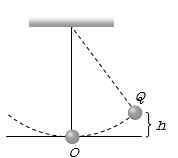
- 1The bob of a simple pendulum is displaced from its equilibrium position $O$ to a position $Q$ which is at height h above $O$ and the bob is then released. Assuming the mass of the bob to be $m$ and time period of oscillations to be $2.0\, sec$, the tension in the string when the bob passes through $O$ isView Solution
- 2For a particle showing motion under the force $F=-5(x-2)^2$, the motion is .......View Solution
- 3A particle executes simple harmonic motion along a straight line with an amplitude $A$. The potential energy is maximum when the displacement isView Solution
- 4A particle is performing simple harmonic motion with amplitude A and angular velocity ${\omega }$. The ratio of maximum velocity to maximum acceleration isView Solution
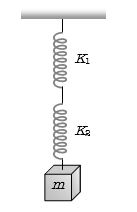
- 5View SolutionThe frequency of oscillation of the springs shown in the figure will be
- 6A particle moves in $xy$ plane according to the law $x = a \sin \omega t$ and $y = a(1-\cos \omega t)$ where $a$ and $\omega$ are constants. The particle tracesView Solution
- 7The force-deformation equation for a nonlinear spring fixed at one end is $F =4x^{1/ 2}$ , where $F$ is the force (expressed in newtons) applied at the other end and $x$ is the deformation expressed in metersView Solution
- 8The potential energy of a particle $\left(U_x\right)$ executing $S.H.M$. is given byView Solution
- 9Two simple pendulums of lengths $1.44 \,m$ and $1\, m$ start swinging together. After how many vibrations will they again start swinging togetherView Solution
- 10A body executing $S.H.M.$ along a straightline has a velocity of $3 \,ms ^{-1}$ when it is at a distance of $4 \,m$ from its mean position and $4 \,ms ^{-1}$ when it is at a distance of $3 \,m$ from its mean position. Its angular frequency and amplitude areView Solution