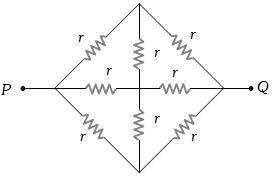
The equivalent resistance between the points $P$ and $Q$ in the network given here is equal to ................ $\Omega$ (given $r = \frac{3}{2}\Omega $)
Medium
Download our app for free and get started
(b) The given circuit can be simplifies as follows
$R' = \frac{{2r}}{3} = \frac{2}{3} \times \frac{3}{2} = 1\Omega $.
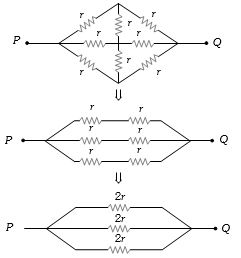
$R' = \frac{{2r}}{3} = \frac{2}{3} \times \frac{3}{2} = 1\Omega $.

Download our appand get started for free
Experience the future of education. Simply download our apps or reach out to us for more information. Let's shape the future of learning together!No signup needed.*
Similar Questions
- 1Two resistors are connected $(a)$ in series $(b)$ in parallel. The equivalent resistance in the two cases are $9$ $ohm$ and $2$ $ohm$ respectively. Then the resistances of the component resistors areView Solution
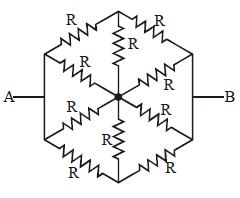
- 2Find out equivalent resistance between $A$ and $B$View Solution
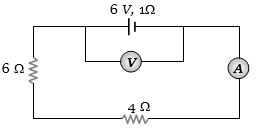
- 3View SolutionIn the circuit shown here, the readings of the ammeter and voltmeter are
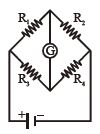
- 4The resistances in $WSB$ circuit shown in the diagram all are different and the current through the galvanometer is zero. If all thermal effects are negligible, the current through the galvanometer will not be zero, whenView Solution
- 5View SolutionAssertion : A current continues to flow in superconducting coil even after switch is off.
Reason : Superconducting coils show Meissner effect
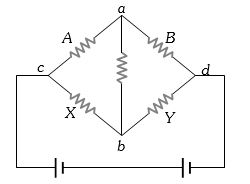
- 6In the Wheatstone's bridge (shown in figure) $X = Y$ and $A > B$. The direction of the current between ab will beView Solution
- 7In an electrolyte $3.2 \times {10^{18}}$ bivalent positive ions drift to the right per second while $3.6 \times {10^{18}}$ monovalent negative ions drift to the left per second. Then the current isView Solution
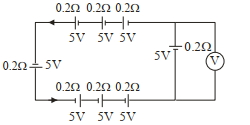
- 8The reading in the ideal voltmeter $(V)$ shown in the given circuit diagram is :View Solution
- 9A button battery is rated $3 \,V$ and $225 \,mAh . A$ cricket ball (mass $=0.163 \,kg$ ) having energy equal to that stored in the battety will have speed closest to ............ $\,m / s$View Solution
- 10A thermocouple of negligible resistance produces an $e.m.f.$ of $40\,\mu V{/^o}C$ in the linear range of temperature. A galvanometer of resistance $10\; ohm$ whose sensitivity is $1\;\mu A/div$, is employed with the thermocouple. The smallest value of temperature difference that can be detected by the system will beView Solution