The frequency of tuning forks $A$ and $B$ are respectively $3\%$ more and $2\%$ less than the frequency of tuning fork $C.$ When $A$ and $B$ are simultaneously excited, $5$ beats per second are produced. Then the frequency of the tuning fork $'A'$ (in $Hz$) is
Medium
Download our app for free and get started
(c) Let $n$ be the frequency of fork $C$
then ${n_A} = n + \frac{{3n}}{{100}} = \frac{{103n}}{{100}}$
and ${n_B} = n - \frac{{2n}}{{100}} = \frac{{98}}{{100}}$
but ${n_A} - {n_B} = 5$
==> $\frac{{5n}}{{100}} = 5$
==> $n = 100\,Hz$
$ \therefore$ ${n_A} = \frac{{(103)(100)}}{{100}} = 103\,Hz$

Download our appand get started for free
Experience the future of education. Simply download our apps or reach out to us for more information. Let's shape the future of learning together!No signup needed.*
Similar Questions
- 1A transverse harmonic wave on a string is given by $y(x, t)=5 \sin (6 t+0.003 x)$ where $x$ and $y$ are in $cm$ and $t$ in $sec$. The wave velocity is $...........\,ms ^{-1}$.View Solution
- 2An observer moves towards a stationary source of sound with a velocity equal to one-fifth of the velocity of sound. The percentage change in the frequency will be $\dots \;$%View Solution
- 3In a plane progressive wave given by $y = 25\cos (2\pi t - \pi x)$, the amplitude and frequency are respectivelyView Solution
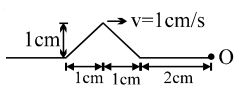
- 4A wave pulse on a string has the dimension shown in figure. The waves speed is $v = 1 \,\,cm/s$. If point $O$ is a free end. The shape of wave at time $t = 3 \,\,s$ is :View Solution
- 5A vibrating string of certain length $\ell$ under a tension $\mathrm{T}$ resonates with a mode corresponding to the first overtone (third harmonic) of an air column of length $75 \mathrm{~cm}$ inside a tube closed at one end. The string also generates $4$ beats per second when excited along with a tuning fork of frequency $\mathrm{n}$. Now when the tension of the string is slightly increased the number of beats reduces $2$ per second. Assuming the velocity of sound in air to be $340 \mathrm{~m} / \mathrm{s}$, the frequency $\mathrm{n}$ of the tuning fork in $\mathrm{Hz}$ isView Solution
- 6Ten tuning forks are arranged in increasing order of frequency in such a way that any two consecutive tuning forks produce $4$ beats per second. The highest frequency is twice that of the lowest. Possible highest and lowest frequencies (in $Hz$ ) are ................View Solution
- 7Tone $A$ has frequency of $240 Hz.$ Of the following tones, the one which will sound least harmonious with $A$ isView Solution
- 8The ends of stretched wire of length $L$ are fixed at $x\, = 0$ and $x \,= L$. In one experiment, the displacement of the wire is ${y_1} = A\sin\, \left( {\pi x/L} \right)\sin \,\omega t$ and energy is $E_1$. and in another experiment its displacement is ${y_2} = A\sin \,\left( {2\pi x/L} \right)\sin 2\omega t$ and energy is $E_2$, ThenView Solution
- 9An earthquake generates both transverse $(S)$ and longitudinal $(P)$ sound waves in the earth. The speed of $S$ waves is about $4.5\,km/s$ and that of $P$ waves is about $8.0\, km/s$. A seismograph records $P$ and $S$ waves from an earthquake. The first $P$ wave arrives $4.0 \,min$ before the first $S$ wave. The epicenter of the earthquake is located at a distance about ..... $km$View Solution
- 10A man is standing on a railway platform listening to the whistle of an engine that passes the man at constant speed without stopping. If the engine passes the man at time ${t_0}$. How does the frequency $f$ of the whistle as heard by the man changes with timeView Solution