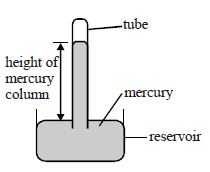
MCQ
The graph signifies
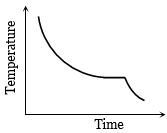
  • A
    Adiabatic expansion of a gas
  • B
    Isothermal expansion of a gas
  • Change of state from liquid to solid
  • D
    Cooling of a heated solid

Answer

Correct option: C.
Change of state from liquid to solid
c
(c)

Need a full question paper?

Generate a complete, print-ready paper with questions like this in minutes — across 16+ boards, with answer keys.
Start Generating Free

Similar questions

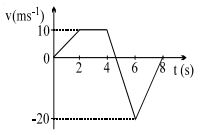
The figure shows a velocity-time graph of a particle moving along a straight line  If the particle starts from the position $x_0=-15\,m$ , then its position at $t=2\,s$ will be   ........ $m$
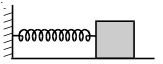
$A$ spring block system is placed on a rough horizontal floor. The block is pulled towards right to give spring an elongation less than $\frac{{2\mu mg}}{K}$ but more than $\frac{{\mu mg}}{K}$ and released. Which of the following laws/principles of physics can be applied on the spring block system
The diagram shows a simple mercury barometer.Which of the following does not cause the height of the mercury column to vary ?
A water drop takes the shape of a sphere in a oil while the oil drop spreads in water, because

 ($A.F.$ = adhesive force, $C.F.$ = cohesive force)

A ball of mass $0.5\, kg$ moving with a velocity of $2\, m/sec$ strikes a wall normally and bounces back with the same speed. If the time of contact between the ball and the wall is one millisecond, the average force exerted by the wall on the ball is ........ $newton$
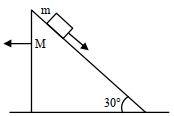
A block of mass $m$ slides on the wooden wedge, which in turn slides backward on the horizontal surface. The acceleration of the block with respect to the wedge is : Given ${m}=8 \,{kg}, {M}=16\, {kg}$

Assume all the surfaces shown in the figure to be frictionless.
Given, $\ce{|A + B| = P, |A - B| = Q.}$ The value of $\ce{P^2 + Q^2}$ is:
The wave described by $y=0.25 \,sin\left[ {10\pi x - 2\pi t} \right]$, where $x$ and $y$ are in meters and $t$ in seconds, is a wave travelling along the 
The Young's modulus of a wire of length $L$ and radius $r$ is $Y$ $N/m^2$. If the length and radius are reduced to $L/2$ and $r/2,$ then its Young's modulus will be
In forced oscillations, a particle oscillates simple harmonically with a frequency equal to