- ✓$T V^{3 / 2} e^{a R T}=$ constant
- B$T V^{3 / 2} e^{3 a R T / 2}=$ constant
- C$T V^{3 / 2}=$ constant
- D$T V^{3 / 2} e^{2 a R T / 3}=$ constant
From the given data,
$C _{ V }=\frac{3 R ( a + aRT )}{2}$
So,
$C _{ p }= C _{ V }+ R =\frac{3 R ( a + aRT )}{2}+ R =\frac{3 R ( a + aRT )+2 R }{2}$
So,
$\gamma=\frac{C_{ P }}{C_{ V }}-1=\frac{\frac{3 R(a+a R T)+2 R}{2}}{\frac{3 R(a+a R T)}{2}}-1=\frac{2}{3(1+a R T)}=\frac{2}{3}(1+a R T)^{-1}$
Now, by putting this value of $\gamma-1$ in the adiabatic expression formula, we get $TV ^{\gamma-1}=$ constant $\Rightarrow TV ^{3 / 2} e ^{ aRT }=$ constant (we get this by binomial expansion).
Hence proved.
Generate a complete, print-ready paper with questions like this in minutes — across 16+ boards, with answer keys.
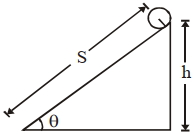
$(1)$ a ring
$(2)$ a disc
$(3)$ a solid cylinder
$(4)$ a solid sphere,
of same mass $m$ and radius $R$ are allowed to roll down without slipping simultaneously from the top of the inclined plane. The body which will reach first at the bottom of the inclined plane is ...........
[Mark the body as per their respective numbering given in the question]