Question
The heat current is written as $\frac{\triangle\text{Q}}{\triangle\text{t}}.$ Why don't we write $\frac{\text{dQ}}{\text{dt}}?$

Answer

The amount of heat crossing through any cross-section of a slab in time $\triangle\text{t}$ is called heat current.
It is written as $\frac{\triangle\text{Q}}{\triangle\text{t}}$ and not as complete derivative $\frac{\text{dQ}}{\text{dt}}.$
This is because the amount of heat crossing through any cross section is a function of many variables like temperature difference, area of cross-section, etc.
So, we cannot write it as a complete derivative with respect to time.

Need a full question paper?

Generate a complete, print-ready paper with questions like this in minutes — across 16+ boards, with answer keys.
Start Generating Free

Similar questions

  1. State Bohr’s quantization condition for defining stationary orbits. How does de Broglie hypothesis explain the stationary orbits?
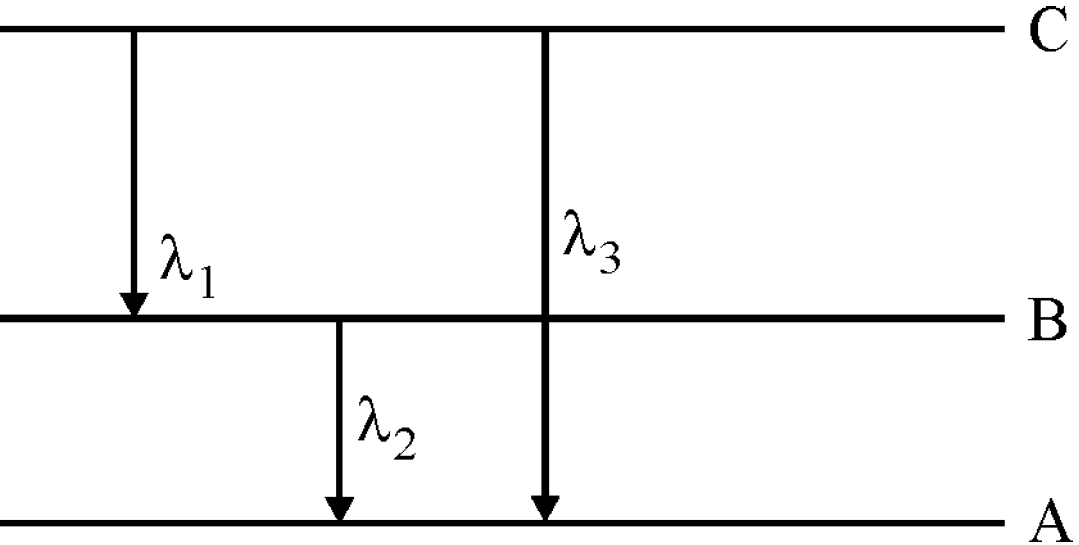
  2. Find the relation between the three wavelengths$\lambda_{1} , \lambda_{2}$ and$\lambda_{3}$ from the energy level diagram shown below.

  1. Explain the processes of nuclear fission and nuclear fusion by using the plot of binding energy per nucleon (BE/ A) versus the mass number A.
  2. A radioactive isotope has a half-life of 10 years. How long will it take for the activity to reduce to 3·125%?
A small conducting sphere (radius r ) is placed concentrically inside a larger conducting hollow sphere of radius $R$. The big and small spheres are charged with $Q$ and $q(Q>q)$ respectively and kept separate from each other. Calculate the potential difference between the spheres.
Explain Ohm's law. State factors on which the resistance of any conductor depends. Define specific resistance and state its relation with the conductivity.
Two neutral particles are kept 1m apart. Suppose by some mechanism some charge is transferred from one particle to the other and the electric potential energy lost is completely converted into a photon. Calculate the longest and the next smaller wavelength of the photon possible.
In Young’s double slit experiment, the two slits are separated by a distance of 1·5 mm and the screen is placed 1 m away from the plane of the slits. A beam of light consisting of two wavelengths 650 nm and 520 nm is used to obtain interference fringes. Find.
  1. The distance of the third bright fringe for$\lambda = 520$ nm on the screen from the central maximum.
  2. The least distance from the central maximum where the bright fringes due to both the wavelengths coincide.
Find the,
  1. maximum frequency, and
  2. minimum wavelength of X-rays produced by 30 kV electrons.
A circular ring of radius r made of a nonconducting material is placed with its axis parallel to a uniform electric field. The ring is rotated about a diameter through 180°. Does the flux of electric field change? If yes, does it decrease or increase?
Two coherent waves of equal amplitude produce interference pattern in Young’s double slit experiment. What is the ratio of intensity at a point where phase difference is $\frac{\pi}{2}$ to intensity at centre?
Explain the construction of refracting telescope by figure and obtain the equation of magnification.